Greater Inwood, Houston
Updated · 37,020 residents
Greater Inwood is a diverse residential community in northwest Houston defined by its scenic White Oak Bayou greenbelts and a mix of traditional mid-century architecture. While the area offers a relatively walkable environment with consistent residential sidewalks, residents should expect a car-dependent lifestyle with limited local commercial options. The neighborhood provides a quiet suburban atmosphere, though proximity to industrial logistics hubs contributes to moderate ambient noise and traffic.
Key Highlights
About Greater Inwood
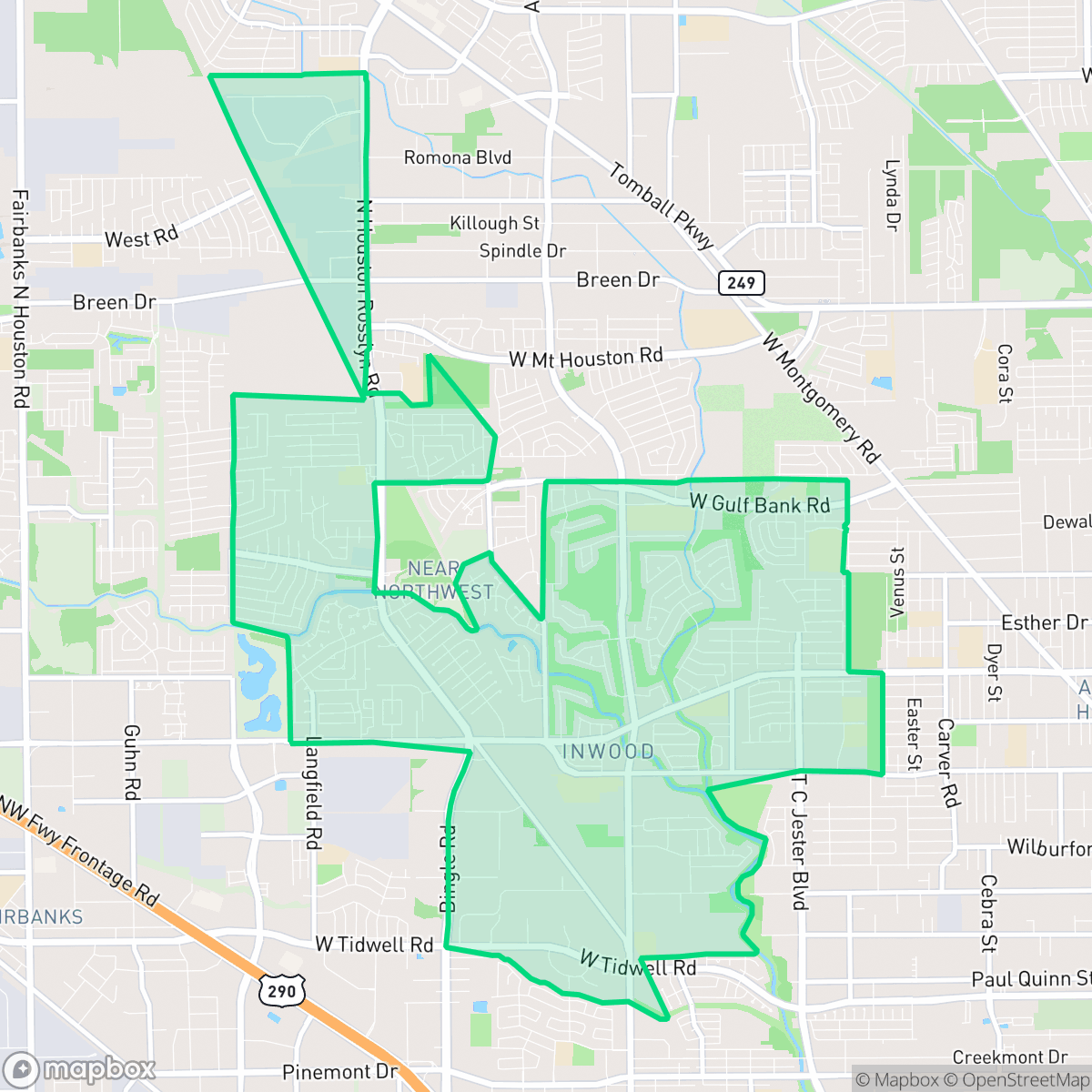
Located in northwest Houston, Greater Inwood originated in the early 1960s as an upscale enclave developed for oil executives during the city’s oil boom. Its growth centered around Inwood Forest, a golf-course-focused subdivision established in the late 1960s, alongside neighborhoods like Candlelight Oaks and Woodland Trails. The former Inwood Forest Country Club on Antoine Drive served as a long-standing community hub, though the course has since closed. The neighborhood features a mix of spacious, traditional brick-and-stone homes and mid-century designs. Bisected by the Burlington Northern Santa Fe Railroad, the area is geographically defined by the scenic White Oak Bayou, which flows directly through the community, providing local green space. Today, Greater Inwood has evolved from its executive origins into a highly diverse residential community.
The area functions as a dense suburban landscape, characterized by a blend of single-family homes and multi-family apartment complexes. It maintains a strong connection to nature through the White Oak Bayou drainage corridors, which serve as primary green spaces for recreation and dog walking. While the residential streets are generally tree-lined and quiet, the neighborhood is situated near significant industrial and logistics zones, which influences the local acoustic environment and traffic patterns.
Prospective residents will find a community that prioritizes residential privacy and access to nature over proximity to retail or nightlife. The area is best suited for those who value a suburban pace and are comfortable with a car-oriented lifestyle, as daily amenities are often spread out. While the school landscape is mixed, with high-performing specialized options available, families should carefully evaluate the specific district and campus performance, as the neighborhood sits at the intersection of several different school systems.
Neighborhood Scores Across 15 Qualities
Residential spacing varies between tightly clustered apartments and detached homes with moderate yard buffers. According to iHuus data, privacy levels in this area are slightly higher than the Houston average.
Connected residential networks and paved paths along drainage systems provide safe pedestrian access, making the area roughly comparable to the Houston average. While sidewalks are extensive in many residential clusters, some street segments and industrial zones may lack continuous paths.
Large homes with manicured lawns and private pools characterize much of the area, matching the city average for visual appeal. According to iHuus data, the landscape varies between affluent residential pockets and standard multi-family apartment complexes.
Extensive green corridors, drainage canals, and large parklands offer ample space for pet owners. According to iHuus data, the availability of connected green spaces and wide paths is notably higher than the Houston average.
Residential pockets and single-family homes are interspersed with large-scale industrial warehouses and logistics hubs. This landscape offers a semi-rural feel that is slightly more open than the typical Houston urban environment.
Local activity is sparse, characterized by a quiet, industrial-suburban landscape that lacks significant social hubs. Most daily errands and dining options require a vehicle, as the area features fewer walkable commercial destinations than the Houston average.
Local traffic from nearby busy streets creates a consistent level of ambient noise. This auditory environment is roughly equivalent to the average found across Houston.
Air quality in this area fluctuates between acceptable and unhealthy levels, though it remains slightly better than the Houston average according to iHuus data. Sensitive individuals may experience occasional concern during certain periods.
Large logistics hubs, rail yards, and wastewater treatment facilities are interspersed with residential zones, leading to more industrial activity than the Houston average. Residents may experience increased truck traffic and intermittent noise from nearby warehouses and commercial storage yards.
Health insurance accessibility is lower than the Houston average, according to iHuus data. Residents may find fewer neighbors with employer-sponsored or private coverage compared to the rest of the city.
Political leanings in this area are more liberal than the Houston average. Residents will find a notable liberal majority within the community according to iHuus data.
Residents live alongside a balanced mix of young professionals, families, and seniors. This demographic spread is largely consistent with the broader Houston area according to iHuus data.
Flood safety levels in this area are lower than the Houston average because FEMA has not yet completed a detailed study for this specific zone. According to iHuus data, the risk remains moderate and undetermined.
Address-Level Insights for Greater Inwood


iHuus Neighborhood Intelligence Insights
Get address-level neighborhood insights for Greater Inwood
- Street-level scores — see how individual blocks compare, not just neighborhood averages
- Micro-zone boundaries — identify quiet pockets, flood boundaries, and walkable clusters before you visit
- 15 dimensions in full — walkability, noise, air quality, school quality, insurance coverage, population age profile, urban/rural index, and more
- Boundary risk alerts — know if your address sits near a block boundary where scores drop, the kind of detail no listing will ever mention
- School insights — individual school ratings and insights, not just district-level data
- Compare before you commit — side-by-side data across neighborhoods, down to block precision
No credit card required
Compare with Any Neighborhood
| Dimension | Greater Inwood | Acres Home |
|---|---|---|
| 🚶 Walkabilityavg 7.08 | ||
| 🔊 Acoustic Comfortavg 4.14 | ||
| 🤫 Privacy Indexavg 5.34 | ||
| 🎨 Visual Appealavg 6.42 | ||
| 🐕 Dog Friendlinessavg 6.33 | ||
| 🗺️ Urban-Rural Indexavg 6.64 | ||
| ✨ Neighborhood Vibeavg 4.4 | ||
| 🏥 Health Insurance Coverageavg 5.46 | ||
| 🌿 Air Qualityavg 3.58 | ||
| 🏭 Industrial Proximityavg 6.9 | ||
| 🌊 Flood Safetyavg 6.27 | ||
| 🗳️ Ideological Leanavg 6.39 | ||
| 👥 Population Age Profileavg 4.6 | ||
| 🔥 Fire Safety | ||
| 🏫 School Quality |
Greater Inwood Rankings
School Districts Serving Greater Inwood
School Insights for Greater Inwood
Below average outcomes; significant attendance and academic challenges.
School Insights
See what's really behind every school rating near Greater Inwood
- Individual school ratings — each school's own score with outcome context, not just a district average
- Enrollment & class size data — student-to-teacher ratio and how it compares to the state average
- Full demographics breakdown — ethnicity and gender composition for every school in the enrollment zone
- Every school in the district — all schools within the enrollment boundary ranked by rating, not just the closest one
- Grade levels & benchmarks — elementary through high school, with below/above state-average flags
No credit card required