Greater Hobby Area, Houston
Updated · 29,474 residents
The Greater Hobby Area is defined by its proximity to the William P. Hobby Airport and a mix of historic garden-style residential enclaves and heavy industrial logistics hubs. Residents experience a car-dependent lifestyle characterized by significant noise from aviation and freight traffic, balanced by pockets of established mid-century architecture.
Key Highlights
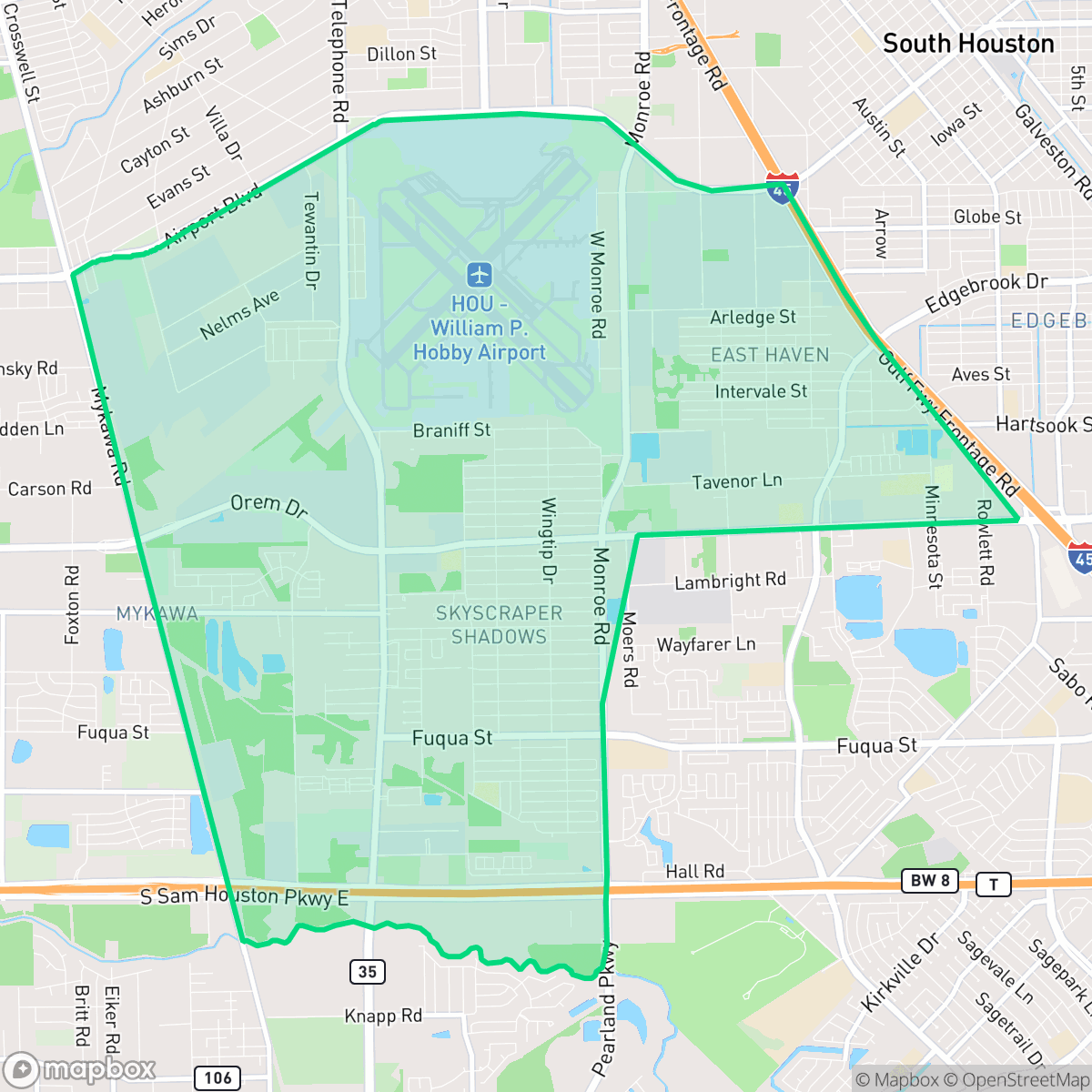
About Greater Hobby Area
The Greater Hobby Area in southeast Houston has a history closely tied to the William P. Hobby Airport and the historic 15,000-acre Allen cattle ranch. Two distinctive neighborhoods anchor the area along Sims Bayou. Garden Villas, platted in 1926 by developer W.T. Carter Jr. and architect Edward Wilkinson, was designed as a unique "garden community" with radial streets, thousands of pecan trees, and large lots intended for orchards and poultry. To its east lies Glenbrook Valley, developed between 1953 and 1962 by the landscape architecture firm Hare and Hare. Known for its striking Ranch and Mid-Century Modern homes, Glenbrook Valley was designated a historic district in 2011, making it Houston's first post-World War II historic district outside the 610 Loop and one of the most intact mid-century neighborhoods in the United States.
The area functions as a hybrid landscape where dense residential grids intersect with large-scale industrial warehouses and regional transit infrastructure. While the neighborhood contains pockets of historic preservation, much of the daily environment is dominated by the logistical demands of the adjacent airport and major freight corridors. Residents often rely on personal vehicles to access amenities, as the local business landscape is primarily oriented toward car-accessible services and industrial support rather than pedestrian-focused retail.
Prospective residents should consider the trade-offs regarding acoustic comfort and air quality, as the proximity to active runways and heavy truck traffic results in elevated noise levels. While the area offers diverse housing options ranging from dense apartment blocks to detached single-family homes, the limited public green space and industrial surroundings may not suit those seeking a traditional suburban park environment. Access to education varies significantly depending on the school district, with performance outcomes ranging from high-performing to volatile, making it essential for families to verify specific school zoning.
Neighborhood Scores Across 15 Qualities
Housing density varies significantly across the area, ranging from shared walls in apartment blocks to detached homes with moderate yard buffering. This level of privacy is roughly in line with the Houston average according to iHuus data.
Pedestrian movement is limited by a lack of continuous sidewalks and high-speed arterial roads that prioritize vehicle traffic. While some residential streets are quiet enough for walking, the area is less walkable than the Houston average according to iHuus data.
Standard tract housing and dense apartment complexes define the landscape, offering a consistent but unremarkable visual environment that sits below the Houston average. According to iHuus data, the area is characterized by uniform rooflines and modest yards with limited natural greenery.
Public park access and green verges are sparse in this area. According to iHuus data, most greenery is contained within private yards, making the neighborhood less dog-friendly than the Houston average.
A blend of suburban residential pockets and extensive industrial infrastructure defines the landscape. Residents will find a mix of wooded patches and open land alongside large-scale warehouses and airport-related facilities, appearing slightly more semi-rural than the Houston average.
Suburban streets and green spaces are interspersed with heavy industrial warehouses and freight corridors, creating a tranquil but low-density environment. Local activity is mostly limited to essential services and scattered dining, resulting in a slightly lower level of social energy than the Houston average.
Frequent acoustic disturbances from nearby flight paths and major freeways characterize this area. According to iHuus data, the level of ambient noise is significantly higher than the Houston average.
Frequent unhealthy air quality levels pose a significant risk to sensitive groups. According to iHuus data, these conditions are slightly worse than the Houston city average.
Heavy freight traffic, airport noise, and large-scale warehouses are common throughout the area. This level of industrial and commercial activity is higher than the Houston average, specifically near the airport runways and rail yards.
Health insurance access is significantly lower than the Houston average. According to iHuus data, a small minority of residents in this area maintain coverage.
Political leanings in this area trend more liberal than the Houston average, according to iHuus data.
A varied demographic of young adults, families, and seniors resides here, reflecting a distribution that is slightly more concentrated in certain age brackets than the Houston average.
Residual flood risk exists within this area as parts of the neighborhood fall within a 500-year floodplain. According to iHuus data, the safety level is slightly above the Houston average.
Address-Level Insights for Greater Hobby Area


iHuus Neighborhood Intelligence Insights
Get address-level neighborhood insights for Greater Hobby Area
- Street-level scores — see how individual blocks compare, not just neighborhood averages
- Micro-zone boundaries — identify quiet pockets, flood boundaries, and walkable clusters before you visit
- 15 dimensions in full — walkability, noise, air quality, school quality, insurance coverage, population age profile, urban/rural index, and more
- Boundary risk alerts — know if your address sits near a block boundary where scores drop, the kind of detail no listing will ever mention
- School insights — individual school ratings and insights, not just district-level data
- Compare before you commit — side-by-side data across neighborhoods, down to block precision
No credit card required
Compare with Any Neighborhood
| Dimension | Greater Hobby Area | Acres Home |
|---|---|---|
| 🚶 Walkabilityavg 7.08 | ||
| 🔊 Acoustic Comfortavg 4.14 | ||
| 🤫 Privacy Indexavg 5.34 | ||
| 🎨 Visual Appealavg 6.42 | ||
| 🐕 Dog Friendlinessavg 6.33 | ||
| 🗺️ Urban-Rural Indexavg 6.64 | ||
| ✨ Neighborhood Vibeavg 4.4 | ||
| 🏥 Health Insurance Coverageavg 5.46 | ||
| 🌿 Air Qualityavg 3.58 | ||
| 🏭 Industrial Proximityavg 6.9 | ||
| 🌊 Flood Safetyavg 6.27 | ||
| 🗳️ Ideological Leanavg 6.39 | ||
| 👥 Population Age Profileavg 4.6 | ||
| 🔥 Fire Safety | ||
| 🏫 School Quality |
Greater Hobby Area Rankings
School Districts Serving Greater Hobby Area
School Insights for Greater Hobby Area
Below average outcomes; significant attendance and academic challenges.
School Insights
See what's really behind every school rating near Greater Hobby Area
- Individual school ratings — each school's own score with outcome context, not just a district average
- Enrollment & class size data — student-to-teacher ratio and how it compares to the state average
- Full demographics breakdown — ethnicity and gender composition for every school in the enrollment zone
- Every school in the district — all schools within the enrollment boundary ranked by rating, not just the closest one
- Grade levels & benchmarks — elementary through high school, with below/above state-average flags
No credit card required