Greater Heights, Houston
Updated · 47,548 residents
Greater Heights is a highly walkable community known for its dense collection of historic Victorian and Craftsman homes. Residents enjoy a vibrant local dining scene and easy access to neighborhood parks, though the area is characterized by high-density living and limited residential privacy.
Key Highlights
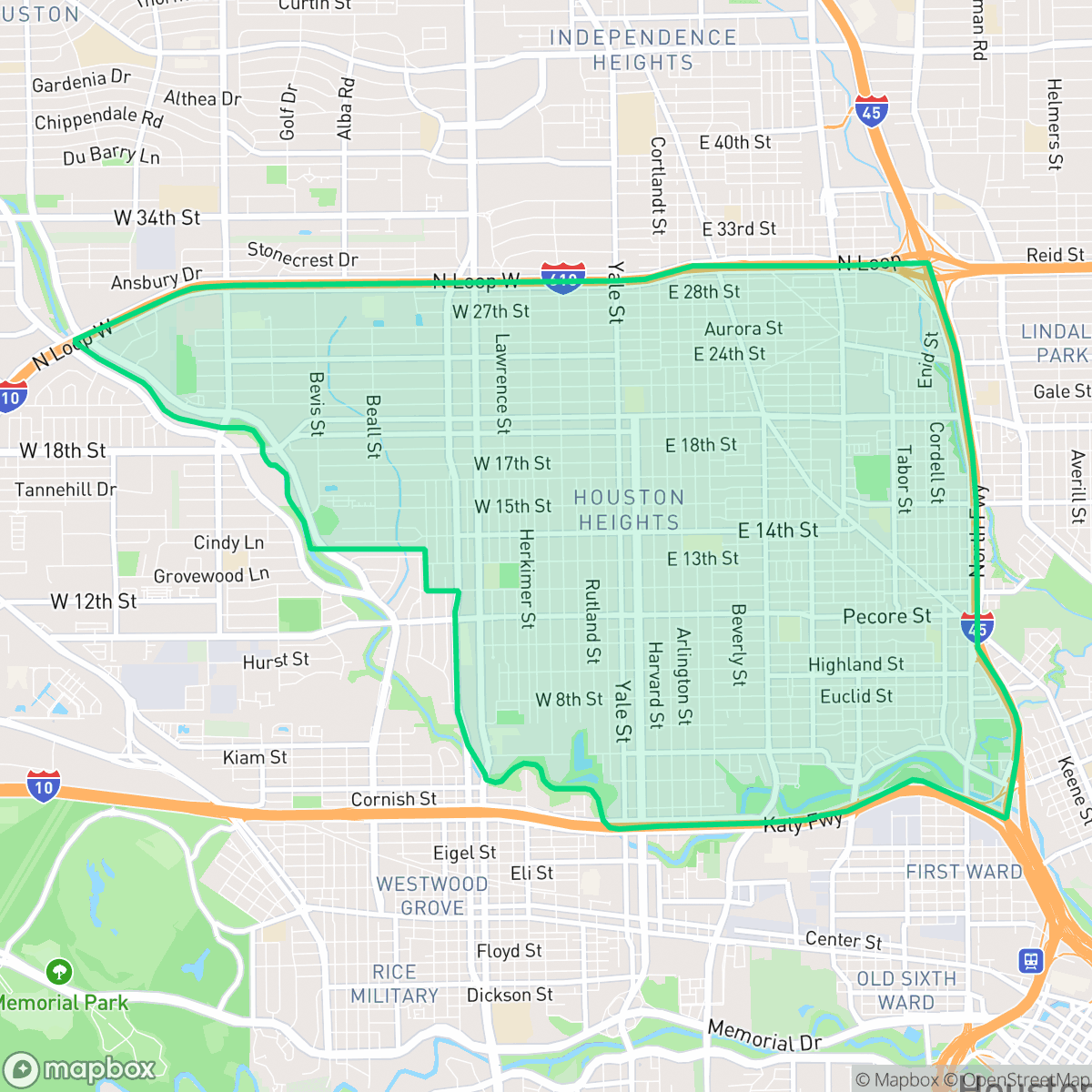
About Greater Heights
Founded in 1891 by Oscar Martin Carter and the Omaha and South Texas Land Company, the Greater Heights (or Houston Heights) was established as Texas’s first planned community and streetcar suburb. Developed on land 23 feet higher than downtown Houston to escape coastal diseases and floods, the neighborhood featured streets named after prestigious colleges and a grand central thoroughfare, Heights Boulevard, modeled after Boston's Commonwealth Avenue. Its architectural character is defined by a rich stock of late 19th-century Victorian, Queen Anne, and Craftsman homes, many originally purchased as catalog kit houses. After being annexed by Houston in 1918, the area faced mid-century industrial decline but was revitalized starting in 1973 by the Houston Heights Association. Today, landmarks like Marmion Park and the historic Heights Theater (1929) anchor its distinct cultural identity.
The area serves as a primary cultural hub in Houston, distinguished by its grid layout and mature tree canopy that facilitate consistent pedestrian activity. The neighborhood maintains a strong identity through its blend of preserved historic architecture and modern urban infill, featuring a diverse array of restaurants, coffee shops, and local social hubs. Its location provides convenient access to major thoroughfares, making it a central point for those seeking an active lifestyle within a dense, established environment. According to iHuus data, the community benefits from high levels of health insurance coverage and a stable, engaged population.
Prospective residents should note that the neighborhood features tightly packed housing, which results in reduced visual privacy compared to more suburban settings. While the area offers access to several high-performing schools, the broader school district faces significant operational volatility and ongoing administrative changes. Additionally, while the community is generally quiet, proximity to major roads contributes to a moderate level of ambient traffic noise. It is best suited for individuals who prioritize walkability and proximity to urban amenities over expansive private yards or total silence.
Neighborhood Scores Across 15 Qualities
Residential structures are often closely packed with narrow gaps between neighbors, resulting in less privacy than the Houston average. According to iHuus data, many homes and townhomes feature shared walls or minimal side yards.
Dense street grids and consistent sidewalks facilitate safe pedestrian movement throughout most residential blocks. While major highways can act as barriers, the local network of crosswalks and tree-lined streets remains slightly above the Houston average for walkability.
Manicured landscapes and large modern homes with private pools are common throughout much of the area, making the visual quality slightly higher than the Houston average. While some sections feature high-density townhomes, many residents will find a premium aesthetic characterized by complex architecture and well-maintained greenery according to iHuus data.
Large public parks and tree-lined streets with grass verges provide good walking options, although some denser areas lack accessible green space. Overall, pet-friendly amenities in this area are slightly below the Houston average according to iHuus data.
Residential streets and green spaces exist in roughly equal measure, providing a suburban feel that is slightly less dense than the Houston average. This mix of multi-story townhomes and single-family plots creates a transition between urban density and residential greenery.
A mix of energetic dining hubs and quiet suburban pockets creates a character that is more active than the Houston average. While some areas feature walkable social centers, many sections remain primarily car-dependent due to the presence of industrial zones and highway proximity.
Steady ambient noise from nearby busy streets is typical for this area, which aligns with the average acoustic levels found across Houston.
Air quality levels fluctuate between acceptable and unhealthy periods, though conditions remain notably better than the Houston average. Sensitive individuals may experience occasional concerns during certain weather patterns, according to iHuus data.
Most of the area consists of residential and light commercial zones with a notable absence of heavy industrial hazards. While some eastern edges feature larger warehouses, the neighborhood remains significantly clearer of large-scale industrial activity than the Houston average.
Health insurance accessibility is significantly higher than the Houston average, providing residents with greater stability in accessing medical care. According to iHuus data, a large majority of the population is covered.
Political leanings in this area favor liberal perspectives, leaning more progressive than the Houston average according to iHuus data.
Residents live alongside a balanced mix of young professionals, families, and older adults. This demographic spread is slightly more varied than the Houston average, according to iHuus data.
Residual flood risk exists within this area due to its location in a 500-year floodplain, though safety levels are comparable to the Houston average according to iHuus data.
Address-Level Insights for Greater Heights


iHuus Neighborhood Intelligence Insights
Get address-level neighborhood insights for Greater Heights
- Street-level scores — see how individual blocks compare, not just neighborhood averages
- Micro-zone boundaries — identify quiet pockets, flood boundaries, and walkable clusters before you visit
- 15 dimensions in full — walkability, noise, air quality, school quality, insurance coverage, population age profile, urban/rural index, and more
- Boundary risk alerts — know if your address sits near a block boundary where scores drop, the kind of detail no listing will ever mention
- School insights — individual school ratings and insights, not just district-level data
- Compare before you commit — side-by-side data across neighborhoods, down to block precision
No credit card required
Compare with Any Neighborhood
| Dimension | Greater Heights | Acres Home |
|---|---|---|
| 🚶 Walkabilityavg 7.08 | ||
| 🔊 Acoustic Comfortavg 4.14 | ||
| 🤫 Privacy Indexavg 5.34 | ||
| 🎨 Visual Appealavg 6.42 | ||
| 🐕 Dog Friendlinessavg 6.33 | ||
| 🗺️ Urban-Rural Indexavg 6.64 | ||
| ✨ Neighborhood Vibeavg 4.4 | ||
| 🏥 Health Insurance Coverageavg 5.46 | ||
| 🌿 Air Qualityavg 3.58 | ||
| 🏭 Industrial Proximityavg 6.9 | ||
| 🌊 Flood Safetyavg 6.27 | ||
| 🗳️ Ideological Leanavg 6.39 | ||
| 👥 Population Age Profileavg 4.6 | ||
| 🔥 Fire Safety | ||
| 🏫 School Quality |
Greater Heights Rankings
School Districts Serving Greater Heights
School Insights for Greater Heights
Below average outcomes; significant attendance and academic challenges.
School Insights
See what's really behind every school rating near Greater Heights
- Individual school ratings — each school's own score with outcome context, not just a district average
- Enrollment & class size data — student-to-teacher ratio and how it compares to the state average
- Full demographics breakdown — ethnicity and gender composition for every school in the enrollment zone
- Every school in the district — all schools within the enrollment boundary ranked by rating, not just the closest one
- Grade levels & benchmarks — elementary through high school, with below/above state-average flags
No credit card required