Greater Fifth Ward, Houston
Updated · 24,561 residents
The Greater Fifth Ward is a historically significant Houston district defined by its deep cultural roots and a mix of industrial and residential landscapes. Residents here experience a tightly packed urban environment with limited privacy and notable noise levels from nearby highway and rail infrastructure.
Key Highlights
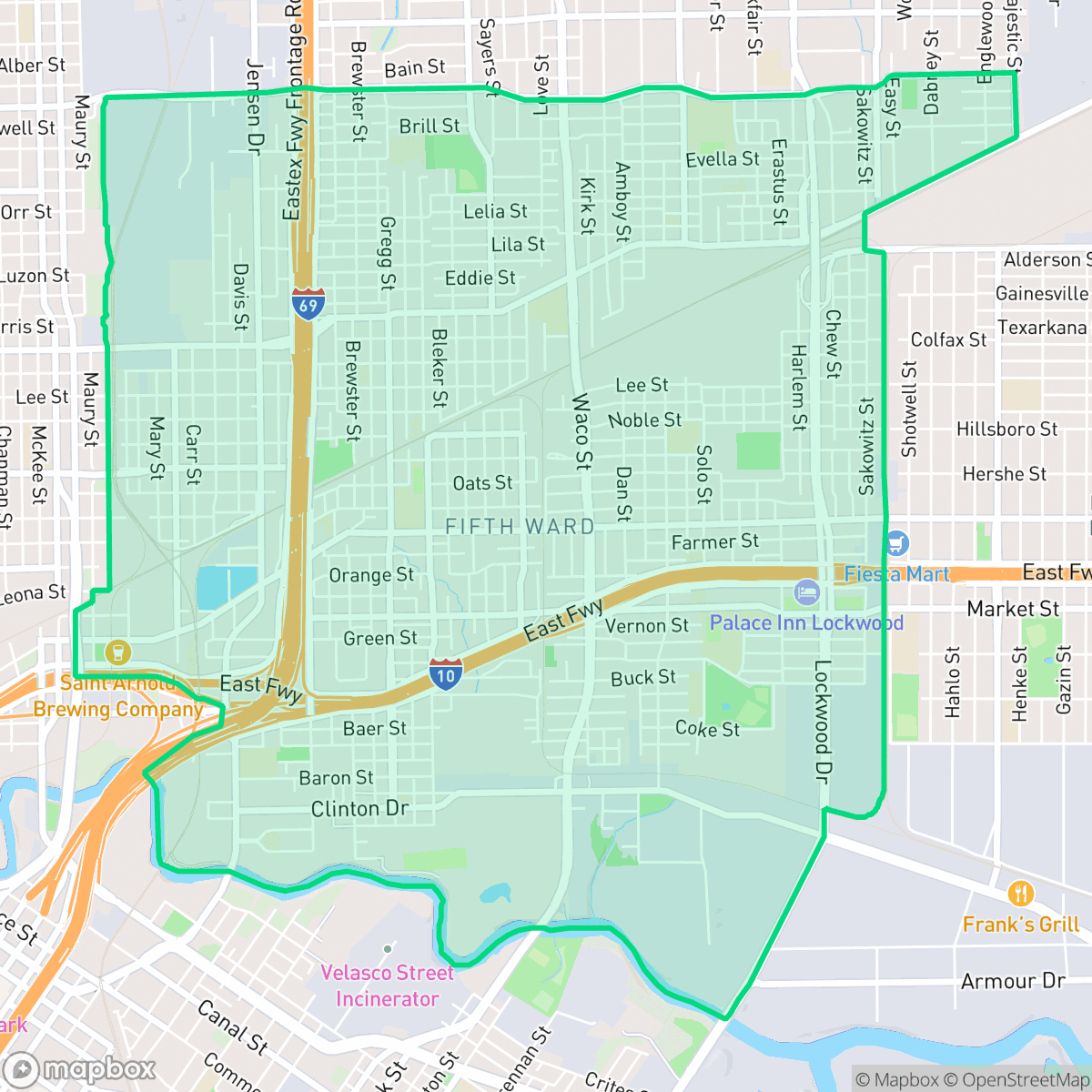
About Greater Fifth Ward
Established in 1866 as one of Houston’s original political districts, the Greater Fifth Ward—affectionately nicknamed "The Nickel"—developed as a prominent freedmen’s settlement after the Civil War. The neighborhood experienced an industrial boom in the 1880s with the expansion of the Southern Pacific Railroad repair shops, though it suffered a devastating fire in 1912. Lyons Avenue emerged as the vibrant heart of the community, hosting dozens of Black-owned businesses and the historic DeLuxe Theater. The ward also housed "Frenchtown," a distinct Creole enclave settled in 1922. Renowned for its rich musical and political legacy, the Fifth Ward was home to Peacock Records, the pioneering rap group Geto Boys, and legendary U.S. Representative Barbara Jordan. Today, the City of Houston actively preserves this heritage, proposing Lyons Avenue for the National Register of Historic Places.
The area functions as an established urban enclave where industrial warehouses and freight corridors sit in close proximity to residential blocks. While the neighborhood maintains a strong sense of identity through its historic churches and local landmarks, the physical landscape is characterized by high density and infrastructure-heavy surroundings. Navigating the district requires a vehicle, as the grid is frequently bisected by major highway interchanges and rail lines that limit continuous pedestrian access. Despite these logistical constraints, the community benefits from a relatively high level of flood safety compared to other parts of the city, and it remains anchored by a variety of local services and educational institutions.
Prospective residents should be aware of the trade-offs inherent in this industrial-adjacent setting, including elevated noise levels and proximity to environmental sites that require ongoing monitoring. The housing stock consists largely of modest, closely spaced structures that offer limited private outdoor space. This neighborhood is best suited for those who prioritize proximity to the city's historic core and value a community with a rich, well-documented heritage over suburban-style amenities or quiet, low-density living.
Neighborhood Scores Across 15 Qualities
Residential spacing varies throughout the area, with some sections featuring closely packed homes and others offering slightly more separation. This level of density is consistent with the average seen across Houston.
Low-traffic residential streets allow for safe walking, but a lack of continuous sidewalks and significant fragmentation from highway interchanges make the area less walkable than much of Houston. According to iHuus data, heavy tree canopy and rail lines also frequently interrupt the sidewalk network throughout the neighborhood.
Simple rooflines and small lots define the local landscape, which appears less manicured than the Houston average. According to iHuus data, the area features a mix of standard tract housing and some industrial proximity, with fewer private amenities like pools or large estates.
Public parks and green verges for walking are sparse throughout most of the area, making the neighborhood less dog friendly than the Houston average. While certain pockets offer access to river trails or centralized parks, much of the neighborhood relies on private yards due to narrow sidewalks and heavy highway infrastructure.
A varied landscape of residential grids, large warehouses, and significant transportation infrastructure characterizes the area. This mix of low-density housing and heavy industrial zones is largely in line with the typical urban-rural balance found across Houston.
Primarily composed of industrial warehouses and suburban blocks, this area offers a calm atmosphere with limited social activity. The local vibe is less active than the Houston average, as most amenities and dining options are concentrated near major highways and railway corridors.
Persistent sounds from nearby busy streets create a level of acoustic activity slightly higher than the Houston average. Residents can expect a consistent background hum of local vehicle traffic throughout the day.
Frequent periods of unhealthy air levels pose significant risks to sensitive groups; according to iHuus data, the air quality in this area is slightly lower than the Houston average.
Significant industrial activity, including a massive rail classification yard and a nearby EPA Superfund site, results in much higher levels of noise and potential environmental contaminants than the Houston average. Residents may experience heavy truck traffic, dust, and utility odors from adjacent logistics hubs and commercial facilities.
Health insurance coverage among residents is below the Houston average. Access to medical coverage is a notable concern for those living in this area, according to iHuus data.
Voting patterns and census indicators show a significantly more liberal political leaning than the Houston average. Residents will find a community with deeply established progressive leanings according to iHuus data.
Residents live alongside a balanced demographic of young professionals, families, and seniors. According to iHuus data, this age distribution is largely consistent with the broader Houston area.
Flood risk levels in this area are currently difficult to assess because detailed federal studies have not been completed. This level of uncertainty is consistent with the average found across Houston.
Address-Level Insights for Greater Fifth Ward


iHuus Neighborhood Intelligence Insights
Get address-level neighborhood insights for Greater Fifth Ward
- Street-level scores — see how individual blocks compare, not just neighborhood averages
- Micro-zone boundaries — identify quiet pockets, flood boundaries, and walkable clusters before you visit
- 15 dimensions in full — walkability, noise, air quality, school quality, insurance coverage, population age profile, urban/rural index, and more
- Boundary risk alerts — know if your address sits near a block boundary where scores drop, the kind of detail no listing will ever mention
- School insights — individual school ratings and insights, not just district-level data
- Compare before you commit — side-by-side data across neighborhoods, down to block precision
No credit card required
Compare with Any Neighborhood
| Dimension | Greater Fifth Ward | Acres Home |
|---|---|---|
| 🚶 Walkabilityavg 7.08 | ||
| 🔊 Acoustic Comfortavg 4.14 | ||
| 🤫 Privacy Indexavg 5.34 | ||
| 🎨 Visual Appealavg 6.42 | ||
| 🐕 Dog Friendlinessavg 6.33 | ||
| 🗺️ Urban-Rural Indexavg 6.64 | ||
| ✨ Neighborhood Vibeavg 4.4 | ||
| 🏥 Health Insurance Coverageavg 5.46 | ||
| 🌿 Air Qualityavg 3.58 | ||
| 🏭 Industrial Proximityavg 6.9 | ||
| 🌊 Flood Safetyavg 6.27 | ||
| 🗳️ Ideological Leanavg 6.39 | ||
| 👥 Population Age Profileavg 4.6 | ||
| 🔥 Fire Safety | ||
| 🏫 School Quality |
Greater Fifth Ward Rankings
School Districts Serving Greater Fifth Ward
School Insights for Greater Fifth Ward
Below average outcomes; significant attendance and academic challenges.
School Insights
See what's really behind every school rating near Greater Fifth Ward
- Individual school ratings — each school's own score with outcome context, not just a district average
- Enrollment & class size data — student-to-teacher ratio and how it compares to the state average
- Full demographics breakdown — ethnicity and gender composition for every school in the enrollment zone
- Every school in the district — all schools within the enrollment boundary ranked by rating, not just the closest one
- Grade levels & benchmarks — elementary through high school, with below/above state-average flags
No credit card required