Greater Eastwood, Houston
Updated · 12,344 residents
Greater Eastwood is a historic residential enclave defined by its dense collection of early 20th-century architectural styles and a strong sense of community. While the area offers a quiet, industrial-suburban atmosphere with pockets of green space, residents experience limited privacy due to tightly packed housing and frequent proximity to rail and logistics corridors.
Key Highlights
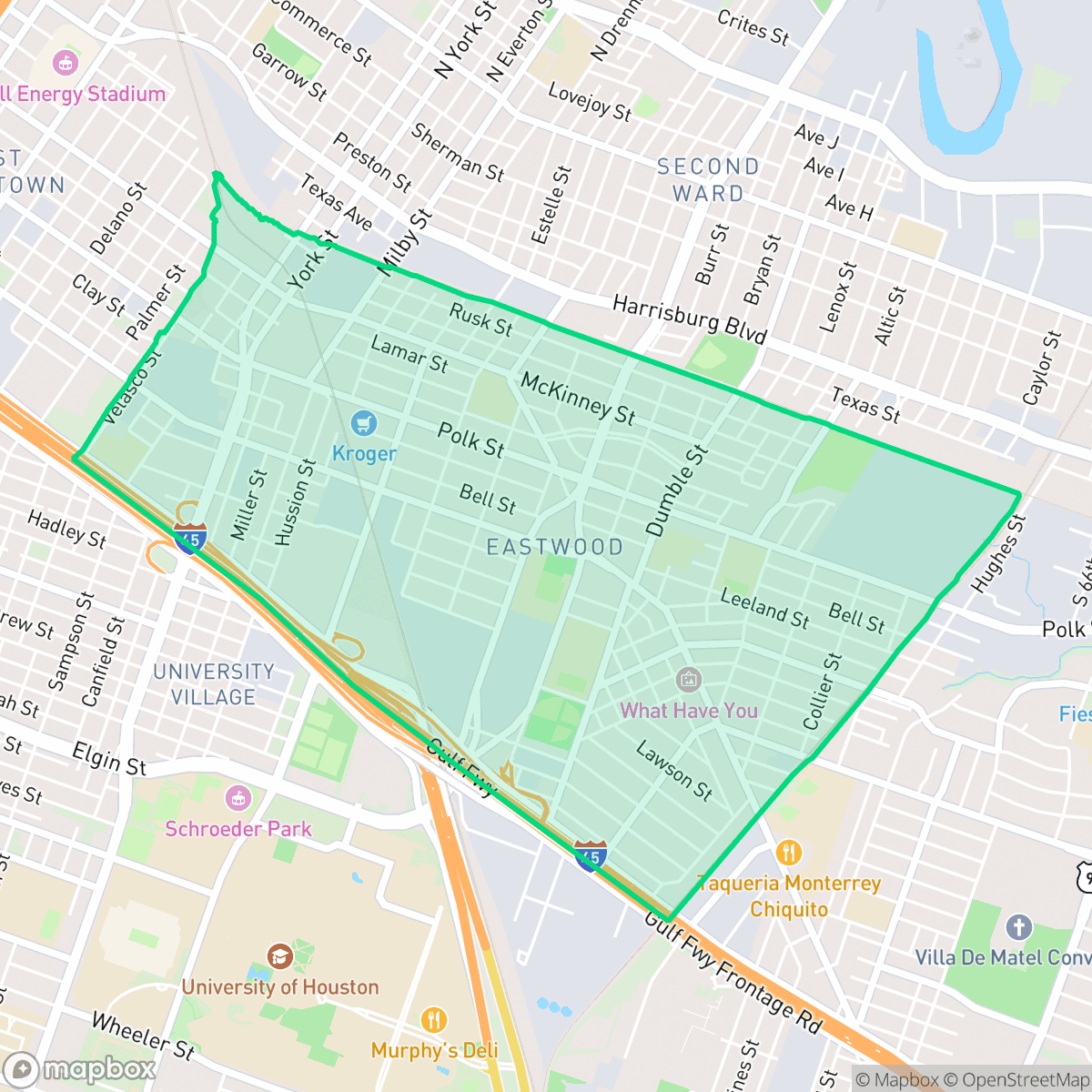
About Greater Eastwood
Developed in 1911 by William A. Wilson and officially opened in 1913, Greater Eastwood is one of Houston’s first master-planned subdivisions. Designed as an upscale "model suburb," it featured advanced early-20th-century infrastructure, including terraced lots, rear-facing utility lines, and symmetrically planted live oaks and sycamores. Today, the neighborhood boasts Houston's largest intact collection of Craftsman, Arts & Crafts, American Foursquare, and Mission-style architecture. Notable early residents included hardware magnate Charles L. Bering and legendary aviator Howard Hughes, who famously built an airplane in a local garage while staying with his aunt. Following World War II, the neighborhood transitioned from an exclusively Anglo suburb into a vibrant, predominantly Hispanic middle-class community. Greater Eastwood remains highly celebrated for its historic preservation, anchored by the annual historic home tours hosted by the active Eastwood Civic Association.
The area functions as a dense urban grid where historic residential charm meets active industrial infrastructure. The streets are characterized by modest homes on narrow lots, creating a tight-knit layout that emphasizes community over expansive private outdoor space. Local amenities include neighborhood staples like Eastwood Park and a variety of independent dining options, though the overall layout remains heavily reliant on personal vehicles for daily errands.
Prospective residents should note the trade-offs inherent in this industrial-adjacent setting, including elevated noise levels from nearby freight rail and traffic. While the neighborhood benefits from a high flood safety rating and access to several top-rated magnet schools, the proximity to logistics centers and historical industrial sites influences the local air quality and privacy index. It is best suited for those who prioritize historic architecture and a central location over modern suburban luxury or quiet seclusion.
Neighborhood Scores Across 15 Qualities
Residential structures are frequently positioned close together with minimal vegetation between neighbors. According to iHuus data, this density provides less separation than the typical Houston neighborhood.
Low traffic on residential streets allows for some walking, but sidewalk availability is inconsistent and below the Houston average. Large industrial zones and major highways periodically interrupt the grid layout, making continuous pedestrian travel difficult.
Dense, utilitarian housing with small yards and simple rooflines characterizes the area. This lack of greenery and luxury amenities makes the visual landscape less lush than the Houston average, according to iHuus data.
Public park access and wide walking verges are below the Houston average. While some areas feature large sports complexes and open grass, much of the neighborhood greenery is confined to private fenced backyards.
Residential grids and small lots transition directly into large-scale warehouses and rail infrastructure. This landscape presents a mix of low-density housing and heavy industrial zones that is largely comparable to the Houston average.
A steady rhythm of residential life and diverse dining exists alongside warehouses and freight corridors, though the car-dependent layout makes the area's liveliness comparable to the Houston average. While green spaces like Eastwood Park provide recreational opportunities, most services and amenities require a vehicle to access.
A steady hum from nearby busy streets is common throughout the area. This level of activity is slightly higher than the average found in other parts of Houston.
Frequent unhealthy air quality levels present significant risks for sensitive groups. According to iHuus data, this neighborhood experiences air pollution levels that are consistent with the Houston average.
Large logistics warehouses, scrapyards, and rail infrastructure are interspersed with residential pockets, resulting in lower industrial proximity than the Houston average. Residents should be aware of increased truck traffic near highways and the presence of a nearby EPA Superfund site according to iHuus data.
Health insurance access among residents is notably lower than the Houston average. According to iHuus data, a small portion of the population maintains active coverage.
Voting patterns and census indicators reflect a significantly more liberal political leaning than the Houston average, according to iHuus data.
Residents live alongside a balanced demographic of young adults, families, and seniors. This age distribution is slightly more varied than the typical Houston profile, according to iHuus data.
Flood risk in this area is slightly higher than the Houston average, as some portions of the neighborhood fall within the 500-year floodplain. According to iHuus data, residents may encounter residual flood risks during extreme weather events.
Address-Level Insights for Greater Eastwood


iHuus Neighborhood Intelligence Insights
Get address-level neighborhood insights for Greater Eastwood
- Street-level scores — see how individual blocks compare, not just neighborhood averages
- Micro-zone boundaries — identify quiet pockets, flood boundaries, and walkable clusters before you visit
- 15 dimensions in full — walkability, noise, air quality, school quality, insurance coverage, population age profile, urban/rural index, and more
- Boundary risk alerts — know if your address sits near a block boundary where scores drop, the kind of detail no listing will ever mention
- School insights — individual school ratings and insights, not just district-level data
- Compare before you commit — side-by-side data across neighborhoods, down to block precision
No credit card required
Compare with Any Neighborhood
| Dimension | Greater Eastwood | Acres Home |
|---|---|---|
| 🚶 Walkabilityavg 7.08 | ||
| 🔊 Acoustic Comfortavg 4.14 | ||
| 🤫 Privacy Indexavg 5.34 | ||
| 🎨 Visual Appealavg 6.42 | ||
| 🐕 Dog Friendlinessavg 6.33 | ||
| 🗺️ Urban-Rural Indexavg 6.64 | ||
| ✨ Neighborhood Vibeavg 4.4 | ||
| 🏥 Health Insurance Coverageavg 5.46 | ||
| 🌿 Air Qualityavg 3.58 | ||
| 🏭 Industrial Proximityavg 6.9 | ||
| 🌊 Flood Safetyavg 6.27 | ||
| 🗳️ Ideological Leanavg 6.39 | ||
| 👥 Population Age Profileavg 4.6 | ||
| 🔥 Fire Safety | ||
| 🏫 School Quality |
Greater Eastwood Rankings
School Districts Serving Greater Eastwood
School Insights for Greater Eastwood
Below average outcomes; significant attendance and academic challenges.
School Insights
See what's really behind every school rating near Greater Eastwood
- Individual school ratings — each school's own score with outcome context, not just a district average
- Enrollment & class size data — student-to-teacher ratio and how it compares to the state average
- Full demographics breakdown — ethnicity and gender composition for every school in the enrollment zone
- Every school in the district — all schools within the enrollment boundary ranked by rating, not just the closest one
- Grade levels & benchmarks — elementary through high school, with below/above state-average flags
No credit card required