Golfcrest - Bellfort - Reveille, Houston
Updated · 55,281 residents
Golfcrest - Bellfort - Reveille is a dense, established Houston neighborhood characterized by its mid-century ranch-style architecture and proximity to the Sims Bayou corridor. While the area offers a quiet, suburban atmosphere with diverse local dining, residents should expect a car-dependent environment with significant industrial activity nearby.
Key Highlights
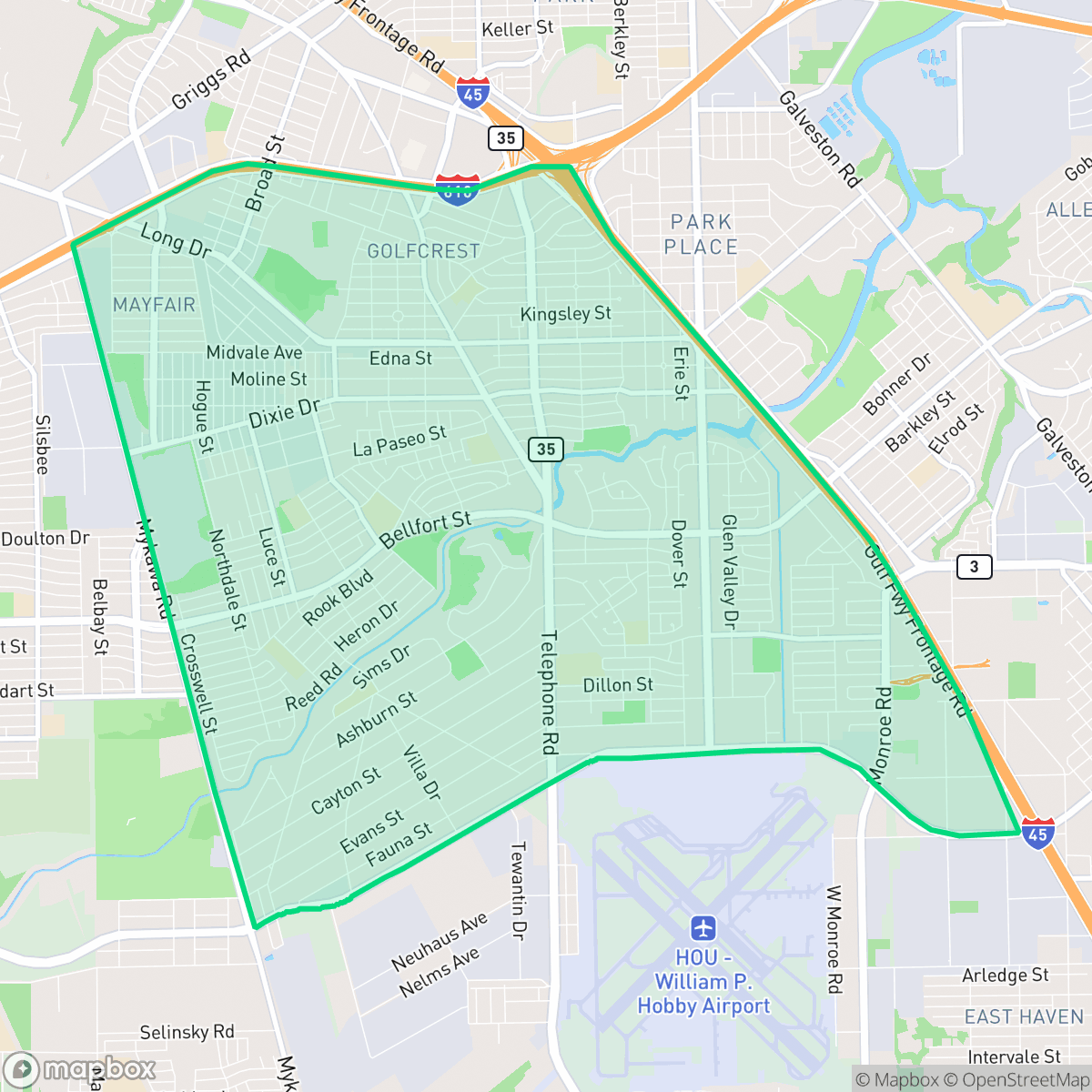
About Golfcrest - Bellfort - Reveille
Located in southeast Houston, the Golfcrest - Bellfort - Reveille neighborhood traces its origins to 1833 when settler Isaac Batterson purchased 1,000 acres of the Ezekiel Thomas estate. The area's modern identity began taking shape in 1926 with the founding of the Golfcrest Country Club by developer Earl Gammage Sr. In 1932, the club became a national pioneer by experimenting with night golf under floodlights. When the club relocated to Pearland in 1971, its original site was redeveloped into a Houston ISD stadium, public housing, and a city park. Post-World War II suburban expansion drove the development of subdivisions like Overbrook and Santa Rosa, featuring mid-century ranch-style homes, particularly along Sims Bayou. Today, the neighborhood maintains its mid-century character, supported by long-standing local institutions like Spanky’s Pizza, which has served the community since the 1970s.
The neighborhood functions as a dense, suburban enclave in southeast Houston, defined by its grid-based street layout and a blend of single-family homes and multi-family complexes. It maintains a distinct identity through its proximity to the Sims Bayou greenway, which offers residents accessible outdoor space, and a variety of local institutions that have served the community for decades. The area is marked by a high density of residential structures and a persistent, active industrial presence that includes warehouses and logistics hubs, contributing to a utilitarian and busy daily rhythm.
Potential residents should consider that the area is primarily car-dependent, as the street grid is often bisected by high-traffic arterial roads and industrial corridors. While the neighborhood provides a range of educational options through both the Pasadena and Houston school districts, the local environment is influenced by its proximity to major highways, resulting in elevated noise levels and lower air quality ratings. This area is best suited for those who prioritize established community roots and mid-century architectural charm over the walkability or quietude of more secluded suburban settings.
Neighborhood Scores Across 15 Qualities
Residential spacing varies between closely packed single-family homes and denser multi-family units, offering a level of privacy that is slightly higher than the Houston average. According to iHuus data, some areas feature shared walls or narrow setbacks, while other sections provide moderate buffering between neighbors.
Low-traffic residential streets and waterway trails offer safe walking routes, though significant highway interchanges and a lack of consistent sidewalks make larger trips more difficult than the city average.
Uniform tract housing and dense apartment complexes define the local landscape, which lacks the lush landscaping or luxury amenities found more frequently across Houston. Most residential lots feature small yards and simple rooflines, with some areas showing proximity to industrial structures.
Access to public green space is inconsistent throughout the area. While some sections feature river trails and large school fields, other residential blocks lack nearby public parks and rely primarily on private backyards.
Open land and wooded tracts are interspersed with residential clusters and industrial zones, making the area slightly more semi-rural than the Houston average. According to iHuus data, the landscape features a blend of scattered homes and undeveloped plots alongside significant warehouse infrastructure.
A blend of light industrial units and residential streets creates a balanced atmosphere that is slightly more active than the Houston average. While many essential services and diverse dining options are available, the area remains primarily car-dependent due to the presence of large warehouses and major highways.
Frequent auditory disturbances from nearby rail lines and major freeway traffic characterize this area. According to iHuus data, acoustic comfort is lower than the Houston city average.
Frequent unhealthy air quality levels pose significant risks to sensitive groups. According to iHuus data, the air quality in this area is worse than the Houston average.
Active logistics hubs, warehouses, and a nearby EPA Superfund site contribute to more industrial activity and potential environmental concerns than the Houston average. Residents may encounter increased heavy truck traffic and noise from nearby rail corridors and large-scale distribution centers.
Health insurance coverage among residents is notably lower than the Houston average, according to iHuus data. This lack of coverage may present challenges regarding access to regular medical care and predictable healthcare costs.
Political leanings in this area are notably more liberal than the Houston average, according to iHuus data.
Residents live alongside a balanced distribution of young adults, families, and older populations. This demographic variety is largely in line with the Houston average, according to iHuus data.
Residual flood risk exists within the area due to its location inside a 500-year floodplain, though safety levels remain slightly above the Houston city average according to iHuus data.
Address-Level Insights for Golfcrest - Bellfort - Reveille


iHuus Neighborhood Intelligence Insights
Get address-level neighborhood insights for Golfcrest - Bellfort - Reveille
- Street-level scores — see how individual blocks compare, not just neighborhood averages
- Micro-zone boundaries — identify quiet pockets, flood boundaries, and walkable clusters before you visit
- 15 dimensions in full — walkability, noise, air quality, school quality, insurance coverage, population age profile, urban/rural index, and more
- Boundary risk alerts — know if your address sits near a block boundary where scores drop, the kind of detail no listing will ever mention
- School insights — individual school ratings and insights, not just district-level data
- Compare before you commit — side-by-side data across neighborhoods, down to block precision
No credit card required
Compare with Any Neighborhood
| Dimension | Golfcrest - Bellfort - Reveille | Acres Home |
|---|---|---|
| 🚶 Walkabilityavg 7.08 | ||
| 🔊 Acoustic Comfortavg 4.14 | ||
| 🤫 Privacy Indexavg 5.34 | ||
| 🎨 Visual Appealavg 6.42 | ||
| 🐕 Dog Friendlinessavg 6.33 | ||
| 🗺️ Urban-Rural Indexavg 6.64 | ||
| ✨ Neighborhood Vibeavg 4.4 | ||
| 🏥 Health Insurance Coverageavg 5.46 | ||
| 🌿 Air Qualityavg 3.58 | ||
| 🏭 Industrial Proximityavg 6.9 | ||
| 🌊 Flood Safetyavg 6.27 | ||
| 🗳️ Ideological Leanavg 6.39 | ||
| 👥 Population Age Profileavg 4.6 | ||
| 🔥 Fire Safety | ||
| 🏫 School Quality |
Golfcrest - Bellfort - Reveille Rankings
School Districts Serving Golfcrest - Bellfort - Reveille
School Insights for Golfcrest - Bellfort - Reveille
Below average outcomes; significant attendance and academic challenges.
School Insights
See what's really behind every school rating near Golfcrest - Bellfort - Reveille
- Individual school ratings — each school's own score with outcome context, not just a district average
- Enrollment & class size data — student-to-teacher ratio and how it compares to the state average
- Full demographics breakdown — ethnicity and gender composition for every school in the enrollment zone
- Every school in the district — all schools within the enrollment boundary ranked by rating, not just the closest one
- Grade levels & benchmarks — elementary through high school, with below/above state-average flags
No credit card required