Garden Oaks, Houston
Updated · 3,644 residents
Garden Oaks is a quiet, suburban enclave known for its mature canopy and diverse housing, ranging from mid-century bungalows to ranch-style homes. According to iHuus data, the area offers above-average walkability and strong flood safety, though residents should anticipate moderate noise levels from local road traffic.
Key Highlights
About Garden Oaks
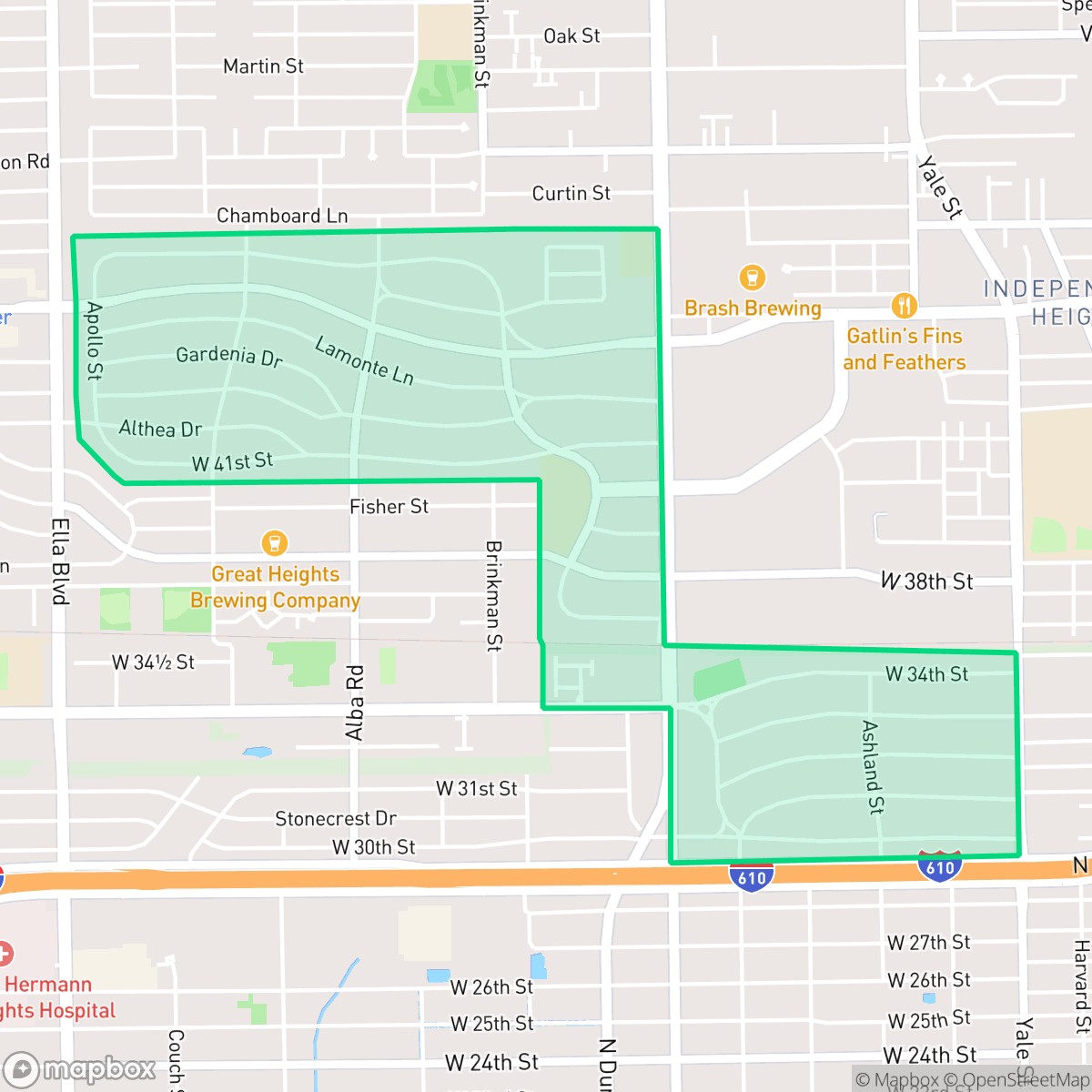
Established in 1937 by developer Edward L. Crain, Garden Oaks is one of Houston’s most distinct mid-century neighborhoods. Located just north of the Heights, the subdivision was laid out with oversized lots under a canopy of mature oak, pecan, and pine trees. Its architectural tapestry spans late-1930s bungalows, cottages, and mid-century ranch homes, many originally built from Crain Ready-Cut House Company kits. Following World War II, the neighborhood's western edge expanded with "G.I. homes" built for returning veterans. Local landmarks include the longest thoroughfare, Sue Barnett Drive—named after the county secretary who approved the subdivision's design—as well as early commercial anchors like the Art Deco Garden Oaks Theater (1947). Today, the neighborhood maintains its historic charm and tight-knit community feel.
The area balances residential tranquility with pockets of light industrial activity, creating a unique, low-key atmosphere. Residents benefit from higher-than-average air quality and robust health insurance coverage compared to the broader Houston region. Local amenities include popular spots like D'Alba and the St. Rose of Lima Catholic Community, which serve as neighborhood hubs. The streetscape remains visually appealing, characterized by its historic tree-lined roads and well-maintained properties.
While the neighborhood provides a peaceful environment, the overall vibe is relatively subdued, making it well-suited for those who prioritize a quiet lifestyle over high-energy nightlife. Prospective residents should note that while the local Garden Oaks Montessori school offers a stable educational option, the surrounding Houston Independent School District faces significant institutional challenges. The area remains a practical choice for individuals seeking a blend of suburban calm and proximity to city conveniences, provided they are comfortable with the ambient noise from nearby thoroughfares.
Neighborhood Scores Across 15 Qualities
Residential spacing varies throughout the area, ranging from closely packed townhomes to single-family lots with more buffer. This level of privacy is roughly comparable to the Houston average, according to iHuus data.
Sidewalks are available on certain streets and crossings are generally safe, though many residential areas lack dedicated paths. This level of accessibility is slightly below the Houston average according to iHuus data.
Spacious driveways and upscale amenities contribute to a visual quality that is above the Houston average. While some areas feature standard tract housing and mid-range apartment complexes, many parts of the neighborhood are characterized by large homes and well-maintained properties.
Narrow sidewalks and private fencing restrict easy access to green spaces for pets. According to iHuus data, the availability of walking areas for dogs is below the Houston average.
Residential streets and green spaces exist in roughly equal measure, though the area feels slightly less urbanized than the Houston average. According to iHuus data, the landscape consists of a blend of single-family homes, townhomes, and larger commercial warehouses.
A variety of dining options and local social hubs create a more active atmosphere than the Houston average. While the area features diverse restaurants and green spaces, the layout remains largely car-dependent for most errands.
Frequent noise from nearby railroads and major freeways characterizes this area. According to iHuus data, acoustic comfort levels are lower than the Houston city average.
Air quality fluctuates between acceptable and unhealthy levels on certain days. This area maintains a higher quality of air than the Houston average, though sensitive groups should remain cautious during peak pollution periods according to iHuus data.
Residential streets and open green spaces dominate the area with no heavy industrial hazards present. This neighborhood offers a significantly cleaner profile regarding industrial proximity compared to the Houston average, according to iHuus data.
Health insurance access among residents is notably higher than the Houston average, according to iHuus data.
Political perspectives in this area are distributed relatively evenly between conservative and liberal leanings, appearing slightly less partisan than the Houston average according to iHuus data.
Residents encounter a diverse age demographic ranging from young professionals to seniors. According to iHuus data, this distribution is slightly more varied than the average found across Houston.
Flood risk in this area is notably higher than the Houston average because portions of the neighborhood sit within the 500-year floodplain. While the risk is considered moderate, residents should account for potential residual flooding during extreme weather events according to iHuus data.
Address-Level Insights for Garden Oaks


iHuus Neighborhood Intelligence Insights
Get address-level neighborhood insights for Garden Oaks
- Street-level scores — see how individual blocks compare, not just neighborhood averages
- Micro-zone boundaries — identify quiet pockets, flood boundaries, and walkable clusters before you visit
- 15 dimensions in full — walkability, noise, air quality, school quality, insurance coverage, population age profile, urban/rural index, and more
- Boundary risk alerts — know if your address sits near a block boundary where scores drop, the kind of detail no listing will ever mention
- School insights — individual school ratings and insights, not just district-level data
- Compare before you commit — side-by-side data across neighborhoods, down to block precision
No credit card required
Compare with Any Neighborhood
| Dimension | Garden Oaks | Acres Home |
|---|---|---|
| 🚶 Walkabilityavg 7.08 | ||
| 🔊 Acoustic Comfortavg 4.14 | ||
| 🤫 Privacy Indexavg 5.34 | ||
| 🎨 Visual Appealavg 6.42 | ||
| 🐕 Dog Friendlinessavg 6.33 | ||
| 🗺️ Urban-Rural Indexavg 6.64 | ||
| ✨ Neighborhood Vibeavg 4.4 | ||
| 🏥 Health Insurance Coverageavg 5.46 | ||
| 🌿 Air Qualityavg 3.58 | ||
| 🏭 Industrial Proximityavg 6.9 | ||
| 🌊 Flood Safetyavg 6.27 | ||
| 🗳️ Ideological Leanavg 6.39 | ||
| 👥 Population Age Profileavg 4.6 | ||
| 🔥 Fire Safety | ||
| 🏫 School Quality |
Garden Oaks Rankings
School Districts Serving Garden Oaks
School Insights for Garden Oaks
Below average outcomes; significant attendance and academic challenges.
School Insights
See what's really behind every school rating near Garden Oaks
- Individual school ratings — each school's own score with outcome context, not just a district average
- Enrollment & class size data — student-to-teacher ratio and how it compares to the state average
- Full demographics breakdown — ethnicity and gender composition for every school in the enrollment zone
- Every school in the district — all schools within the enrollment boundary ranked by rating, not just the closest one
- Grade levels & benchmarks — elementary through high school, with below/above state-average flags
No credit card required