Fourth Ward, Houston
Updated · 4,529 residents
Fourth Ward is a dense, highly walkable urban enclave characterized by a mix of modern townhomes and apartment blocks. While the area offers excellent access to local green spaces and vibrant social hubs, residents should expect significant noise from nearby highway traffic.
Key Highlights
About Fourth Ward
Established in 1839 as one of Houston’s original political districts, the Fourth Ward became the historic epicenter of the city's Black community following the Civil War. In 1866, formerly enslaved people settled the swampy southern banks of Buffalo Bayou, founding Freedmen’s Town. The self-sufficient neighborhood grew into a thriving cultural and professional hub, boasting landmarks like the Antioch Missionary Baptist Church and the Gregory School, Houston's first public school for African Americans. By the 1920s, its vibrant jazz and blues nightlife along West Dallas Street earned the area the moniker "Harlem of the South." However, mid-20th-century urban renewal, eminent domain seizures for the San Felipe Courts housing project, and the 1955 construction of the Pierce Elevated (Interstate 45) heavily fractured the historic neighborhood.
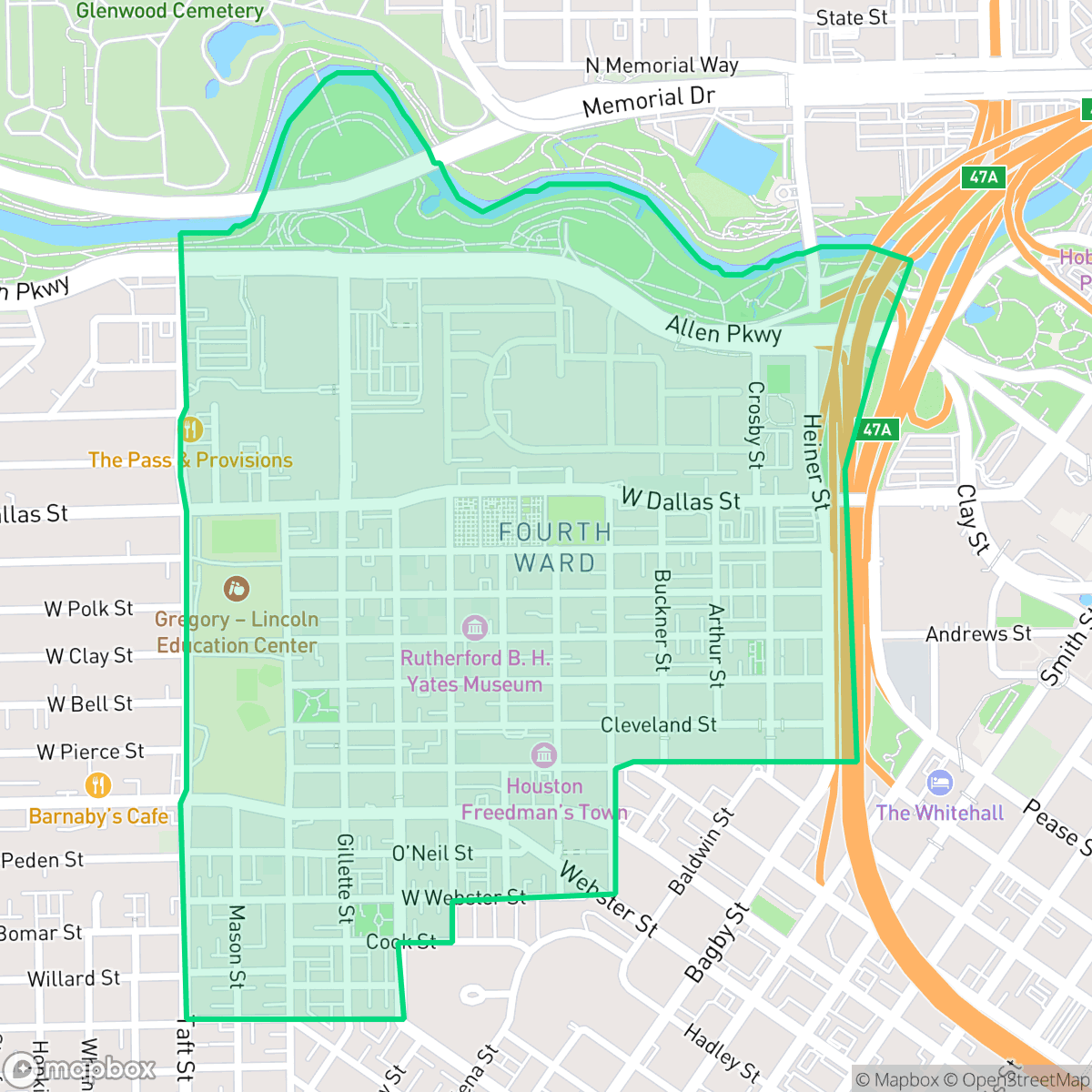
The neighborhood features a high-density urban landscape with a grid-based street layout that facilitates easy pedestrian movement. It is defined by its proximity to major transit corridors and popular social spots like Bagby Park, which contribute to its lively atmosphere. The architectural fabric consists primarily of tightly packed townhomes and multi-story apartment complexes, reflecting a modern residential shift that prioritizes central access over expansive private space.
Prospective residents should weigh the benefits of high walkability and dog-friendly trails against the reality of lower acoustic comfort due to road noise. While the area lacks heavy industrial activity, the proximity to major highways is a primary factor in the local soundscape. The neighborhood is well-suited for those who value an active urban lifestyle and proximity to downtown, though it is important to consider the broader challenges facing the local school district when evaluating long-term educational stability.
Neighborhood Scores Across 15 Qualities
Close proximity to neighbors and frequent shared walls in townhome developments result in less privacy than the Houston average. According to iHuus data, many residences feature narrow gaps or attached structures that offer minimal buffering between properties.
Pedestrian connectivity is strong due to a consistent grid pattern and visible sidewalks on most streets. According to iHuus data, the presence of crosswalks and pedestrian bridges makes this area more walkable than the Houston average.
Modern townhomes and mid-range apartment complexes define the area, creating a visual landscape that is largely consistent with the Houston average. Shared amenities like communal pools and varied rooflines characterize the neighborhood's aesthetic, according to iHuus data.
Access to large park areas and trails provides better-than-average opportunities for pet exercise. While some densely packed areas feature narrow sidewalks, the presence of green buffers and connected paths makes this area more dog-friendly than much of Houston.
Characterized by a dense urban fabric, this area features a concentrated mix of mid-rise apartments and tightly packed townhomes. This level of density is notably lower than the Houston average, providing a more balanced ratio of built structures to street space.
High density of social venues, dining options, and public parks creates a much more active environment than the Houston average. Residents can access a diverse mix of mid-rise urban streets and green spaces that maintain constant movement and social activity.
Steady traffic sounds from nearby busy thoroughfares create a consistent hum. This level of acoustic activity is slightly higher than the average seen across Houston, according to iHuus data.
Air quality in this area fluctuates between acceptable and unhealthy levels, though it remains slightly better than the Houston average according to iHuus data. Sensitive groups may experience occasional concerns during certain periods.
Heavy industrial facilities and warehouses are entirely absent from this area, making it significantly cleaner than the Houston average. Residents can expect a landscape composed primarily of residential and light commercial zones without proximity to hazardous sites.
Health insurance accessibility is slightly below the Houston average, according to iHuus data. Residents may find fewer options for coverage through local employer-sponsored plans compared to the broader city area.
Voting patterns and census indicators show a significantly more liberal leaning than the Houston average, according to iHuus data.
Residents live alongside a balanced mix of young professionals, families, and older adults. According to iHuus data, this age distribution is consistent with the broader Houston area.
Residual flood risk exists within this area as it sits within a 500-year floodplain, though the safety level remains higher than the Houston average according to iHuus data.
Address-Level Insights for Fourth Ward


iHuus Neighborhood Intelligence Insights
Get address-level neighborhood insights for Fourth Ward
- Street-level scores — see how individual blocks compare, not just neighborhood averages
- Micro-zone boundaries — identify quiet pockets, flood boundaries, and walkable clusters before you visit
- 15 dimensions in full — walkability, noise, air quality, school quality, insurance coverage, population age profile, urban/rural index, and more
- Boundary risk alerts — know if your address sits near a block boundary where scores drop, the kind of detail no listing will ever mention
- School insights — individual school ratings and insights, not just district-level data
- Compare before you commit — side-by-side data across neighborhoods, down to block precision
No credit card required
Compare with Any Neighborhood
| Dimension | Fourth Ward | Acres Home |
|---|---|---|
| 🚶 Walkabilityavg 7.08 | ||
| 🔊 Acoustic Comfortavg 4.14 | ||
| 🤫 Privacy Indexavg 5.34 | ||
| 🎨 Visual Appealavg 6.42 | ||
| 🐕 Dog Friendlinessavg 6.33 | ||
| 🗺️ Urban-Rural Indexavg 6.64 | ||
| ✨ Neighborhood Vibeavg 4.4 | ||
| 🏥 Health Insurance Coverageavg 5.46 | ||
| 🌿 Air Qualityavg 3.58 | ||
| 🏭 Industrial Proximityavg 6.9 | ||
| 🌊 Flood Safetyavg 6.27 | ||
| 🗳️ Ideological Leanavg 6.39 | ||
| 👥 Population Age Profileavg 4.6 | ||
| 🔥 Fire Safety | ||
| 🏫 School Quality |
Fourth Ward Rankings
School Districts Serving Fourth Ward
School Insights for Fourth Ward
Below average outcomes; significant attendance and academic challenges.
School Insights
See what's really behind every school rating near Fourth Ward
- Individual school ratings — each school's own score with outcome context, not just a district average
- Enrollment & class size data — student-to-teacher ratio and how it compares to the state average
- Full demographics breakdown — ethnicity and gender composition for every school in the enrollment zone
- Every school in the district — all schools within the enrollment boundary ranked by rating, not just the closest one
- Grade levels & benchmarks — elementary through high school, with below/above state-average flags
No credit card required