Fondren Gardens, Houston
Updated · 3,279 residents
Fondren Gardens is a quiet, car-dependent area in southwest Houston defined by its proximity to major logistics hubs and the expansive Blue Ridge Park. While the neighborhood offers higher-than-average flood safety, residents experience significant noise from nearby highway traffic and industrial activity.
Key Highlights
About Fondren Gardens
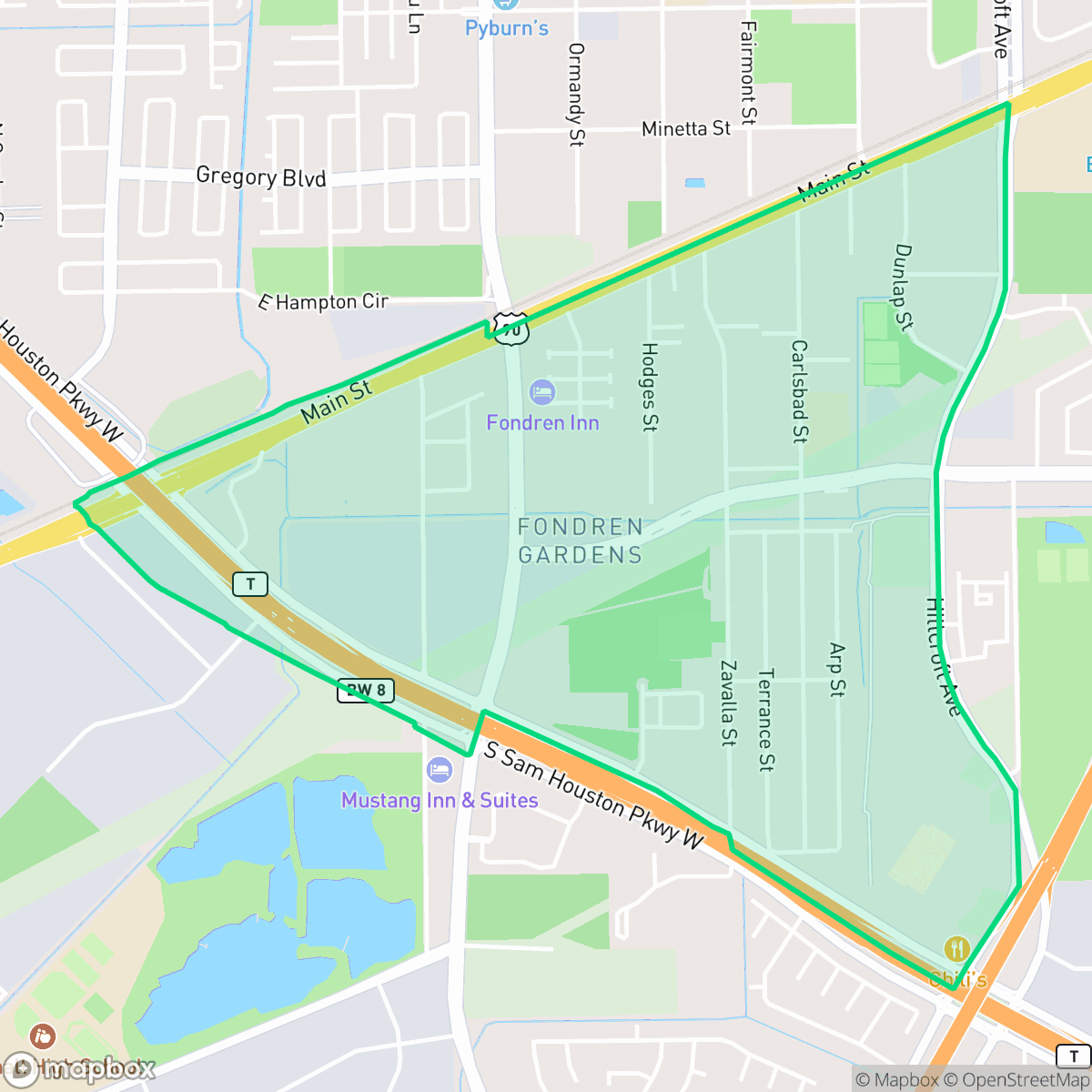
Located in southwest Houston, Fondren Gardens (Super Neighborhood 39) was originally developed to offer residents the opportunity to "work in the city and live in the country." The neighborhood, named after Humble Oil Company co-founder Walter W. Fondren, was once isolated on the edge of Harris County and accessible only via South Main Street and a narrow Fondren Road. Its large lots were sold to individuals who constructed modest homes over several decades, including brick ranch houses dating to the 1930s and 1950s. Today, the area is bordered by the Sam Houston Tollway. Notably, Blue Ridge Park—a prominent youth soccer training complex—covers roughly half of the neighborhood's land area.
The neighborhood functions as a low-density mix of residential, warehouse, and light industrial land uses. Its landscape is heavily influenced by its proximity to the Sam Houston Tollway, which contributes to high levels of road noise and frequent truck traffic associated with local logistics centers and salvage yards. Despite the industrial presence, the area maintains a calm, suburban atmosphere, anchored by the significant land footprint of the Blue Ridge Park youth soccer complex and local religious institutions like The Fountain Of Praise.
Neighborhood Scores Across 15 Qualities
Residential spacing offers a balanced level of separation between neighbors, providing more distance than the typical Houston area. According to iHuus data, the neighborhood features mixed density with some buffer between adjacent properties.
Low sidewalk availability limits pedestrian movement, although quiet streets allow for walking. This level of walkability is lower than the Houston average, according to iHuus data.
Residential views consist of modest tract housing with uniform rooflines and small yards. This level of visual variety is lower than the Houston city average, according to iHuus data.
Pet owners have access to some greenery and park proximity, though opportunities for walking on wide green verges are slightly below the Houston average according to iHuus data.
Residential pockets are interspersed with large-scale warehouses and major highway intersections. This landscape of suburban tracts and logistics corridors is largely consistent with the broader Houston area.
Primarily composed of warehouses and freight corridors, this area is significantly less lively than the Houston average. Residents will find a quiet, car-oriented landscape with limited social hubs and few walkable destinations.
Frequent noise from nearby freeways and railroad tracks makes this area significantly louder than the Houston average. According to iHuus data, residents can expect persistent acoustic disturbances throughout the day.
Air quality levels fluctuate between acceptable and unhealthy ranges, though conditions are slightly better than the Houston average according to iHuus data. Sensitive groups should remain cautious on days when pollutants are more concentrated.
Heavy truck traffic and large logistics hubs are prevalent near the southern boundaries of the area. According to iHuus data, this level of industrial and commercial activity is notably higher than the Houston average.
Health insurance accessibility is roughly in line with the Houston average. According to iHuus data, a significant portion of the resident population remains uninsured.
Voting patterns and census indicators show a significantly more liberal leaning than the Houston average, according to iHuus data.
Residents live alongside a balanced mix of young professionals, families, and seniors. This demographic spread is slightly more varied than the average seen across Houston, according to iHuus data.
Flood risk in this area is slightly higher than the Houston average due to its location within a 500-year floodplain. According to iHuus data, residents should be aware of potential residual flood risks during extreme weather events.
Address-Level Insights for Fondren Gardens


iHuus Neighborhood Intelligence Insights
Get address-level neighborhood insights for Fondren Gardens
- Street-level scores — see how individual blocks compare, not just neighborhood averages
- Micro-zone boundaries — identify quiet pockets, flood boundaries, and walkable clusters before you visit
- 15 dimensions in full — walkability, noise, air quality, school quality, insurance coverage, population age profile, urban/rural index, and more
- Boundary risk alerts — know if your address sits near a block boundary where scores drop, the kind of detail no listing will ever mention
- School insights — individual school ratings and insights, not just district-level data
- Compare before you commit — side-by-side data across neighborhoods, down to block precision
No credit card required
Compare with Any Neighborhood
| Dimension | Fondren Gardens | Acres Home |
|---|---|---|
| 🚶 Walkabilityavg 7.08 | ||
| 🔊 Acoustic Comfortavg 4.14 | ||
| 🤫 Privacy Indexavg 5.34 | ||
| 🎨 Visual Appealavg 6.42 | ||
| 🐕 Dog Friendlinessavg 6.33 | ||
| 🗺️ Urban-Rural Indexavg 6.64 | ||
| ✨ Neighborhood Vibeavg 4.4 | ||
| 🏥 Health Insurance Coverageavg 5.46 | ||
| 🌿 Air Qualityavg 3.58 | ||
| 🏭 Industrial Proximityavg 6.9 | ||
| 🌊 Flood Safetyavg 6.27 | ||
| 🗳️ Ideological Leanavg 6.39 | ||
| 👥 Population Age Profileavg 4.6 | ||
| 🔥 Fire Safety | ||
| 🏫 School Quality |
Fondren Gardens Rankings
School Districts Serving Fondren Gardens
School Insights for Fondren Gardens
Below average outcomes; significant attendance and academic challenges.
School Insights
See what's really behind every school rating near Fondren Gardens
- Individual school ratings — each school's own score with outcome context, not just a district average
- Enrollment & class size data — student-to-teacher ratio and how it compares to the state average
- Full demographics breakdown — ethnicity and gender composition for every school in the enrollment zone
- Every school in the district — all schools within the enrollment boundary ranked by rating, not just the closest one
- Grade levels & benchmarks — elementary through high school, with below/above state-average flags
No credit card required