Flying Acres, Houston
Updated · 198 residents
Flying Acres is a quiet, semi-rural community in Northwest Houston known for its spacious lots and legacy as a former residential airpark. Residents enjoy a peaceful atmosphere with minimal traffic and well-maintained properties, though the area remains car-dependent for most daily needs.
Key Highlights
About Flying Acres
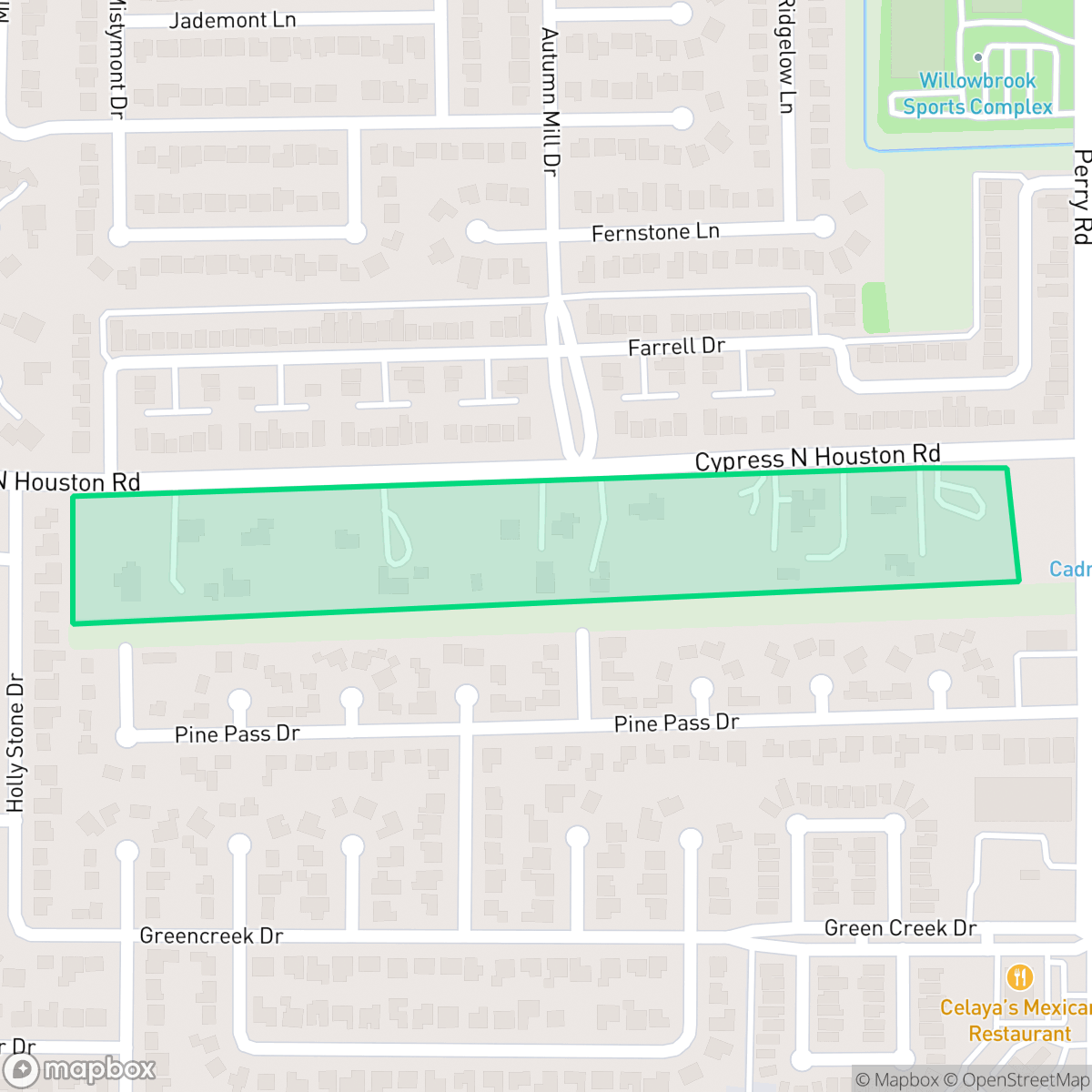
Flying Acres, located in Northwest Houston near Cypress North Houston Road, originated in the mid-1960s as a specialized 'fly-in' residential community. The neighborhood was centered around the Flying Acres Airfield, a private, unpaved east-west landing strip that allowed residents to store aircraft directly on their properties. Established by approximately 1965, the subdivision was characterized by large, unrestricted lots and traditional architecture, catering to aviation enthusiasts. While the airfield remained active through the 1980s, it was phased out by the early 2000s, leaving behind remnants of hangars and a clear runway path. Today, the area remains distinct for its spacious, semi-rural lots and its historical identity as a residential airpark.
The area maintains a distinct semi-rural character defined by its expansive residential plots and a visual landscape marked by mature trees and private swimming pools. Unlike the denser suburban developments found elsewhere in Houston, this community offers a quieter living environment with minimal traffic noise. The neighborhood benefits from wide utility easements and green drainage corridors that provide residents with accessible space for walking pets, despite the overall reliance on personal vehicles for transportation.
Families are served by the Cypress-Fairbanks Independent School District, which is recognized for strong academic programs and elite high schools, though the district is currently navigating budgetary and operational adjustments. Prospective residents should note that while the environment is calm, the proximity to industrial zones and potential groundwater concerns related to nearby environmental sites are factors to consider. This community is best suited for those seeking a spacious, conservative-leaning environment who prioritize privacy and a slower pace of life over proximity to urban lifestyle services.
Neighborhood Scores Across 15 Qualities
Residential plots offer a moderate level of separation with standard yard buffers and fenced backyards. According to iHuus data, this spacing provides more distance between neighbors than is typical for the Houston average.
Low traffic and safe crossings make internal streets pleasant for walking, although some sidewalks are obscured by a dense tree canopy. This level of walkability is slightly below the Houston average.
Large homes and a high density of private swimming pools contribute to a visual landscape that is more aesthetically pleasing than the Houston average. According to iHuus data, many properties feature expansive driveways and well-maintained suburban amenities.
Wide utility easements and continuous green drainage corridors provide ample space for walking dogs outside private yards. According to iHuus data, these grassy setbacks offer slightly less accessibility for pet owners than the Houston average.
Open land and scattered homes amid woodland are common here, making the landscape nearly identical to the Houston average in terms of density. Some areas transition into more traditional suburban developments with uniform single-family housing and commercial clusters.
Limited access to walkable shops and lifestyle services makes this area primarily car-oriented. According to iHuus data, the local level of activity and social vibrancy is lower than the Houston average.
Acoustic levels are notably lower than the Houston average, characterized by infrequent distant traffic and rare train sounds. According to iHuus data, this area provides a much calmer environment than most parts of the city.
Air quality fluctuates between acceptable and unhealthy levels, though conditions remain slightly better than the Houston average according to iHuus data. Sensitive groups should monitor local reports for occasional periods of concern.
Light industrial and commercial units exist alongside residential areas, though the neighborhood experiences a higher concentration of heavy industrial zones and freight traffic than the Houston average. According to iHuus data, the proximity to an EPA Superfund site may also present concerns regarding groundwater contaminants.
Health insurance access among residents is roughly average for the city of Houston. According to iHuus data, a significant portion of the population remains uninsured.
Conservative viewpoints hold a clear majority in this area, representing a notable shift toward more conservative politics than the Houston average according to iHuus data.
Residents live alongside a balanced blend of young adults, families, and older populations, mirroring the broader demographic spread found across Houston.
Residual flood risks exist within this area as it sits within a 500-year floodplain, which is consistent with the average risk levels found across Houston.
Address-Level Insights for Flying Acres


iHuus Neighborhood Intelligence Insights
Get address-level neighborhood insights for Flying Acres
- Street-level scores — see how individual blocks compare, not just neighborhood averages
- Micro-zone boundaries — identify quiet pockets, flood boundaries, and walkable clusters before you visit
- 15 dimensions in full — walkability, noise, air quality, school quality, insurance coverage, population age profile, urban/rural index, and more
- Boundary risk alerts — know if your address sits near a block boundary where scores drop, the kind of detail no listing will ever mention
- School insights — individual school ratings and insights, not just district-level data
- Compare before you commit — side-by-side data across neighborhoods, down to block precision
No credit card required
Compare with Any Neighborhood
| Dimension | Flying Acres | Acres Home |
|---|---|---|
| 🚶 Walkabilityavg 7.08 | ||
| 🔊 Acoustic Comfortavg 4.14 | ||
| 🤫 Privacy Indexavg 5.34 | ||
| 🎨 Visual Appealavg 6.42 | ||
| 🐕 Dog Friendlinessavg 6.33 | ||
| 🗺️ Urban-Rural Indexavg 6.64 | ||
| ✨ Neighborhood Vibeavg 4.4 | ||
| 🏥 Health Insurance Coverageavg 5.46 | ||
| 🌿 Air Qualityavg 3.58 | ||
| 🏭 Industrial Proximityavg 6.9 | ||
| 🌊 Flood Safetyavg 6.27 | ||
| 🗳️ Ideological Leanavg 6.39 | ||
| 👥 Population Age Profileavg 4.6 | ||
| 🔥 Fire Safety | ||
| 🏫 School Quality |
Flying Acres Rankings
School Districts Serving Flying Acres
School Insights for Flying Acres
Below average outcomes; significant attendance and academic challenges.
School Insights
See what's really behind every school rating near Flying Acres
- Individual school ratings — each school's own score with outcome context, not just a district average
- Enrollment & class size data — student-to-teacher ratio and how it compares to the state average
- Full demographics breakdown — ethnicity and gender composition for every school in the enrollment zone
- Every school in the district — all schools within the enrollment boundary ranked by rating, not just the closest one
- Grade levels & benchmarks — elementary through high school, with below/above state-average flags
No credit card required