Edgebrook Area, Houston
Updated · 22,014 residents
The Edgebrook Area is a dense, post-war suburban community in southeast Houston characterized by its grid-based street layout and proximity to the Gulf Freeway. While residents enjoy access to local parks and established school districts, the neighborhood features tightly packed housing with limited privacy and significant noise from surrounding road traffic.
Key Highlights
About Edgebrook Area
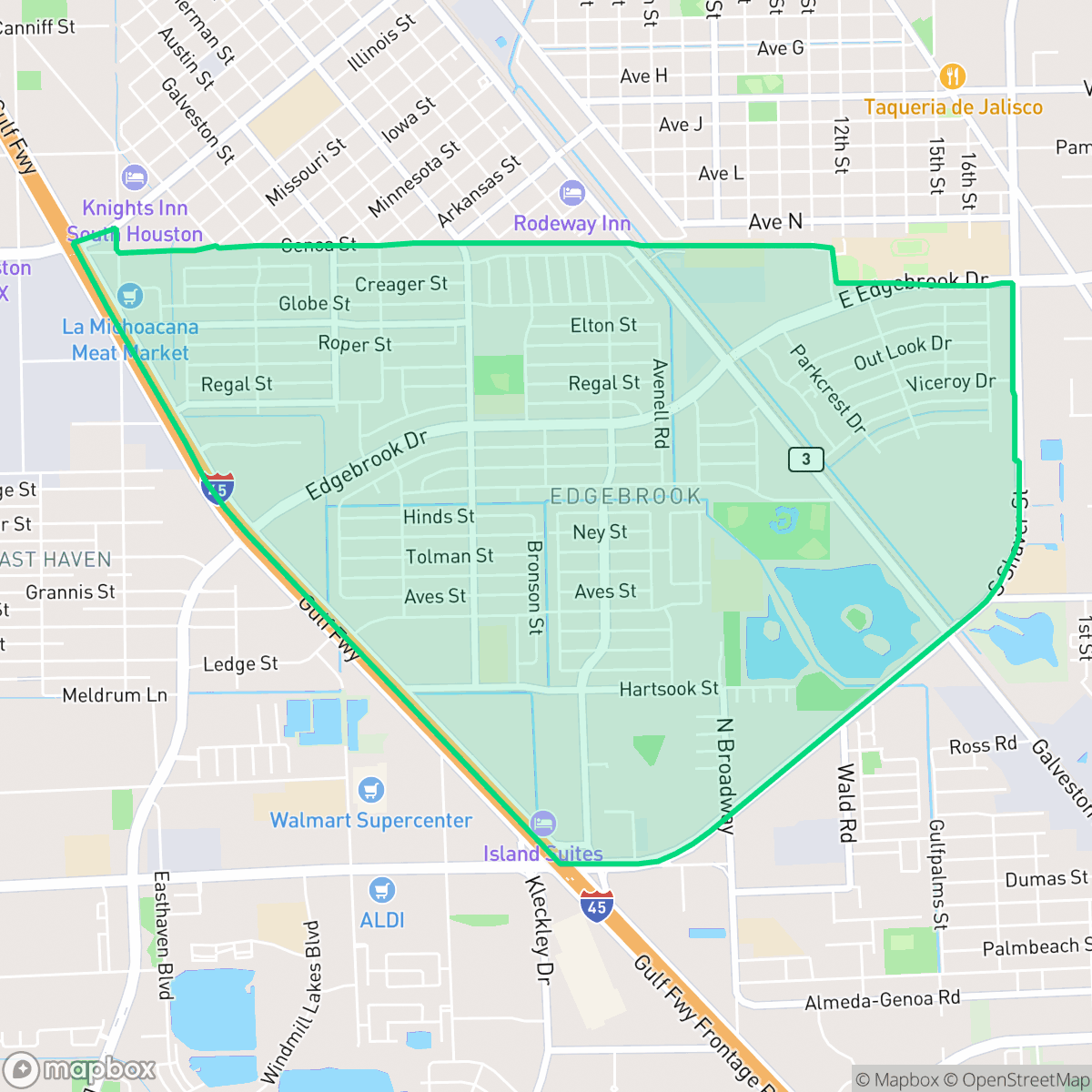
The Edgebrook Area in southeast Houston began to rapidly develop following the opening of the Gulf Freeway in 1948. Bounded by the freeway and South Shaver Street, the neighborhood is characterized by its post-World War II single-family subdivisions. Its oldest subdivision, Freeway Manor, was established in the early 1950s, followed closely by Gulfway Terrace, Sun Valley, and Arlington Heights. The area is bisected by State Highway 3 and features mid-century housing stock along with local landmarks like Freeway Manor Park, Wilson Memorial Park, and Saint Frances Cabrini Catholic Church. Due to its vulnerability to severe flooding, particularly after Hurricane Harvey, Edgebrook was selected as a pilot community for the city’s first Neighborhood Resilience Plan to improve infrastructure and environmental safety.
The Edgebrook Area functions as a classic dense suburban environment, blending single-family homes with apartment complexes and light industrial zones. Its layout is defined by a consistent grid of streets, though the presence of major arterial roads and the Gulf Freeway creates a car-dependent atmosphere. Residents benefit from the stability of the Pasadena Independent School District, which serves the local student population with reliable academic programs and specialized career training. Local landmarks such as Wilson Memorial Park and Freeway Manor Park provide essential green space within this industrial-adjacent suburban landscape.
Potential residents should note that the neighborhood experiences higher levels of ambient noise and lower air quality compared to the city average. Housing is closely spaced, offering minimal yard buffering, and the area faces ongoing challenges related to flood safety and environmental proximity to industrial sites. This location is best suited for those seeking established, affordable suburban housing with convenient access to major transit corridors, provided they are comfortable with a more industrial-adjacent environment.
Neighborhood Scores Across 15 Qualities
Residential density is higher than the Houston average, with houses and apartment structures often positioned with minimal distance between rooftops. According to iHuus data, many properties feature narrow side yards and limited buffering between neighbors.
Low-traffic residential streets provide a safe environment for walking, though the lack of a continuous sidewalk network makes it less walkable than the Houston average. Major arterial roads and heavy highway corridors can occasionally interrupt pedestrian paths throughout the area.
Standard tract housing and mid-range apartment complexes dominate the landscape with uniform rooflines and small yards. This area presents a more modest visual profile than the Houston average, characterized by high-density lot coverage and limited private greenery.
Large school sports fields and central public parks provide decent walking space, though the neighborhood falls below the Houston average due to narrow residential verges and limited park access in some areas. According to iHuus data, greenery is often concentrated in private backyards or utility corridors rather than along sidewalks.
Residential areas feature a classic suburban density with a blend of single-family homes, apartment complexes, and commercial zones. This landscape is largely comparable to the broader Houston area in terms of its balance of developed land and open space.
Suburban streets and green spaces are interspersed with light industrial units and railway corridors, creating a calm but car-dependent atmosphere. This steady, low-density rhythm is slightly more subdued than the average for Houston.
Frequent acoustic disturbances from nearby railroad tracks and heavy freeway traffic characterize this area. According to iHuus data, noise levels are notably higher than the Houston average.
Frequent periods of unhealthy air levels pose a significant risk to sensitive groups. According to iHuus data, air quality in this area is worse than the Houston average.
Industrial activity and logistics hubs are more prominent here than in the city average, featuring elements like warehouses, electrical substations, and heavy freight traffic. Residents should also note the proximity to an EPA Superfund site, which may impact local soil and groundwater quality.
Health insurance access is significantly lower here than the Houston average, according to iHuus data. Residents may face greater challenges accessing employer-sponsored or subsidized medical coverage compared to most of the city.
Political leanings in this area are evenly split between conservative and liberal residents, reflecting a landscape that is very similar to the broader Houston average.
Residents live alongside a balanced mix of young adults, families, and older populations. According to iHuus data, this age distribution is slightly lower than the Houston average.
Flood risk in this area is slightly higher than the Houston average due to a lack of detailed FEMA flood studies. Residents should remain cautious as the specific risk level remains undetermined according to iHuus data.
Address-Level Insights for Edgebrook Area


iHuus Neighborhood Intelligence Insights
Get address-level neighborhood insights for Edgebrook Area
- Street-level scores — see how individual blocks compare, not just neighborhood averages
- Micro-zone boundaries — identify quiet pockets, flood boundaries, and walkable clusters before you visit
- 15 dimensions in full — walkability, noise, air quality, school quality, insurance coverage, population age profile, urban/rural index, and more
- Boundary risk alerts — know if your address sits near a block boundary where scores drop, the kind of detail no listing will ever mention
- School insights — individual school ratings and insights, not just district-level data
- Compare before you commit — side-by-side data across neighborhoods, down to block precision
No credit card required
Compare with Any Neighborhood
| Dimension | Edgebrook Area | Acres Home |
|---|---|---|
| 🚶 Walkabilityavg 7.08 | ||
| 🔊 Acoustic Comfortavg 4.14 | ||
| 🤫 Privacy Indexavg 5.34 | ||
| 🎨 Visual Appealavg 6.42 | ||
| 🐕 Dog Friendlinessavg 6.33 | ||
| 🗺️ Urban-Rural Indexavg 6.64 | ||
| ✨ Neighborhood Vibeavg 4.4 | ||
| 🏥 Health Insurance Coverageavg 5.46 | ||
| 🌿 Air Qualityavg 3.58 | ||
| 🏭 Industrial Proximityavg 6.9 | ||
| 🌊 Flood Safetyavg 6.27 | ||
| 🗳️ Ideological Leanavg 6.39 | ||
| 👥 Population Age Profileavg 4.6 | ||
| 🔥 Fire Safety | ||
| 🏫 School Quality |
Edgebrook Area Rankings
School Districts Serving Edgebrook Area
School Insights for Edgebrook Area
Below average outcomes; significant attendance and academic challenges.
School Insights
See what's really behind every school rating near Edgebrook Area
- Individual school ratings — each school's own score with outcome context, not just a district average
- Enrollment & class size data — student-to-teacher ratio and how it compares to the state average
- Full demographics breakdown — ethnicity and gender composition for every school in the enrollment zone
- Every school in the district — all schools within the enrollment boundary ranked by rating, not just the closest one
- Grade levels & benchmarks — elementary through high school, with below/above state-average flags
No credit card required