Downtown, Houston
Updated · 19,218 residents
Downtown Houston serves as the city's vibrant corporate and civic core, defined by a dense skyline and historic architecture. Residents here experience a fast-paced urban lifestyle characterized by significant road noise and limited green space, making it best suited for those who prioritize proximity to work and nightlife over quiet residential living.
Key Highlights
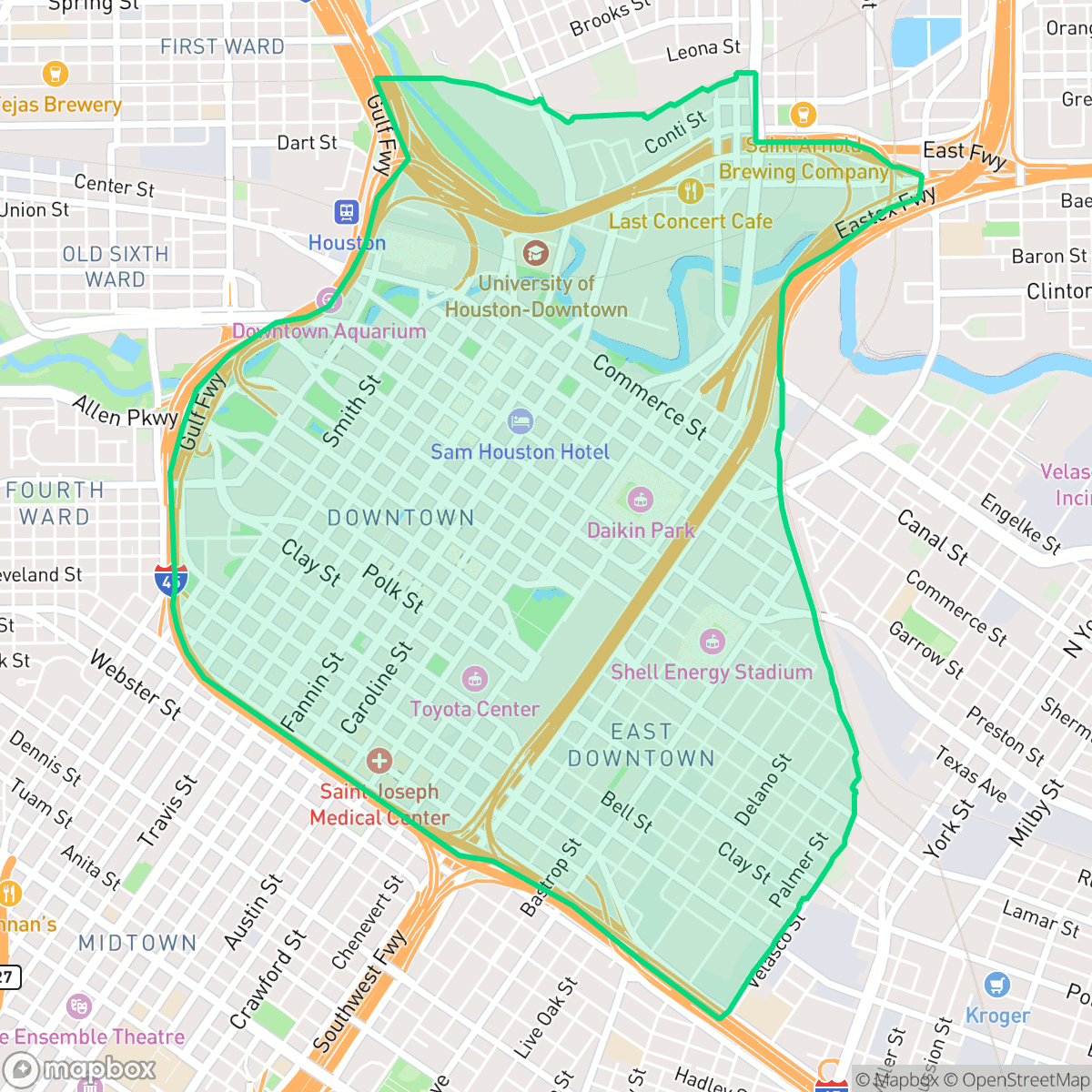
About Downtown
Downtown Houston, established in 1836 by brothers Augustus and John Kirby Allen, originated at the confluence of Buffalo and White Oak Bayous, now known as Allen’s Landing. As the city’s historic core and original port, the neighborhood served as the primary commercial and government center of the Republic of Texas. Its architectural character is defined by a blend of Victorian-era commercial buildings, such as those on Main Street, and prominent Art Deco landmarks like the Gulf Building. Throughout the 20th century, the area transitioned into a major corporate hub, undergoing significant urban renewal that introduced an extensive underground tunnel system connecting its skyscrapers. Today, the neighborhood preserves its heritage through the adaptive reuse of historic structures, including the iconic Rice Hotel, while maintaining its role as the city’s central civic and business district.
The neighborhood functions as a dynamic center for business, sports, and entertainment, featuring major venues and a dense collection of high-rise residential buildings. The area offers a unique energy that blends modern corporate life with remnants of the city's past, providing residents with immediate access to diverse dining and social hubs. While the skyline is impressive, the environment is dominated by concrete and infrastructure, resulting in a landscape that feels intensely built up and disconnected from natural settings, according to iHuus data.
Living in this area requires adjusting to a high-density environment where privacy is limited and ambient noise from highways and rail lines is a constant factor. Pedestrian movement can be challenging due to large-scale infrastructure that segments the sidewalk network, and pet owners may find the lack of accessible green space a notable drawback. This location is ideal for young professionals or individuals who value an active, central lifestyle and are willing to trade suburban quiet for the convenience of being at the heart of the city's transit and commercial activity.
Neighborhood Scores Across 15 Qualities
Dense urban configurations and shared-wall structures result in minimal residential buffering. According to iHuus data, privacy levels are below the Houston average due to the prevalence of closely packed apartment blocks and commercial buildings.
Pedestrian movement is hindered by massive highway interchanges and rail lines that sever the sidewalk network. While newer developments include visible walkways, the overall walkability is below the Houston average due to significant vehicle-oriented infrastructure.
Large-scale sports venues and modern apartment blocks define the visual landscape, though the area contains many industrial warehouses and surface lots. According to iHuus data, the architectural variety is slightly below the Houston average.
Extensive concrete surfaces and highway infrastructure dominate the landscape, providing fewer grassy areas for pets compared to the city average. While some river trails exist, much of the greenery is private or limited to small pockets surrounded by dense urban development.
High-rise buildings, major highways, and industrial infrastructure dominate the landscape, resulting in a much more built-up environment than the Houston average. Minimal green space is available due to the prevalence of concrete surfaces and large commercial blocks, according to iHuus data.
Lively social hubs and diverse dining options exist alongside quieter, industrial, and suburban pockets. This variety of energy and activity is more pronounced here than the city average, according to iHuus data.
Frequent disturbances from nearby highways and rail lines characterize the area. According to iHuus data, acoustic comfort is significantly lower than the Houston average.
Air quality levels fluctuate between acceptable and unhealthy periods, presenting occasional concerns for sensitive groups. According to iHuus data, conditions in this area are slightly better than the Houston average.
Active commercial services and light utility traffic are present alongside residential areas, though this level of industrial proximity is lower than the Houston average. Residents should be aware of occasional loading activity and the presence of a nearby EPA Superfund site which may impact local soil and groundwater.
Health insurance accessibility among residents is lower than the Houston average, according to iHuus data. This reflects a higher proportion of uninsured individuals compared to most other parts of the city.
Voting patterns and census indicators show a significantly more liberal leaning than the rest of Houston. According to iHuus data, the area maintains a predominant liberal political profile.
Residents live alongside a balanced mix of young professionals, families, and seniors. This age distribution is largely consistent with the broader Houston area, according to iHuus data.
Residual flood risk exists within this area as it sits within a 500-year floodplain; however, the safety level remains slightly above the Houston city average according to iHuus data.
Address-Level Insights for Downtown


iHuus Neighborhood Intelligence Insights
Get address-level neighborhood insights for Downtown
- Street-level scores — see how individual blocks compare, not just neighborhood averages
- Micro-zone boundaries — identify quiet pockets, flood boundaries, and walkable clusters before you visit
- 15 dimensions in full — walkability, noise, air quality, school quality, insurance coverage, population age profile, urban/rural index, and more
- Boundary risk alerts — know if your address sits near a block boundary where scores drop, the kind of detail no listing will ever mention
- School insights — individual school ratings and insights, not just district-level data
- Compare before you commit — side-by-side data across neighborhoods, down to block precision
No credit card required
Compare with Any Neighborhood
| Dimension | Downtown | Acres Home |
|---|---|---|
| 🚶 Walkabilityavg 7.08 | ||
| 🔊 Acoustic Comfortavg 4.14 | ||
| 🤫 Privacy Indexavg 5.34 | ||
| 🎨 Visual Appealavg 6.42 | ||
| 🐕 Dog Friendlinessavg 6.33 | ||
| 🗺️ Urban-Rural Indexavg 6.64 | ||
| ✨ Neighborhood Vibeavg 4.4 | ||
| 🏥 Health Insurance Coverageavg 5.46 | ||
| 🌿 Air Qualityavg 3.58 | ||
| 🏭 Industrial Proximityavg 6.9 | ||
| 🌊 Flood Safetyavg 6.27 | ||
| 🗳️ Ideological Leanavg 6.39 | ||
| 👥 Population Age Profileavg 4.6 | ||
| 🔥 Fire Safety | ||
| 🏫 School Quality |
Downtown Rankings
School Districts Serving Downtown
School Insights for Downtown
Below average outcomes; significant attendance and academic challenges.
School Insights
See what's really behind every school rating near Downtown
- Individual school ratings — each school's own score with outcome context, not just a district average
- Enrollment & class size data — student-to-teacher ratio and how it compares to the state average
- Full demographics breakdown — ethnicity and gender composition for every school in the enrollment zone
- Every school in the district — all schools within the enrollment boundary ranked by rating, not just the closest one
- Grade levels & benchmarks — elementary through high school, with below/above state-average flags
No credit card required