Copperfield Westcreek Village, Houston
Updated · 2,512 residents
Copperfield Westcreek Village is a well-maintained suburban enclave known for its extensive network of pedestrian paths and mature tree canopy. While the area offers a highly walkable environment with a polished aesthetic, residents should be prepared for frequent noise from nearby regional transit corridors.
Key Highlights
About Copperfield Westcreek Village
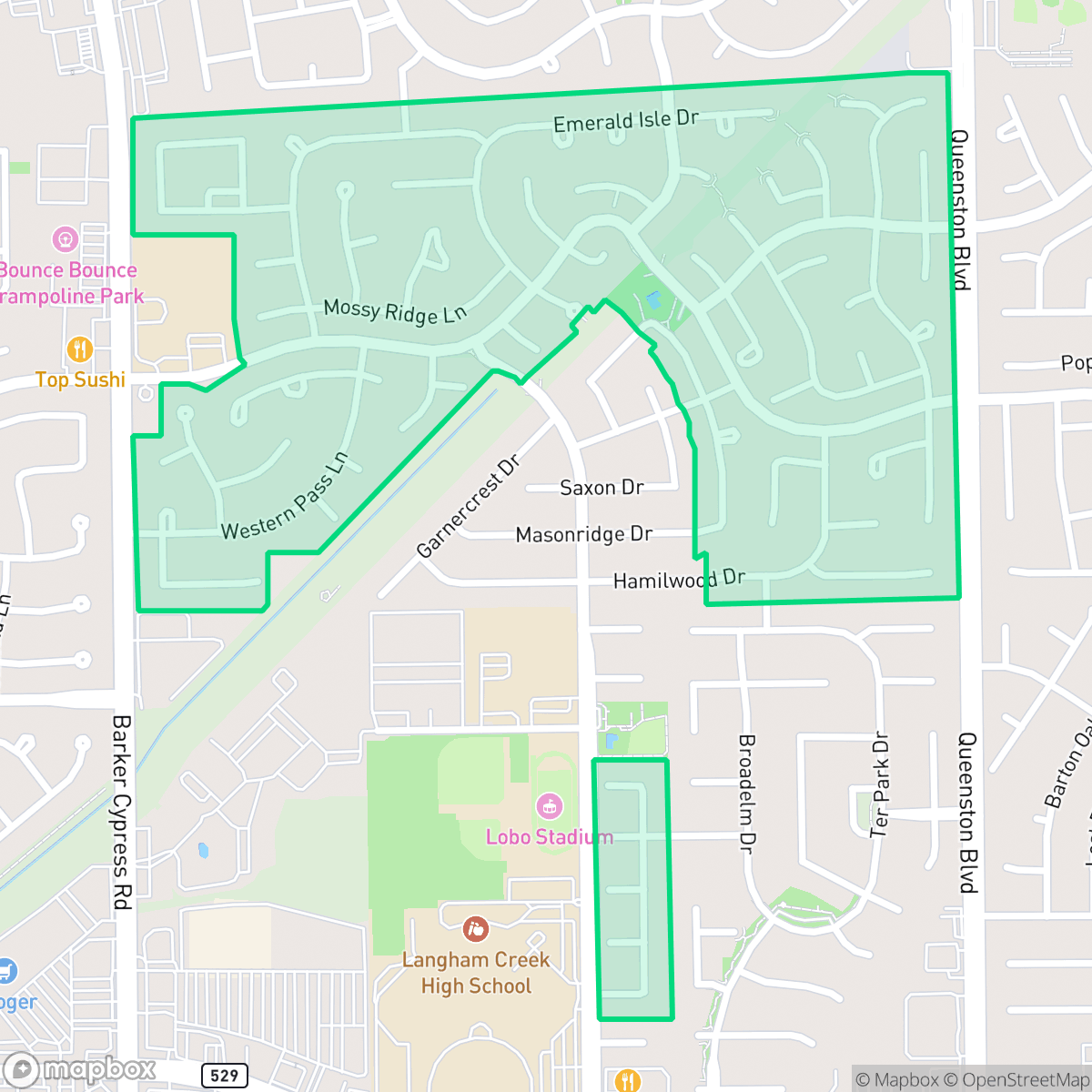
Copperfield Westcreek Village is one of seven distinct villages within Copperfield, a 2,000-acre master-planned community in northwest Harris County. The broader Copperfield development was established in 1977 when the Friendswood Development Company acquired 1,800 acres of former farmland from the Gus Wortham estate. Designed to define the region's suburban growth, the community was developed in phases throughout the 1980s and 1990s. Westcreek Village, like its counterparts, was integrated into a cohesive layout characterized by mature trees, extensive greenbelts, and shared recreational amenities. The village is served by the Cypress-Fairbanks Independent School District, with local schools such as Copeland Elementary and Aragon Middle School, and remains defined by its suburban residential identity and strategic location near State Highway 6 and FM 529.
The area features a consistent suburban layout with manicured lawns and a high density of private pools that contribute to a visually cohesive environment. Its design prioritizes pedestrian connectivity through integrated greenbelts and sidewalks, allowing for safe movement throughout the community. Residents benefit from a residential atmosphere that remains largely free from heavy industrial activity, fostering a stable living environment that balances privacy with shared recreational access. According to iHuus data, the neighborhood maintains a higher level of health insurance coverage and a demographic mix that includes a balanced range of young adults, families, and older residents. Prospective residents should consider the trade-offs associated with the location, specifically regarding acoustic comfort. The proximity to major freeways and rail lines results in frequent traffic noise, which contrasts with the otherwise tranquil residential setting. While the area offers significant advantages in walkability and aesthetic appeal, it is best suited for those who prioritize established suburban infrastructure and pedestrian-friendly streets over absolute silence.
Neighborhood Scores Across 15 Qualities
Residential spacing offers a moderate level of seclusion that is slightly higher than the Houston average. While some homes are closely situated, many properties benefit from green buffers or fenced yards that provide distinct separation between neighbors.
Extensive sidewalk networks on both sides of residential streets and dedicated internal green paths provide much safer pedestrian connectivity than the Houston average. According to iHuus data, the presence of ample crossings and pedestrian-priority areas makes navigating the area on foot very reliable.
Manicured lawns, complex rooflines, and a high density of private swimming pools contribute to a visual landscape that is notably more polished than the Houston average. According to iHuus data, the area features large, well-maintained residences and premium amenities.
Extensive green utility corridors and wide sidewalk verges provide ample space for pets, making this area more dog friendly than the Houston average. Continuous paths and grass-lined drainage canals offer safe routes away from traffic for regular exercise.
Low-density residential layouts and significant tree canopy coverage characterize this area. This suburban environment is largely in line with the broader Houston area.
Diverse dining and social hubs provide more activity than the typical Houston neighborhood, though many amenities require a car to reach. While some pockets offer walkable access to local services, much of the area is characterized by a quiet, suburban atmosphere near green spaces and water.
Frequent noise from nearby major freeways and rail lines characterizes this area. Acoustic levels are noticeably higher than the Houston average, according to iHuus data.
Air quality in this area fluctuates between acceptable and unhealthy levels, though it remains slightly better than the average for Houston. Sensitive groups may experience occasional concerns during certain periods, according to iHuus data.
Industrial presence is minimal, providing a quiet environment that is notably cleaner of heavy industry than the Houston average. While some light commercial warehouses and utility facilities exist nearby, the area remains predominantly residential with very little heavy industrial activity.
Health insurance access among residents is notably higher than the Houston average, according to iHuus data. This indicates a greater proportion of the population has access to medical coverage.
Conservative-leaning residents form the majority here, reflecting a political landscape that is notably more conservative than the Houston average according to iHuus data.
Residents live alongside a balanced mix of young adults, families, and older populations. This demographic variety is largely consistent with the broader Houston area, according to iHuus data.
Residual flood risk exists due to being within a 500-year floodplain, though safety levels remain above the Houston average according to iHuus data.
Address-Level Insights for Copperfield Westcreek Village


iHuus Neighborhood Intelligence Insights
Get address-level neighborhood insights for Copperfield Westcreek Village
- Street-level scores — see how individual blocks compare, not just neighborhood averages
- Micro-zone boundaries — identify quiet pockets, flood boundaries, and walkable clusters before you visit
- 15 dimensions in full — walkability, noise, air quality, school quality, insurance coverage, population age profile, urban/rural index, and more
- Boundary risk alerts — know if your address sits near a block boundary where scores drop, the kind of detail no listing will ever mention
- School insights — individual school ratings and insights, not just district-level data
- Compare before you commit — side-by-side data across neighborhoods, down to block precision
No credit card required
Compare with Any Neighborhood
| Dimension | Copperfield Westcreek Village | Acres Home |
|---|---|---|
| 🚶 Walkabilityavg 7.08 | ||
| 🔊 Acoustic Comfortavg 4.14 | ||
| 🤫 Privacy Indexavg 5.34 | ||
| 🎨 Visual Appealavg 6.42 | ||
| 🐕 Dog Friendlinessavg 6.33 | ||
| 🗺️ Urban-Rural Indexavg 6.64 | ||
| ✨ Neighborhood Vibeavg 4.4 | ||
| 🏥 Health Insurance Coverageavg 5.46 | ||
| 🌿 Air Qualityavg 3.58 | ||
| 🏭 Industrial Proximityavg 6.9 | ||
| 🌊 Flood Safetyavg 6.27 | ||
| 🗳️ Ideological Leanavg 6.39 | ||
| 👥 Population Age Profileavg 4.6 | ||
| 🔥 Fire Safety | ||
| 🏫 School Quality |
Copperfield Westcreek Village Rankings
School Districts Serving Copperfield Westcreek Village
School Insights for Copperfield Westcreek Village
Below average outcomes; significant attendance and academic challenges.
School Insights
See what's really behind every school rating near Copperfield Westcreek Village
- Individual school ratings — each school's own score with outcome context, not just a district average
- Enrollment & class size data — student-to-teacher ratio and how it compares to the state average
- Full demographics breakdown — ethnicity and gender composition for every school in the enrollment zone
- Every school in the district — all schools within the enrollment boundary ranked by rating, not just the closest one
- Grade levels & benchmarks — elementary through high school, with below/above state-average flags
No credit card required