Chinatown, Houston
Updated · 16,469 residents
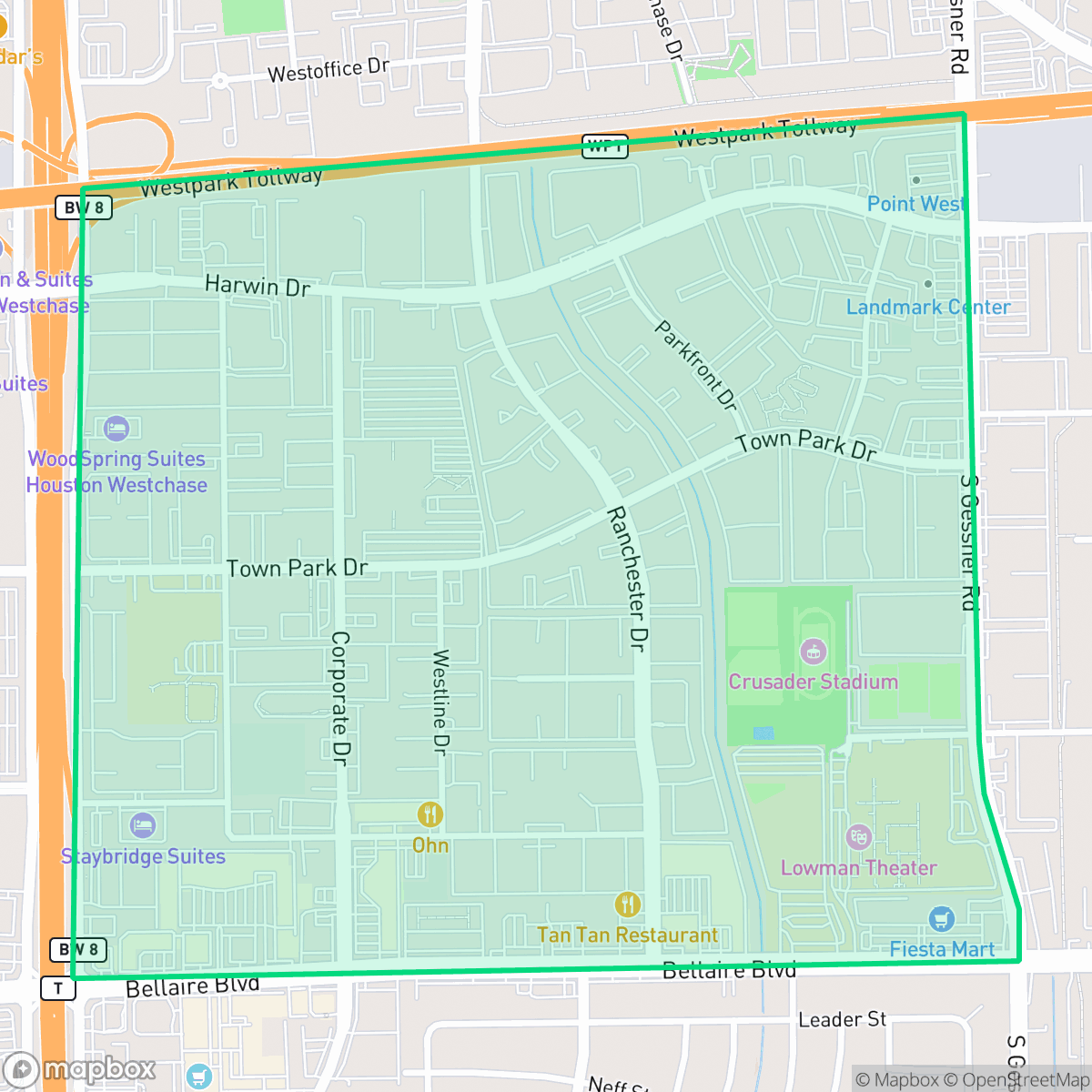
Houston's Chinatown is a vibrant, pan-Asian commercial corridor known for its dense concentration of diverse dining, markets, and social hubs along Bellaire Boulevard. While the area offers a lively atmosphere, it is a car-dependent environment characterized by high-density apartment living and significant road traffic.
Key Highlights
About Chinatown
Houston’s Chinatown historically evolved through two distinct eras. The original Chinatown emerged in downtown during the 1930s, centering on Chartres Street in East Downtown (EaDo) after the On Leong Chinese Merchants Association relocated there in 1951. However, the 1981 construction of the George R. Brown Convention Center and rising property values catalyzed its decline. In 1983, the neighborhood migrated southwest to Bellaire Boulevard in the Alief area, where developers Kenneth Li and T.D. Wong opened Diho Market, the district's first Asian supermarket. The area rapidly expanded into a sprawling, multi-mile commercial corridor. The opening of the massive Hong Kong City Mall in 1999 solidified its transition into a diverse, pan-Asian hub, today widely known as Asiatown.
This neighborhood serves as a major cultural and economic hub, defined by its sprawling multi-mile stretch of businesses, restaurants, and shopping centers. The area maintains a high-energy environment where residents have immediate access to a wide array of international cuisine and retail options. According to iHuus data, the architectural landscape consists primarily of dense multi-family apartment complexes and commercial blocks, reflecting a suburban layout that prioritizes utility over pedestrian connectivity. Living in this district requires a reliance on personal vehicles, as the infrastructure features discontinuous sidewalks and busy intersections that limit walkability. Prospective residents should also consider that the neighborhood faces challenges with flood safety and noise levels from constant road traffic. While the area offers a unique cultural experience, the local school districts present a mixed academic landscape, and the proximity to industrial zones and nearby environmental sites are factors to weigh when choosing a home.
Neighborhood Scores Across 15 Qualities
Close quarters and shared walls are common throughout the area, resulting in a lower level of privacy than the Houston average. According to iHuus data, many residents live in high density apartment clusters or detached homes with minimal separation between structures.
Navigating the area on foot is challenging due to fragmented sidewalks and large, high-traffic highway intersections. According to iHuus data, the pedestrian environment is less accessible than the Houston average.
The area features a mix of dense apartment complexes, industrial warehouses, and standard suburban housing. According to iHuus data, the visual landscape is slightly below the Houston average due to the prevalence of utilitarian roof geometries and smaller residential yards.
Available green space for pets is slightly below the city average, though residents can utilize large school sports fields and various grassy verges found throughout the area. According to iHuus data, some sections offer larger park-like environments, while other high-density areas feature limited greenery mostly confined to apartment landscaping.
Primarily comprised of dense suburban landscapes, this area features a significant amount of multi-family housing, office parks, and commercial zones. The level of open land and low-density development is roughly consistent with the Houston average, according to iHuus data.
Diverse dining and social hubs provide a higher level of activity than the Houston average, though the suburban layout remains heavily dependent on vehicle travel. According to iHuus data, the area offers a vibrant mix of international eateries and essential services set against a backdrop of industrial and green spaces.
Consistent noise from nearby thoroughfares is typical for this area, mirroring the general acoustic levels found across Houston. According to iHuus data, the auditory environment remains largely comparable to the city average.
Air quality levels fluctuate between acceptable and unhealthy, which may cause occasional concern for sensitive groups. According to iHuus data, the air quality in this area is slightly better than the Houston average.
Light commercial and residential zones are interspersed with heavy industrial areas characterized by significant freight traffic. According to iHuus data, the presence of industrial facilities and a nearby Superfund site means this area has a higher industrial density than the Houston average.
Health insurance coverage among residents is significantly lower than the Houston average, according to iHuus data. Access to employer-sponsored or private medical coverage is notably sparse within this community.
Political leanings in this area align closely with the broader Houston area, characterized by a liberal majority alongside a modest presence of opposing viewpoints.
Residents live among a diverse range of age groups, including young adults, families, and seniors. This demographic distribution is consistent with the broader Houston area, according to iHuus data.
Flood safety levels in this area are lower than the Houston average due to a lack of detailed federal studies for this specific zone. According to iHuus data, the risk remains uncertain as official flood maps have not yet been fully updated for this location.
Address-Level Insights for Chinatown


iHuus Neighborhood Intelligence Insights
Get address-level neighborhood insights for Chinatown
- Street-level scores — see how individual blocks compare, not just neighborhood averages
- Micro-zone boundaries — identify quiet pockets, flood boundaries, and walkable clusters before you visit
- 15 dimensions in full — walkability, noise, air quality, school quality, insurance coverage, population age profile, urban/rural index, and more
- Boundary risk alerts — know if your address sits near a block boundary where scores drop, the kind of detail no listing will ever mention
- School insights — individual school ratings and insights, not just district-level data
- Compare before you commit — side-by-side data across neighborhoods, down to block precision
No credit card required
Compare with Any Neighborhood
| Dimension | Chinatown | Acres Home |
|---|---|---|
| 🚶 Walkabilityavg 7.08 | ||
| 🔊 Acoustic Comfortavg 4.14 | ||
| 🤫 Privacy Indexavg 5.34 | ||
| 🎨 Visual Appealavg 6.42 | ||
| 🐕 Dog Friendlinessavg 6.33 | ||
| 🗺️ Urban-Rural Indexavg 6.64 | ||
| ✨ Neighborhood Vibeavg 4.4 | ||
| 🏥 Health Insurance Coverageavg 5.46 | ||
| 🌿 Air Qualityavg 3.58 | ||
| 🏭 Industrial Proximityavg 6.9 | ||
| 🌊 Flood Safetyavg 6.27 | ||
| 🗳️ Ideological Leanavg 6.39 | ||
| 👥 Population Age Profileavg 4.6 | ||
| 🔥 Fire Safety | ||
| 🏫 School Quality |
Chinatown Rankings
School Districts Serving Chinatown
School Insights for Chinatown
Below average outcomes; significant attendance and academic challenges.
School Insights
See what's really behind every school rating near Chinatown
- Individual school ratings — each school's own score with outcome context, not just a district average
- Enrollment & class size data — student-to-teacher ratio and how it compares to the state average
- Full demographics breakdown — ethnicity and gender composition for every school in the enrollment zone
- Every school in the district — all schools within the enrollment boundary ranked by rating, not just the closest one
- Grade levels & benchmarks — elementary through high school, with below/above state-average flags
No credit card required