Briargrove, Houston
Updated · 4,779 residents
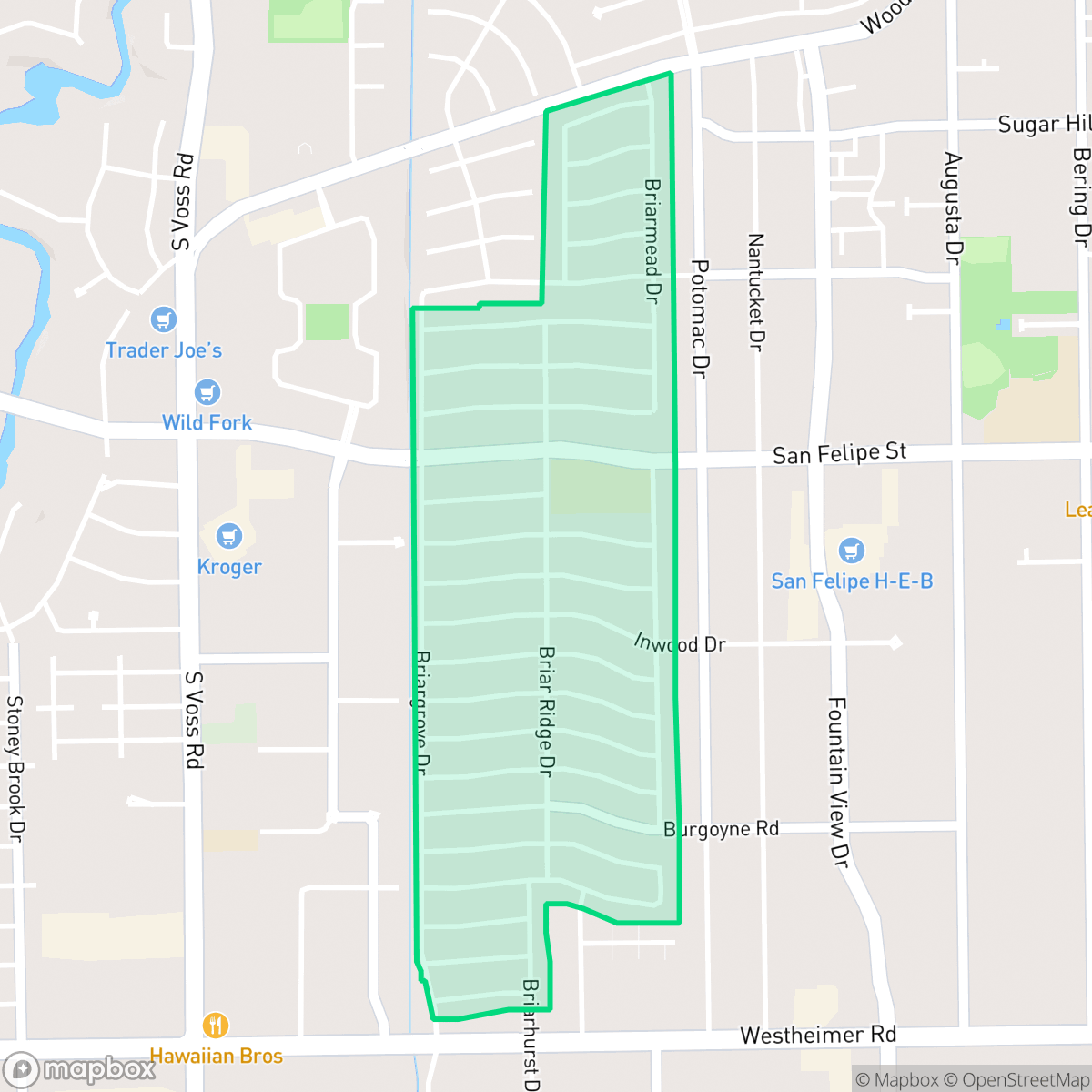
Briargrove is a dense, affluent residential community characterized by its high walkability and well-manicured landscape. While it offers a vibrant suburban atmosphere, residents experience limited privacy due to closely spaced homes and a lack of public green space.
Key Highlights
About Briargrove
Established in 1948 on the former Peckham family farm, Briargrove began as a quiet subdivision located well outside Houston's city limits. The neighborhood was developed throughout the 1950s and 1960s, characterized by single-story mid-century ranch homes situated on generous lots shaded by mature live oaks. A major architectural transformation occurred after 1986, when neighborhood deed restrictions were modified to permit 1.5- and two-story structures, prompting the replacement of many original ranch houses with larger custom homes. At the heart of the community is Briargrove Elementary School, which opened in 1958 and remains a central neighborhood landmark and gathering spot.
The neighborhood maintains a distinct suburban character defined by its lack of industrial presence and high visual appeal. According to iHuus data, the area features a robust sidewalk network that supports high walkability, making it easy for residents to navigate the residential grid. The community is largely defined by its residential layout, which integrates single-family homes with larger apartment complexes, creating a dense but cohesive environment that remains free from industrial facilities.
Prospective residents should note that the high density results in reduced acoustic comfort, with road traffic contributing to a steady ambient noise level. While the area boasts excellent flood safety and high rates of health insurance coverage, the limited public green space and narrow sidewalk verges present challenges for pet owners. It is an ideal setting for those prioritizing school access and a managed, affluent aesthetic over total seclusion.
Neighborhood Scores Across 15 Qualities
Building density is higher than the Houston average, with many residences featuring shared walls or minimal distance between neighbors. According to iHuus data, various areas contain closely spaced homes and apartment blocks with very small setbacks.
Sidewalks are available on many residential streets and near main roads, though crossing large arterial intersections can be difficult. According to iHuus data, the overall connectivity for pedestrians is slightly below the Houston average.
Large homes with complex rooflines and private swimming pools contribute to a visual landscape that is more aesthetically pleasing than the Houston average. Well-maintained grounds and spacious properties are common throughout the area, according to iHuus data.
Private backyards are plentiful, but public green space and wide walking verges are below the Houston average. According to iHuus data, greenery is largely restricted to private yards and gated apartment courtyards.
A variety of single-family homes, large apartment complexes, and commercial shopping centers create a dense suburban landscape. This level of development is largely consistent with the broader Houston area according to iHuus data.
A mix of lively dining pockets and quiet residential streets provides a more active atmosphere than the Houston average. While diverse restaurant options are available, many amenities require a short drive as they are not all within walking distance.
Frequent noise from nearby major freeways and transit corridors is common in this area. According to iHuus data, acoustic comfort in Briargrove is lower than the Houston city average.
Air quality levels fluctuate between acceptable and unhealthy, presenting occasional concerns for sensitive groups. According to iHuus data, the atmospheric conditions in Briargrove are slightly better than the Houston city average.
Industrial presence is minimal in Briargrove, as the area consists almost entirely of residential, retail, and recreational land use. This lack of heavy industry and warehouses is notably lower than the Houston average, according to iHuus data.
Health insurance enrollment among residents is notably higher than the Houston average, according to iHuus data. This indicates a greater level of access to medical coverage within the community.
Political leanings in this area are notably more conservative than the Houston average. According to iHuus data, the neighborhood maintains a conservative majority with a modest opposing presence.
Residents live alongside a balanced mix of young professionals, families, and seniors. According to iHuus data, this age distribution is more varied than the average found across Houston.
Flood risk is notably lower here than the Houston average, though some residual risk remains within the 500-year floodplain according to iHuus data.
Address-Level Insights for Briargrove


iHuus Neighborhood Intelligence Insights
Get address-level neighborhood insights for Briargrove
- Street-level scores — see how individual blocks compare, not just neighborhood averages
- Micro-zone boundaries — identify quiet pockets, flood boundaries, and walkable clusters before you visit
- 15 dimensions in full — walkability, noise, air quality, school quality, insurance coverage, population age profile, urban/rural index, and more
- Boundary risk alerts — know if your address sits near a block boundary where scores drop, the kind of detail no listing will ever mention
- School insights — individual school ratings and insights, not just district-level data
- Compare before you commit — side-by-side data across neighborhoods, down to block precision
No credit card required
Compare with Any Neighborhood
| Dimension | Briargrove | Acres Home |
|---|---|---|
| 🚶 Walkabilityavg 7.08 | ||
| 🔊 Acoustic Comfortavg 4.14 | ||
| 🤫 Privacy Indexavg 5.34 | ||
| 🎨 Visual Appealavg 6.42 | ||
| 🐕 Dog Friendlinessavg 6.33 | ||
| 🗺️ Urban-Rural Indexavg 6.64 | ||
| ✨ Neighborhood Vibeavg 4.4 | ||
| 🏥 Health Insurance Coverageavg 5.46 | ||
| 🌿 Air Qualityavg 3.58 | ||
| 🏭 Industrial Proximityavg 6.9 | ||
| 🌊 Flood Safetyavg 6.27 | ||
| 🗳️ Ideological Leanavg 6.39 | ||
| 👥 Population Age Profileavg 4.6 | ||
| 🔥 Fire Safety | ||
| 🏫 School Quality |
Briargrove Rankings
School Districts Serving Briargrove
School Insights for Briargrove
Below average outcomes; significant attendance and academic challenges.
School Insights
See what's really behind every school rating near Briargrove
- Individual school ratings — each school's own score with outcome context, not just a district average
- Enrollment & class size data — student-to-teacher ratio and how it compares to the state average
- Full demographics breakdown — ethnicity and gender composition for every school in the enrollment zone
- Every school in the district — all schools within the enrollment boundary ranked by rating, not just the closest one
- Grade levels & benchmarks — elementary through high school, with below/above state-average flags
No credit card required