Briarforest Area, Houston
Updated · 49,080 residents
Briarforest is a wooded, suburban community in Houston defined by its proximity to Terry Hershey Park and the scenic Buffalo Bayou. The area offers high walkability and strong visual appeal, characterized by a mix of 1970s soft contemporary homes and modern apartment complexes.
Key Highlights
About Briarforest Area
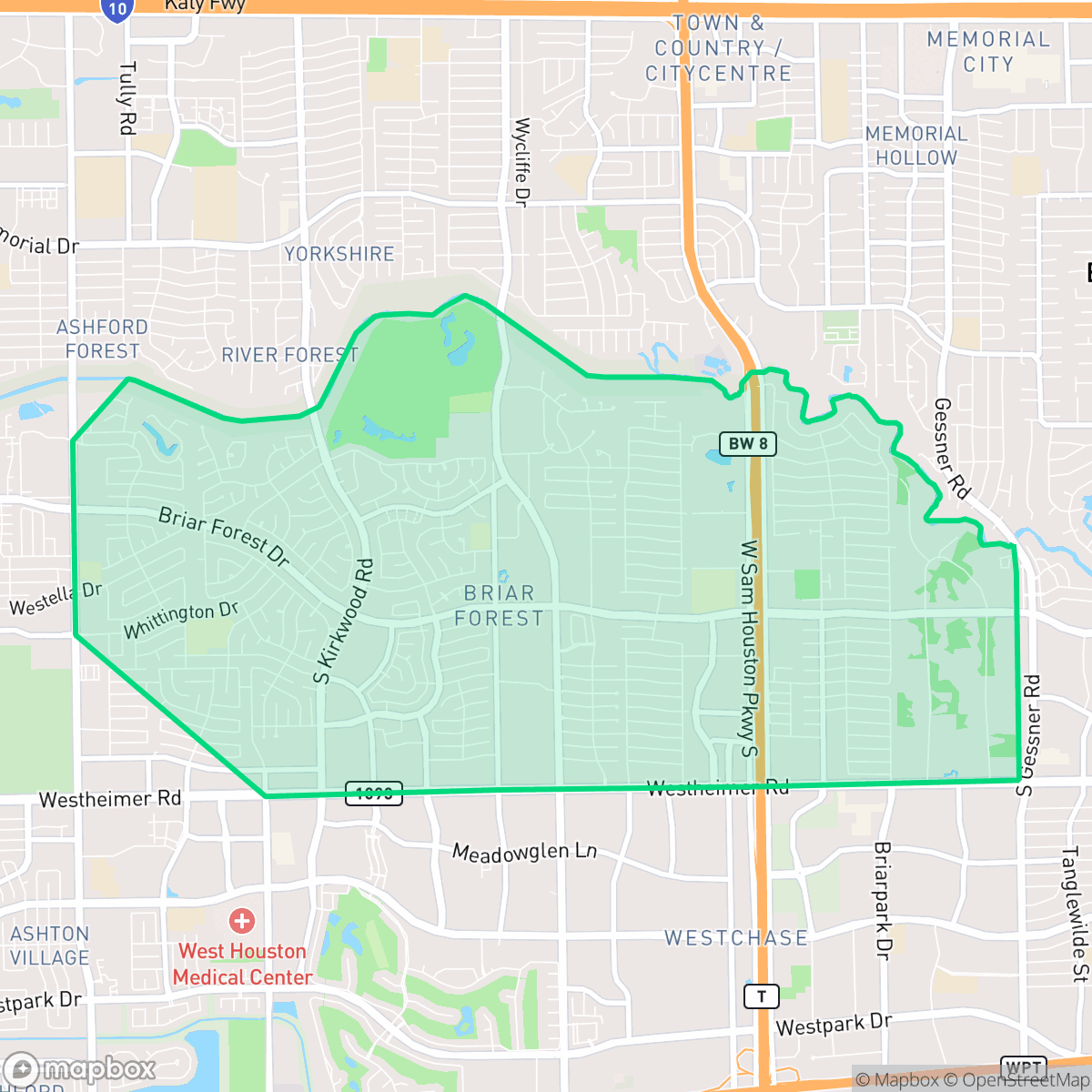
Bounded by Buffalo Bayou, Gessner Road, Westheimer Road, and Dairy Ashford Road, Houston’s Briarforest Area was historically a rural passage defined by cotton and rice farming. Prior to World War II, travelers crossed Buffalo Bayou en route to Alief or the Habermacher ranch. In the 1960s, developer Walter Mischer, Sr. catalyzed the area's transformation, replacing agricultural lands with forested bedroom communities like Briargrove Park, Ashford, and Lakeside. Westheimer Road subsequently evolved from a quiet two-lane road into a major commercial corridor. Architecturally, Briarforest is known for its late-1970s and 1980s "soft contemporary" and innovative patio homes, which offered modern layouts that contrasted with traditional styles. Today, the neighborhood maintains its distinct wooded character, anchored by its proximity to the scenic Buffalo Bayou and Terry Hershey Park.
The area benefits from extensive sidewalk connectivity and mature tree canopies, which foster a pedestrian-friendly environment rarely found in similar suburban settings. Residents have access to a variety of housing types, ranging from established single-family homes with private pools to denser multi-family developments. According to iHuus data, the neighborhood maintains a balanced urban-rural feel, blending quiet residential streets with convenient access to major commercial corridors like Westheimer Road.
Prospective residents should consider the trade-offs between the area's aesthetic appeal and its proximity to major infrastructure. While the neighborhood enjoys high flood safety and strong school options like Shadowbriar Elementary, some sectors are located near environmental sites that warrant attention. The community is best suited for families and professionals who prioritize outdoor access and an established suburban atmosphere over a high-density nightlife scene.
Neighborhood Scores Across 15 Qualities
Residential spacing varies significantly across the area, ranging from dense apartment complexes with shared walls to detached single-family homes with moderate buffers. This level of privacy is slightly higher than the Houston average due to the presence of larger lots and wooded estates in certain sectors.
Residential streets feature a consistent sidewalk network and shaded paths through greenbelts, though high-traffic arterials can make crossing between sectors difficult. This level of connectivity is slightly above the Houston average according to iHuus data.
Expansive homes with manicured landscapes, private pools, and mature tree canopies provide a highly aesthetic environment. This level of visual greenery and architectural variety is notably higher than the Houston average, according to iHuus data.
Extensive green corridors, golf courses, and wide grass verges provide ample space for walking dogs. According to iHuus data, the availability of continuous shaded paths and connected green spaces is slightly above the Houston average.
Residential layouts here consist of a mix of single-family homes, apartment complexes, and commercial strips. This environment is slightly more open than the typical Houston urban landscape, featuring a notable amount of greenery and interspersed woodland.
A balanced mix of residential streets and green space provides a consistent level of activity that is slightly above the Houston average. While diverse dining and local services are available, many areas remain car-dependent for most errands.
A steady hum of local traffic from nearby busy streets is present. This level of acoustic activity is slightly higher than the Houston average, according to iHuus data.
Air quality in this area fluctuates between acceptable and unhealthy levels, though it remains slightly better than the Houston average according to iHuus data. Sensitive groups may experience occasional concern during certain periods.
Residential and light commercial zones dominate the landscape, providing a cleaner environment than the Houston average. While most of the area is free from heavy industry, some sections are located near a wastewater treatment plant and a nearby Superfund site, according to iHuus data.
Health insurance access is more prevalent in this area than in the rest of Houston, according to iHuus data.
Political views within this area are split relatively evenly between conservative and liberal leanings, making it less partisan than the Houston average according to iHuus data.
A balanced mix of young adults, families, and older residents defines the local community. This demographic spread is slightly more varied than the average found across Houston, according to iHuus data.
Flood risk in this area remains uncertain because a detailed FEMA study has not yet been completed for the neighborhood. According to iHuus data, this level of risk is slightly higher than the Houston city average.
Address-Level Insights for Briarforest Area


iHuus Neighborhood Intelligence Insights
Get address-level neighborhood insights for Briarforest Area
- Street-level scores — see how individual blocks compare, not just neighborhood averages
- Micro-zone boundaries — identify quiet pockets, flood boundaries, and walkable clusters before you visit
- 15 dimensions in full — walkability, noise, air quality, school quality, insurance coverage, population age profile, urban/rural index, and more
- Boundary risk alerts — know if your address sits near a block boundary where scores drop, the kind of detail no listing will ever mention
- School insights — individual school ratings and insights, not just district-level data
- Compare before you commit — side-by-side data across neighborhoods, down to block precision
No credit card required
Compare with Any Neighborhood
| Dimension | Briarforest Area | Acres Home |
|---|---|---|
| 🚶 Walkabilityavg 7.08 | ||
| 🔊 Acoustic Comfortavg 4.14 | ||
| 🤫 Privacy Indexavg 5.34 | ||
| 🎨 Visual Appealavg 6.42 | ||
| 🐕 Dog Friendlinessavg 6.33 | ||
| 🗺️ Urban-Rural Indexavg 6.64 | ||
| ✨ Neighborhood Vibeavg 4.4 | ||
| 🏥 Health Insurance Coverageavg 5.46 | ||
| 🌿 Air Qualityavg 3.58 | ||
| 🏭 Industrial Proximityavg 6.9 | ||
| 🌊 Flood Safetyavg 6.27 | ||
| 🗳️ Ideological Leanavg 6.39 | ||
| 👥 Population Age Profileavg 4.6 | ||
| 🔥 Fire Safety | ||
| 🏫 School Quality |
Briarforest Area Rankings
School Districts Serving Briarforest Area
School Insights for Briarforest Area
Below average outcomes; significant attendance and academic challenges.
School Insights
See what's really behind every school rating near Briarforest Area
- Individual school ratings — each school's own score with outcome context, not just a district average
- Enrollment & class size data — student-to-teacher ratio and how it compares to the state average
- Full demographics breakdown — ethnicity and gender composition for every school in the enrollment zone
- Every school in the district — all schools within the enrollment boundary ranked by rating, not just the closest one
- Grade levels & benchmarks — elementary through high school, with below/above state-average flags
No credit card required