Braeswood Place, Houston
Updated · 24,529 residents
Braeswood Place is a well-established Houston community known for its mature tree canopy, mid-century architecture, and high walkability. Residents enjoy a dense, pedestrian-friendly environment with excellent access to local schools, though the area faces significant flood safety challenges and moderate noise levels from surrounding traffic.
Key Highlights
About Braeswood Place
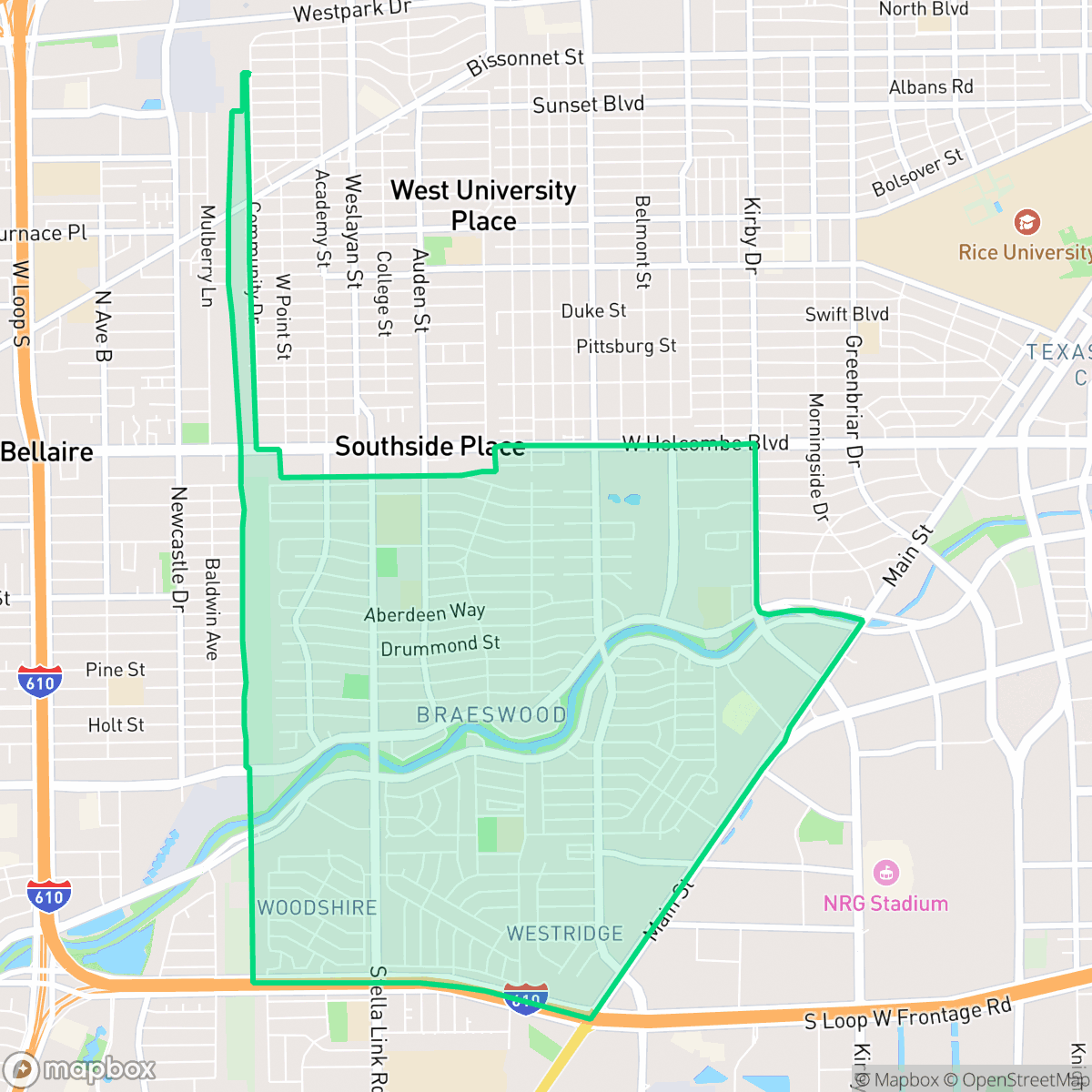
Developed inside Houston’s 610 Loop after World War II, Braeswood Place is a collection of seven subdivisions—including Braes Heights, Ayrshire, and Southern Oaks—with a homeowners association chartered in 1951. The neighborhood originally featured spacious, mid-century ranch-style homes on generous lots shaded by mature trees, situated along the winding Brays Bayou. While many original 1950s homes have transitioned to modern custom builds, the community retains a distinct mid-century charm. Locally significant institutions define its character, such as the Weekley Family YMCA (originating from the 1951 Southwest YMCA) and iconic, long-standing local businesses like Moeller's Bakery, Houston's oldest family-owned bakery, and Molina's Cantina, the city's oldest Tex-Mex establishment.
Situated within Houston’s 610 Loop, the neighborhood offers a dense, pedestrian-oriented environment characterized by consistent sidewalk networks and quiet residential streets. The area maintains a strong visual identity through its blend of preserved mid-century ranch homes and modern custom builds, all set against a mature tree canopy. Its proximity to the Texas Medical Center makes it a convenient location for professionals, while the high concentration of well-rated elementary schools, such as Twain and Longfellow, attracts families looking for established educational options.
The area presents distinct trade-offs regarding environmental and institutional factors. Prospective residents should note the low flood safety score, which is a critical consideration for property in this part of Houston. While the neighborhood boasts high health insurance coverage and a stable, affluent population, it remains subject to the broader operational volatility of the Houston Independent School District. Acoustic comfort is moderate, influenced by road traffic, and while the setting is serene, it offers a quieter, residential-focused lifestyle with limited commercial density compared to more urban corridors.
Neighborhood Scores Across 15 Qualities
Residential density varies throughout the area, ranging from closely packed townhomes to detached houses with modest setbacks. This level of neighbor proximity is roughly in line with the Houston average.
Extensive sidewalk networks and safe pedestrian crossings throughout residential streets provide better connectivity than the Houston average. While a major highway creates a barrier for some areas, many blocks offer continuous paths and shaded walkways for easy movement.
Large custom homes with complex rooflines, manicured landscapes, and frequent private swimming pools characterize the area. This level of visual amenity and property scale is notably higher than the Houston average, according to iHuus data.
Wide grassy verges and accessible greenway corridors provide safe, continuous paths for exercise. According to iHuus data, the availability of these buffered walking spaces is slightly above the city average.
Developed residential grids feature a mix of single-family homes and multi-story apartments integrated with a mature tree canopy. This landscape is very similar to the broader Houston area in terms of its balance between built infrastructure and greenery.
Residential streets and green spaces provide a serene atmosphere, though access to a variety of local businesses is somewhat limited compared to the Houston average. While some dining and essential services are reachable via walkable paths, much of the area remains car-dependent.
Local traffic from nearby busy streets creates a consistent level of ambient noise. This acoustic environment is slightly more active than the Houston average, according to iHuus data.
Air quality in this area fluctuates between acceptable and unhealthy levels, presenting occasional concerns for sensitive groups. This condition is slightly worse than the Houston average, according to iHuus data.
Largely residential and light commercial land use ensures few heavy industrial hazards; however, residents should note the presence of a nearby wastewater treatment facility and an EPA Superfund site in the surrounding area. According to iHuus data, the lack of large-scale warehouses or factories makes this area cleaner than the Houston average.
Health insurance accessibility is significantly higher than the Houston average, according to iHuus data. Residents in this area benefit from a much larger proportion of covered individuals compared to the rest of the city.
Political leanings in this area trend more liberal than the Houston average, characterized by a liberal majority with a modest opposing presence according to iHuus data.
Residents live alongside a balanced variety of young professionals, families, and seniors. According to iHuus data, this demographic spread is slightly more varied than the average found across Houston.
Flood risk in this area remains difficult to assess because a detailed study has not yet been completed by federal authorities. According to iHuus data, the potential for flooding is notably higher than the Houston average.
Address-Level Insights for Braeswood Place


iHuus Neighborhood Intelligence Insights
Get address-level neighborhood insights for Braeswood Place
- Street-level scores — see how individual blocks compare, not just neighborhood averages
- Micro-zone boundaries — identify quiet pockets, flood boundaries, and walkable clusters before you visit
- 15 dimensions in full — walkability, noise, air quality, school quality, insurance coverage, population age profile, urban/rural index, and more
- Boundary risk alerts — know if your address sits near a block boundary where scores drop, the kind of detail no listing will ever mention
- School insights — individual school ratings and insights, not just district-level data
- Compare before you commit — side-by-side data across neighborhoods, down to block precision
No credit card required
Compare with Any Neighborhood
| Dimension | Braeswood Place | Acres Home |
|---|---|---|
| 🚶 Walkabilityavg 7.08 | ||
| 🔊 Acoustic Comfortavg 4.14 | ||
| 🤫 Privacy Indexavg 5.34 | ||
| 🎨 Visual Appealavg 6.42 | ||
| 🐕 Dog Friendlinessavg 6.33 | ||
| 🗺️ Urban-Rural Indexavg 6.64 | ||
| ✨ Neighborhood Vibeavg 4.4 | ||
| 🏥 Health Insurance Coverageavg 5.46 | ||
| 🌿 Air Qualityavg 3.58 | ||
| 🏭 Industrial Proximityavg 6.9 | ||
| 🌊 Flood Safetyavg 6.27 | ||
| 🗳️ Ideological Leanavg 6.39 | ||
| 👥 Population Age Profileavg 4.6 | ||
| 🔥 Fire Safety | ||
| 🏫 School Quality |
Braeswood Place Rankings
School Districts Serving Braeswood Place
School Insights for Braeswood Place
Below average outcomes; significant attendance and academic challenges.
School Insights
See what's really behind every school rating near Braeswood Place
- Individual school ratings — each school's own score with outcome context, not just a district average
- Enrollment & class size data — student-to-teacher ratio and how it compares to the state average
- Full demographics breakdown — ethnicity and gender composition for every school in the enrollment zone
- Every school in the district — all schools within the enrollment boundary ranked by rating, not just the closest one
- Grade levels & benchmarks — elementary through high school, with below/above state-average flags
No credit card required