Braeburn, Houston
Updated · 21,167 residents
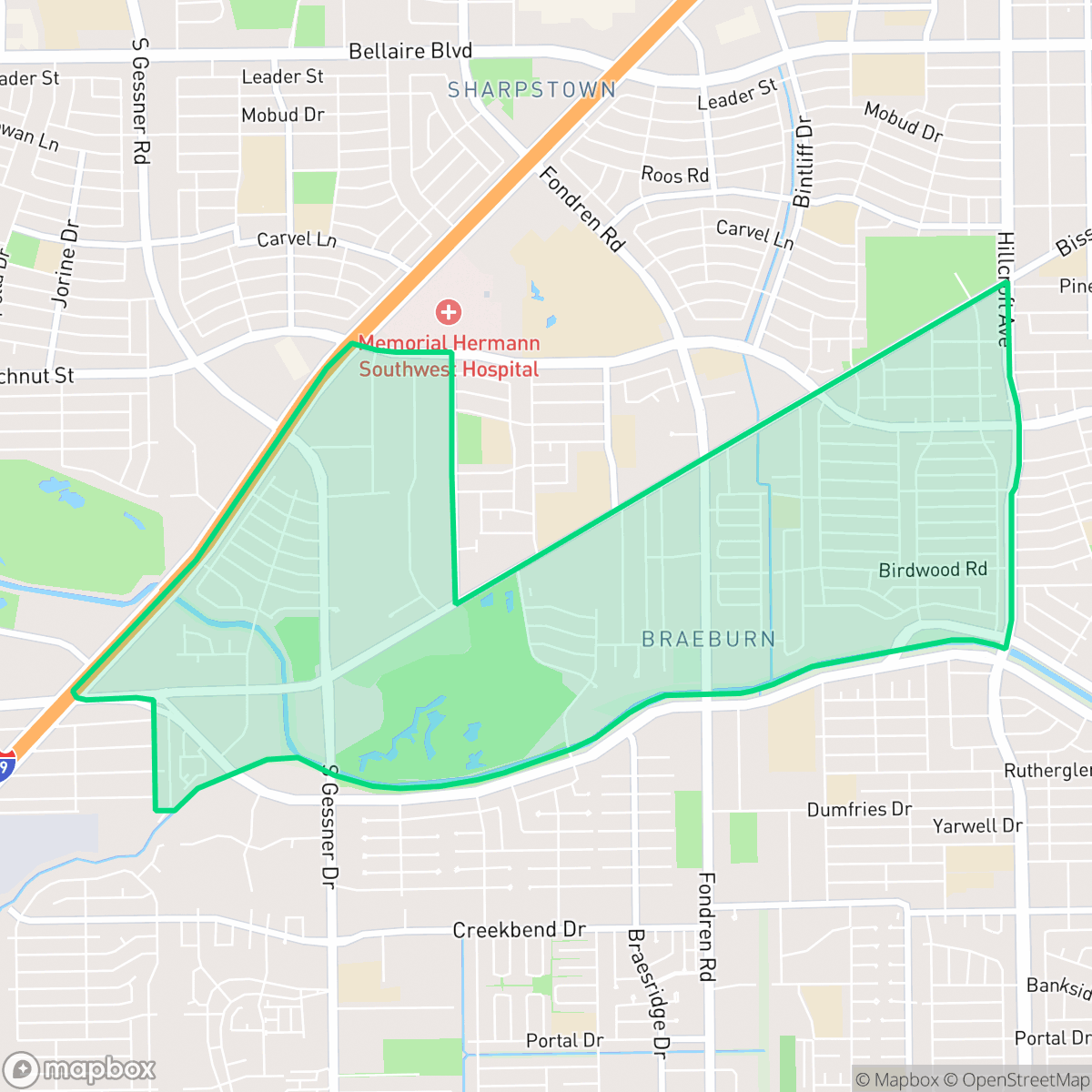
Braeburn is a quiet, suburban community in southwest Houston known for its mid-century modern aesthetic and proximity to Brays Bayou. While the area offers convenient access to diverse local dining and green corridors for outdoor activity, residents should be aware of significant road noise and flood risks.
Key Highlights
About Braeburn
Developed along Brays Bayou in southwest Houston after World War II, Braeburn grew as a collection of middle-class subdivisions, including Robindell, Braeburn Glen, and Braeburn Valley. During its initial boom, residents relied on Richmond Farm-to-Market Road (now Bissonnet Street) to reach the city center before the construction of U.S. Highway 59. The neighborhood is highly regarded for its custom-built mid-century modern homes, with several in Braeburn Valley designed by prominent Houston modernist architects Lucian Hood and W.W. Crochet. At the heart of the community lies the historic BraeBurn Country Club, founded in 1931, which once featured legendary three-time Masters champion Jimmy Demaret as an early club professional. Today, the neighborhood maintains its distinct mid-century character, defined by tree-lined streets and the adjacent Brays Bayou trail.
The area is defined by a dense suburban landscape that blends single-family homes with multi-unit apartment complexes. It maintains a functional, low-key atmosphere characterized by light commercial activity and steady traffic from nearby highways. Residents benefit from the presence of green drainage corridors and neighborhood parks, which provide essential outdoor space for recreation and pet owners. The local dining scene is notably diverse, offering a variety of international cuisines that cater to the multicultural demographic of the surrounding region. Prospective residents should consider the trade-offs associated with living in this sector of Houston. The neighborhood experiences elevated noise levels due to its proximity to major thoroughfares, and the area faces substantial challenges regarding flood safety and air quality. While the school landscape is mixed, with some high-performing options available, the overall institutional environment remains complex. This location is best suited for individuals who prioritize affordability and proximity to major transit routes over absolute quiet or environmental perfection.
Neighborhood Scores Across 15 Qualities
Residential units provide a moderate level of separation, matching the typical density found across Houston. While some apartment clusters feature shared walls, many homes maintain private yards and small buffers between neighbors.
Low-traffic residential streets and a comprehensive trail system along the bayou provide safe routes for walking. According to iHuus data, the sidewalk network is largely consistent with the city average.
Residential scenery here is consistent with the Houston average, featuring a mix of standard tract housing and apartment complexes. Some areas offer more manicured landscapes and private pools, but much of the neighborhood maintains a typical suburban density.
Continuous green canal corridors and wooded residential streets provide ample space for pets, making this area more dog friendly than the Houston average. Large grassy easements and nearby athletic fields offer additional accessible areas for exercise away from traffic.
Residential areas feature a dense suburban layout with single-family homes and apartment complexes, closely mirroring the typical urban-rural balance found across Houston. According to iHuus data, the landscape provides a blend of established residential pockets and commercial clusters.
Primarily a quiet, suburban environment, this area features a low level of activity compared to the Houston average. Most residents will find the neighborhood's rhythm to be steady and subdued, with local dining and services often requiring a drive due to limited walking options.
Frequent noise from nearby major freeways and railroad tracks impacts the area. According to iHuus data, acoustic comfort in Braeburn is slightly below the Houston city average.
Frequent unhealthy air quality levels pose a significant risk to sensitive groups. This area experiences worse air quality than the Houston average, according to iHuus data.
Industrial presence is minimal throughout the area, consisting primarily of residential streets and light commercial uses. According to iHuus data, the neighborhood is notably clearer of heavy manufacturing and industrial hazards than the Houston average.
Health insurance coverage levels in Braeburn are notably lower than the Houston average. According to iHuus data, a significant majority of the local population lacks medical coverage.
Political leanings in this area trend more liberal than the Houston average. Residents may find a community presence that leans toward progressive values according to iHuus data.
Residents live alongside a balanced mix of young adults, families, and seniors. According to iHuus data, this demographic variety is slightly lower than the Houston average.
Flood risk in this area is significantly higher than the Houston average, as much of the neighborhood sits within a designated floodplain. Residents should be prepared for the potential requirement of flood insurance according to iHuus data.
Address-Level Insights for Braeburn


iHuus Neighborhood Intelligence Insights
Get address-level neighborhood insights for Braeburn
- Street-level scores — see how individual blocks compare, not just neighborhood averages
- Micro-zone boundaries — identify quiet pockets, flood boundaries, and walkable clusters before you visit
- 15 dimensions in full — walkability, noise, air quality, school quality, insurance coverage, population age profile, urban/rural index, and more
- Boundary risk alerts — know if your address sits near a block boundary where scores drop, the kind of detail no listing will ever mention
- School insights — individual school ratings and insights, not just district-level data
- Compare before you commit — side-by-side data across neighborhoods, down to block precision
No credit card required
Compare with Any Neighborhood
| Dimension | Braeburn | Acres Home |
|---|---|---|
| 🚶 Walkabilityavg 7.08 | ||
| 🔊 Acoustic Comfortavg 4.14 | ||
| 🤫 Privacy Indexavg 5.34 | ||
| 🎨 Visual Appealavg 6.42 | ||
| 🐕 Dog Friendlinessavg 6.33 | ||
| 🗺️ Urban-Rural Indexavg 6.64 | ||
| ✨ Neighborhood Vibeavg 4.4 | ||
| 🏥 Health Insurance Coverageavg 5.46 | ||
| 🌿 Air Qualityavg 3.58 | ||
| 🏭 Industrial Proximityavg 6.9 | ||
| 🌊 Flood Safetyavg 6.27 | ||
| 🗳️ Ideological Leanavg 6.39 | ||
| 👥 Population Age Profileavg 4.6 | ||
| 🔥 Fire Safety | ||
| 🏫 School Quality |
Braeburn Rankings
School Districts Serving Braeburn
School Insights for Braeburn
Below average outcomes; significant attendance and academic challenges.
School Insights
See what's really behind every school rating near Braeburn
- Individual school ratings — each school's own score with outcome context, not just a district average
- Enrollment & class size data — student-to-teacher ratio and how it compares to the state average
- Full demographics breakdown — ethnicity and gender composition for every school in the enrollment zone
- Every school in the district — all schools within the enrollment boundary ranked by rating, not just the closest one
- Grade levels & benchmarks — elementary through high school, with below/above state-average flags
No credit card required