Binz, Houston
Updated · 3,716 residents
Binz is a vibrant cultural hub defined by its proximity to world-class museums and the expansive greenery of Hermann Park. While the area offers high walkability and excellent access to public amenities, residents should expect elevated noise levels from nearby road traffic.
Key Highlights
About Binz
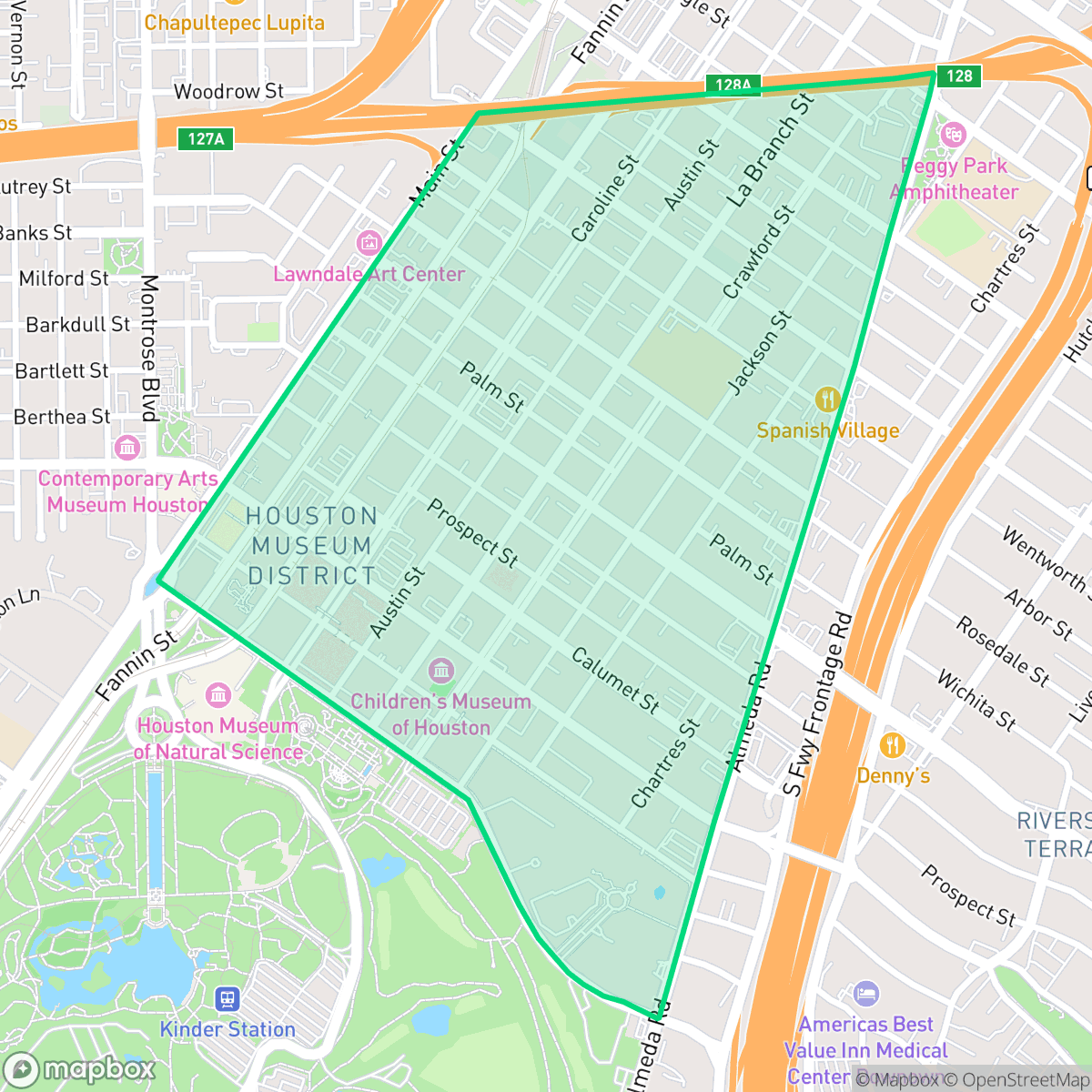
Originally platted in 1914 as the westernmost residential subdivision of Houston’s Third Ward, the historic Binz neighborhood was named after Jacob Binz, a prominent German immigrant and real estate developer. In 2010, the neighborhood was officially renamed "Museum Park" to reflect its modern identity as the cultural heart of Houston's Museum District. Bordered by the sprawling Hermann Park, the neighborhood features major landmarks such as the Holocaust Museum Houston and the Children's Museum Houston, the latter housed in a playful, post-modernist building at 1500 Binz Street designed by renowned architects Denise Scott Brown and Robert Venturi. Today, the area has transitioned from its early 20th-century residential roots into a highly walkable, internationally recognized hub of arts, science, and education education.
Binz serves as a dense urban-suburban environment that balances institutional grandeur with modern residential living. The streetscape is characterized by a mix of mid-rise luxury complexes, well-maintained estates, and cultural landmarks, creating a unique aesthetic that favors pedestrians. With high scores for dog friendliness and access to public green spaces, the area provides significant recreational opportunities for active residents. The neighborhood maintains a strong sense of community health and safety, bolstered by high levels of health insurance coverage and effective flood management systems.
Living here involves certain trade-offs, particularly regarding acoustic comfort. The proximity to major thoroughfares results in consistent road noise, which may impact those seeking a quiet retreat. While the local Macgregor Elementary School maintains a high rating, the broader Houston Independent School District faces ongoing institutional volatility and community friction. This area is best suited for professionals and families who prioritize proximity to the city's cultural core and desire a walkable lifestyle, provided they are comfortable with the inherent noise levels of a central urban environment.
Neighborhood Scores Across 15 Qualities
Residential spacing fluctuates between tightly packed multi-family structures and detached homes with larger garden buffers, resulting in a privacy level slightly below the Houston average according to iHuus data.
Sidewalks are available on many blocks and provide safe crossings; however, the adjacent highway acts as a significant barrier to pedestrian movement. According to iHuus data, the neighborhood offers slightly better walkability than the Houston average.
Landscaped grounds, large estates, and high-end architecture create a visual environment that is more polished than the Houston average. According to iHuus data, the area features frequent upscale amenities and well-maintained residential properties.
Access to large parks and manicured green spaces provides several options for pet exercise. According to iHuus data, the availability of these walking areas is slightly above the Houston average.
A blend of dense residential grids and multi-story apartments characterizes this area, providing a landscape that is comparable to the broader Houston area. According to iHuus data, the neighborhood features significant green buffers alongside mid-rise institutional and commercial structures.
Frequent social activity and a high concentration of local dining and cultural spots make this area significantly more active than the Houston average. Residents can find a diverse mix of coffee bars, eateries, and green spaces throughout the neighborhood, according to iHuus data.
Persistent traffic and transit sounds from nearby major roadways and rail lines make this area notably louder than the Houston average. According to iHuus data, residents can expect significant acoustic disturbance throughout the day.
Air quality in this area is notably better than the Houston average, though residents should expect a mix of acceptable and unhealthy days. According to iHuus data, sensitive groups may experience occasional concern during certain periods.
Residential and commercial uses dominate the area with very little heavy industry nearby. According to iHuus data, this lack of industrial activity is significantly higher than the Houston average, leaving only light commercial traffic and highway noise as notable environmental factors.
Health insurance access among residents is significantly higher than the Houston average, according to iHuus data.
Voting patterns and census indicators show a much more liberal political leaning than the Houston average, according to iHuus data.
Residents live alongside a balanced mix of young professionals, families, and seniors. According to iHuus data, this demographic spread is slightly more varied than the Houston average.
Residual flood risk exists within this area as it sits inside a 500-year floodplain, though safety levels are slightly above the Houston average according to iHuus data.
Address-Level Insights for Binz


iHuus Neighborhood Intelligence Insights
Get address-level neighborhood insights for Binz
- Street-level scores — see how individual blocks compare, not just neighborhood averages
- Micro-zone boundaries — identify quiet pockets, flood boundaries, and walkable clusters before you visit
- 15 dimensions in full — walkability, noise, air quality, school quality, insurance coverage, population age profile, urban/rural index, and more
- Boundary risk alerts — know if your address sits near a block boundary where scores drop, the kind of detail no listing will ever mention
- School insights — individual school ratings and insights, not just district-level data
- Compare before you commit — side-by-side data across neighborhoods, down to block precision
No credit card required
Compare with Any Neighborhood
| Dimension | Binz | Acres Home |
|---|---|---|
| 🚶 Walkabilityavg 7.08 | ||
| 🔊 Acoustic Comfortavg 4.14 | ||
| 🤫 Privacy Indexavg 5.34 | ||
| 🎨 Visual Appealavg 6.42 | ||
| 🐕 Dog Friendlinessavg 6.33 | ||
| 🗺️ Urban-Rural Indexavg 6.64 | ||
| ✨ Neighborhood Vibeavg 4.4 | ||
| 🏥 Health Insurance Coverageavg 5.46 | ||
| 🌿 Air Qualityavg 3.58 | ||
| 🏭 Industrial Proximityavg 6.9 | ||
| 🌊 Flood Safetyavg 6.27 | ||
| 🗳️ Ideological Leanavg 6.39 | ||
| 👥 Population Age Profileavg 4.6 | ||
| 🔥 Fire Safety | ||
| 🏫 School Quality |
Binz Rankings
School Districts Serving Binz
School Insights for Binz
Below average outcomes; significant attendance and academic challenges.
School Insights
See what's really behind every school rating near Binz
- Individual school ratings — each school's own score with outcome context, not just a district average
- Enrollment & class size data — student-to-teacher ratio and how it compares to the state average
- Full demographics breakdown — ethnicity and gender composition for every school in the enrollment zone
- Every school in the district — all schools within the enrollment boundary ranked by rating, not just the closest one
- Grade levels & benchmarks — elementary through high school, with below/above state-average flags
No credit card required