Astrodome Area, Houston
Updated · 18,412 residents
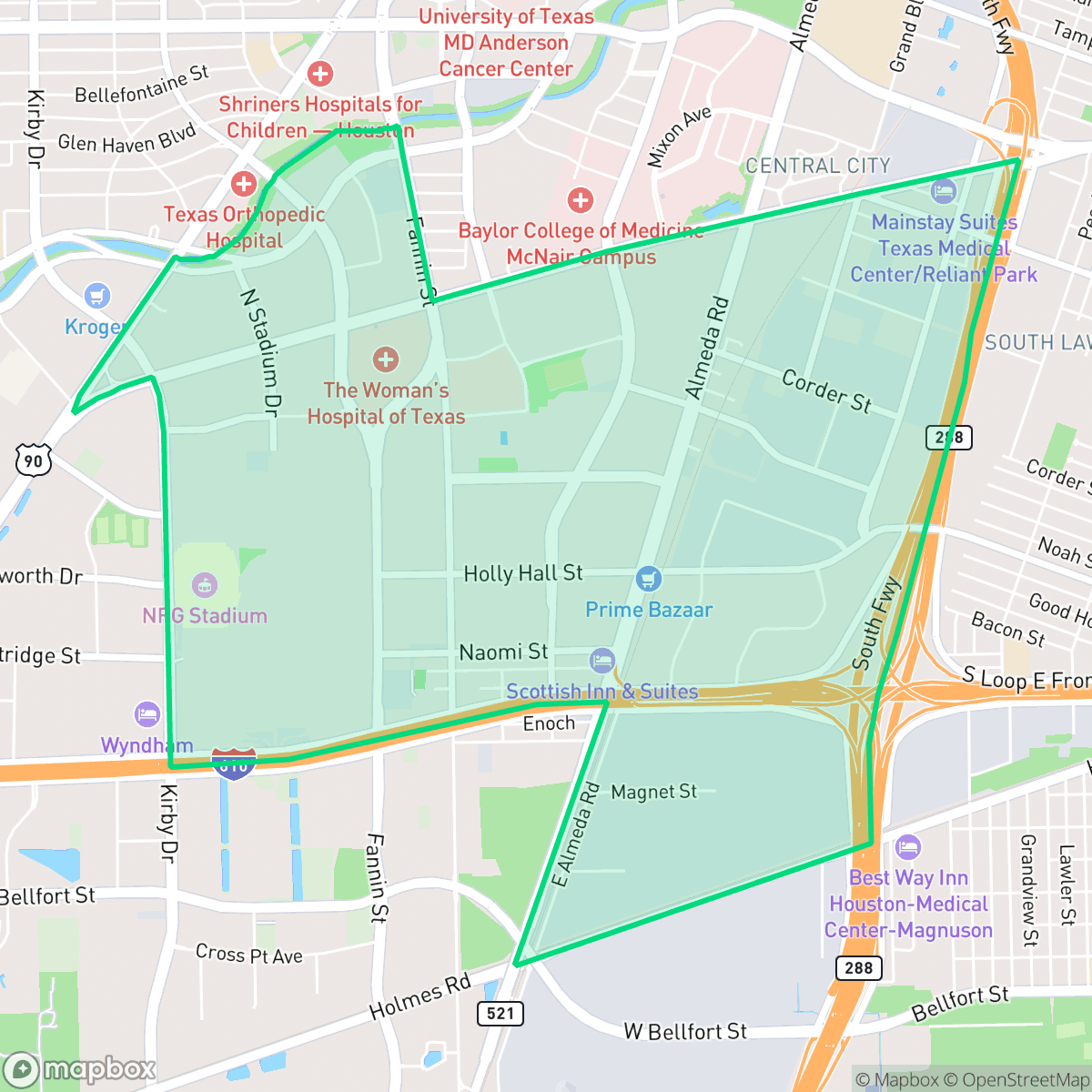
The Astrodome Area is a high-density, car-dependent neighborhood defined by its proximity to the NRG Park sports complex and a landscape of mid-rise multi-family housing. While residents benefit from high rates of health insurance coverage, the area faces challenges including limited local businesses, significant road noise, and concerns regarding nearby industrial sites.
Key Highlights
About Astrodome Area
The Astrodome Area neighborhood in south Houston was a virtually empty, treeless plain until the 1965 opening of the iconic Houston Astrodome, the world’s first domed, air-conditioned stadium. Dubbed the "Eighth Wonder of the World," the landmark catalyzed rapid commercial and residential development. A major driver of this growth was Plaza Del Oro, a massive mixed-use project initiated by Shell Oil Company that brought technical offices, apartments, and condominiums to the area. Today, the neighborhood is characterized by its high density of multi-family residential complexes built between 1970 and 1999, alongside the expansive NRG Park complex. This complex includes both the historic, preserved Astrodome and the modern NRG Stadium, keeping the neighborhood at the center of Houston's sports and entertainment identity.
The neighborhood functions as a dense, transit-adjacent hub that balances its role as a major regional entertainment destination with a residential population living in mid-rise apartments and townhomes. The streetscape is characterized by a mix of institutional buildings, large-scale parking infrastructure, and modest green verges, though pedestrian movement is frequently hindered by major highway interchanges and industrial blocks. While the area offers a quiet, steady rhythm of residential life, it remains largely car-oriented with few walkable commercial amenities.
Prospective residents should note that the neighborhood features limited privacy due to high-density housing layouts and shared walls. While the area maintains a calm atmosphere, noise levels are primarily driven by heavy road traffic. Additionally, potential residents should consider the neighborhood's proximity to regional industrial zones and the associated environmental considerations. The area is best suited for those who prioritize proximity to the Medical Center or NRG Park and are comfortable navigating a car-centric, suburban-industrial environment.
Neighborhood Scores Across 15 Qualities
Residential density is high, featuring shared walls and very narrow gaps between structures. According to iHuus data, this level of proximity to neighbors is noticeably lower than the Houston average.
Large industrial blocks and high-speed highway interchanges create significant barriers to safe movement, making the area less walkable than the Houston average. While some residential streets offer continuous sidewalks and tree cover, the network is frequently interrupted by expansive parking lots and industrial edges.
Residential views consist of standard tract housing and high-density apartment complexes, which is slightly below the Houston average. While some pockets feature mature landscaping and private pools, much of the area is characterized by boxy rooflines and shared amenities according to iHuus data.
Access to public parks and wide green verges for walking dogs is below the Houston average. While some apartment courtyards and canal greenways provide walking paths, several areas feature narrow verges and high traffic barriers that can limit safe outdoor exercise.
Large-scale industrial warehouses and vast paved parking lots characterize much of the landscape. This area feels more suburban than the Houston average due to a heavy presence of logistics hubs and transit infrastructure alongside residential clusters.
Low business density and a heavy presence of industrial and warehouse zones create a subdued atmosphere. According to iHuus data, the area lacks the vibrant social activity found elsewhere in Houston and requires a vehicle for most errands.
Frequent noise from nearby major freeways and railroad lines makes this area significantly louder than the Houston average. Residents may experience consistent auditory disturbances due to the proximity of heavy transit corridors.
Air quality levels fluctuate between acceptable and unhealthy, presenting occasional concerns for sensitive groups. This area maintains slightly better air quality than the Houston average, according to iHuus data.
Commercial activity and storage facilities introduce heavy freight traffic and loading dock noise to certain parts of the area. Residents should also be aware that nearby EPA Superfund sites pose potential environmental risks to local soil and air quality, making industrial proximity lower than the Houston average.
Health insurance access is significantly higher than the Houston average, providing residents with more reliable access to medical services. According to iHuus data, a large majority of the local population is covered.
Voting patterns and census indicators reflect a predominantly liberal political leaning that is significantly more pronounced than the Houston average. According to iHuus data, this area demonstrates much stronger liberal alignment compared to the rest of the city.
A varied demographic of young adults, families, and seniors resides here, representing a slightly more even age distribution than the Houston average according to iHuus data.
Flood risk levels in this area are difficult to assess because FEMA has not completed a detailed study for this specific location; according to iHuus data, the area sits slightly below the Houston city average for flood safety.
Address-Level Insights for Astrodome Area


iHuus Neighborhood Intelligence Insights
Get address-level neighborhood insights for Astrodome Area
- Street-level scores — see how individual blocks compare, not just neighborhood averages
- Micro-zone boundaries — identify quiet pockets, flood boundaries, and walkable clusters before you visit
- 15 dimensions in full — walkability, noise, air quality, school quality, insurance coverage, population age profile, urban/rural index, and more
- Boundary risk alerts — know if your address sits near a block boundary where scores drop, the kind of detail no listing will ever mention
- School insights — individual school ratings and insights, not just district-level data
- Compare before you commit — side-by-side data across neighborhoods, down to block precision
No credit card required
Compare with Any Neighborhood
| Dimension | Astrodome Area | Acres Home |
|---|---|---|
| 🚶 Walkabilityavg 7.08 | ||
| 🔊 Acoustic Comfortavg 4.14 | ||
| 🤫 Privacy Indexavg 5.34 | ||
| 🎨 Visual Appealavg 6.42 | ||
| 🐕 Dog Friendlinessavg 6.33 | ||
| 🗺️ Urban-Rural Indexavg 6.64 | ||
| ✨ Neighborhood Vibeavg 4.4 | ||
| 🏥 Health Insurance Coverageavg 5.46 | ||
| 🌿 Air Qualityavg 3.58 | ||
| 🏭 Industrial Proximityavg 6.9 | ||
| 🌊 Flood Safetyavg 6.27 | ||
| 🗳️ Ideological Leanavg 6.39 | ||
| 👥 Population Age Profileavg 4.6 | ||
| 🔥 Fire Safety | ||
| 🏫 School Quality |
Astrodome Area Rankings
School Districts Serving Astrodome Area
School Insights for Astrodome Area
Below average outcomes; significant attendance and academic challenges.
School Insights
See what's really behind every school rating near Astrodome Area
- Individual school ratings — each school's own score with outcome context, not just a district average
- Enrollment & class size data — student-to-teacher ratio and how it compares to the state average
- Full demographics breakdown — ethnicity and gender composition for every school in the enrollment zone
- Every school in the district — all schools within the enrollment boundary ranked by rating, not just the closest one
- Grade levels & benchmarks — elementary through high school, with below/above state-average flags
No credit card required