Afton Oaks - River Oaks Area, Houston
Updated · 17,686 residents
The Afton Oaks - River Oaks Area is defined by its blend of historic, high-status residential estates and dense, tree-lined suburban streets. While the area offers high visual appeal and good walkability for an urban setting, residents should expect notable noise from nearby major highways and limited access to public green spaces.
Key Highlights
About Afton Oaks - River Oaks Area
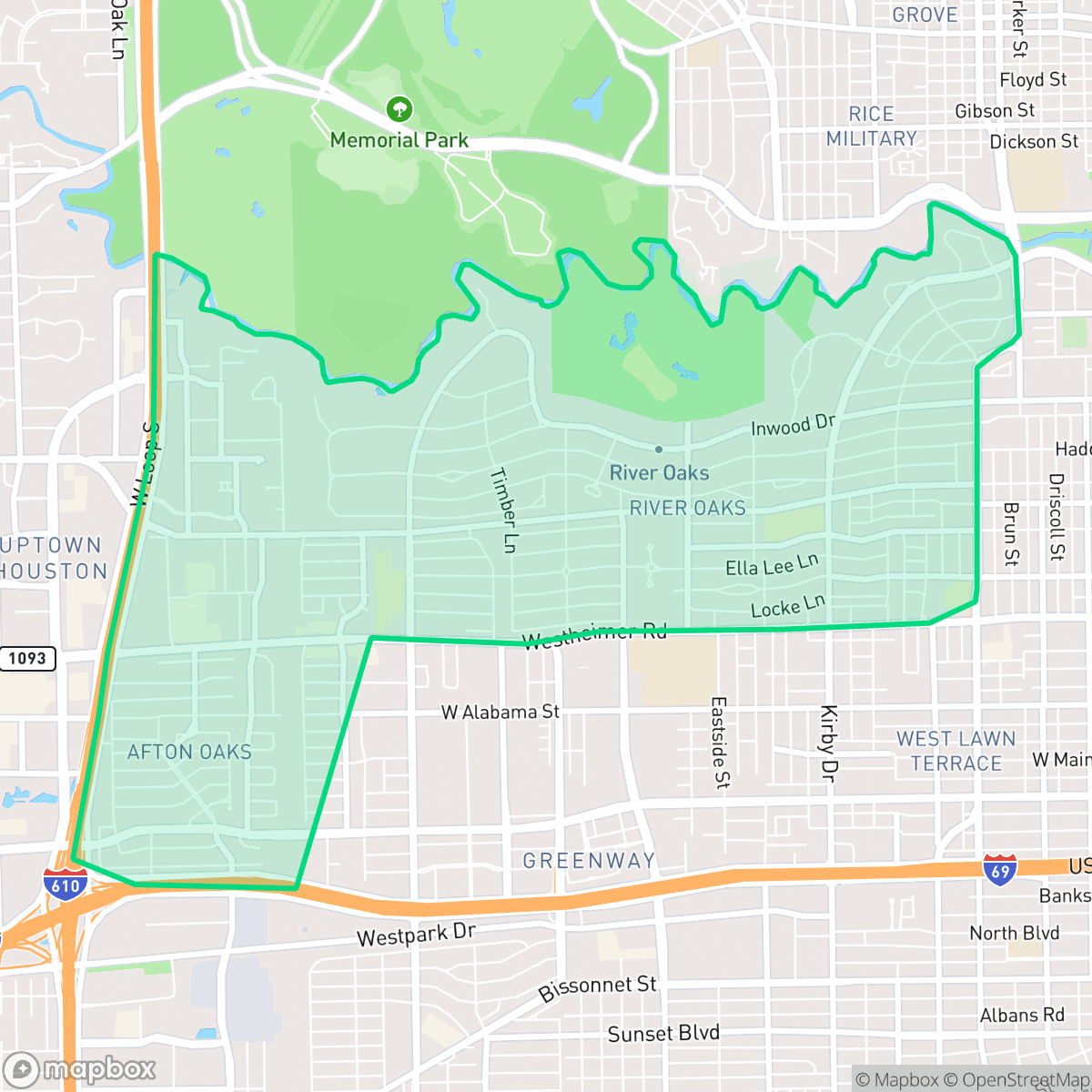
The Afton Oaks - River Oaks Area in Houston encompasses two distinct, prestigious eras of urban development. Established in the 1920s by Michael and William Hogg alongside Hugh Potter, River Oaks was Houston's first master-planned community, quickly evolving from a middle-income development into an affluent enclave famous for its historic mansions and the annual "Azalea Trail" home and garden tour. Just to the west, Afton Oaks emerged during the post-World War II suburban boom. Built between 1951 and 1959 on former farming and ranching land owned by the O'Meara and Stahlman families, Afton Oaks originally featured single-story ranch-style homes. Characterized by its signature Newcastle Drive esplanade lined with mature hardwood trees, the neighborhood is also defined by long-standing local businesses along Richmond Avenue, including Nielsen's Delicatessen (established in 1952) and Ragin' Cajun.
The area functions as a prestigious residential hub that balances established, affluent estates with a dense network of townhomes and mid-rise apartment complexes. The visual character is anchored by mature tree canopies and manicured landscaping, creating a distinct aesthetic that sets it apart from more utilitarian parts of the city. While the neighborhood benefits from a robust sidewalk grid, the presence of major thoroughfares and large-scale commercial development can create physical barriers for pedestrians and contribute to elevated ambient noise levels.
Prospective residents will find a community with high health insurance coverage and relatively strong flood safety, though the local school district presents a complex environment. While Houston ISD faces significant operational challenges, the neighborhood is home to highly rated local elementary options. The area is best suited for those prioritizing proximity to established dining and commercial services, provided they are comfortable with the trade-offs of living in a high-density, urban-adjacent environment where private green space is more common than public parks.
Neighborhood Scores Across 15 Qualities
Residential spacing varies significantly between dense, shared-wall townhomes and larger estate lots with substantial tree buffers. According to iHuus data, the level of separation between neighbors is roughly in line with the Houston average.
Established sidewalk networks and frequent crosswalks make most residential streets easy to navigate on foot. This connectivity is slightly above the Houston average, though large highways and high-traffic arterials can create occasional barriers to movement.
Large custom homes, manicured landscaping, and frequent private pools characterize this area. The presence of mature tree canopies and high-end amenities makes the visual landscape significantly more premium than the Houston average.
Tree-lined residential streets and nearby athletic fields provide decent walking opportunities, though access to large public parks is slightly below the city average according to iHuus data.
Residential blocks feature a combination of single-family homes, mid-rise apartments, and significant tree canopy. This layout provides a slightly more developed feel than the more open, semi-rural areas found elsewhere in the city.
A mix of quiet, tree-lined streets and lively dining districts provides a level of activity notably higher than the Houston average. Residents can access various upscale eateries and social landmarks, though many services require a short drive due to the low-density nature of certain blocks.
Local traffic from nearby thoroughfares creates a consistent level of ambient noise. According to iHuus data, this acoustic environment is roughly in line with the city average.
Air quality in this area fluctuates between acceptable and unhealthy levels, though it remains slightly better than the Houston average according to iHuus data. Sensitive groups may experience occasional concerns during periods of poor air quality.
Residents can enjoy an environment free from warehouses, factories, or hazardous industrial facilities. This area is notably cleaner than the Houston average, consisting almost entirely of residential, commercial, and educational zones.
Health insurance access is significantly higher than the Houston average, according to iHuus data. Residents in this area benefit from a much more widely covered population regarding medical coverage.
Political leanings in this area are relatively balanced between conservative and liberal viewpoints, making it less partisan than the Houston average according to iHuus data.
A wide variety of age groups live here, providing a more balanced demographic spread than the Houston average. According to iHuus data, the area contains a stable blend of young professionals, established families, and older residents.
Residual flood risk exists within parts of this area, though safety levels are higher than the Houston average according to iHuus data.
Address-Level Insights for Afton Oaks - River Oaks Area


iHuus Neighborhood Intelligence Insights
Get address-level neighborhood insights for Afton Oaks - River Oaks Area
- Street-level scores — see how individual blocks compare, not just neighborhood averages
- Micro-zone boundaries — identify quiet pockets, flood boundaries, and walkable clusters before you visit
- 15 dimensions in full — walkability, noise, air quality, school quality, insurance coverage, population age profile, urban/rural index, and more
- Boundary risk alerts — know if your address sits near a block boundary where scores drop, the kind of detail no listing will ever mention
- School insights — individual school ratings and insights, not just district-level data
- Compare before you commit — side-by-side data across neighborhoods, down to block precision
No credit card required
Compare with Any Neighborhood
| Dimension | Afton Oaks - River Oaks Area | Acres Home |
|---|---|---|
| 🚶 Walkabilityavg 7.08 | ||
| 🔊 Acoustic Comfortavg 4.14 | ||
| 🤫 Privacy Indexavg 5.34 | ||
| 🎨 Visual Appealavg 6.42 | ||
| 🐕 Dog Friendlinessavg 6.33 | ||
| 🗺️ Urban-Rural Indexavg 6.64 | ||
| ✨ Neighborhood Vibeavg 4.4 | ||
| 🏥 Health Insurance Coverageavg 5.46 | ||
| 🌿 Air Qualityavg 3.58 | ||
| 🏭 Industrial Proximityavg 6.9 | ||
| 🌊 Flood Safetyavg 6.27 | ||
| 🗳️ Ideological Leanavg 6.39 | ||
| 👥 Population Age Profileavg 4.6 | ||
| 🔥 Fire Safety | ||
| 🏫 School Quality |
Afton Oaks - River Oaks Area Rankings
School Districts Serving Afton Oaks - River Oaks Area
School Insights for Afton Oaks - River Oaks Area
Below average outcomes; significant attendance and academic challenges.
School Insights
See what's really behind every school rating near Afton Oaks - River Oaks Area
- Individual school ratings — each school's own score with outcome context, not just a district average
- Enrollment & class size data — student-to-teacher ratio and how it compares to the state average
- Full demographics breakdown — ethnicity and gender composition for every school in the enrollment zone
- Every school in the district — all schools within the enrollment boundary ranked by rating, not just the closest one
- Grade levels & benchmarks — elementary through high school, with below/above state-average flags
No credit card required