Sun City, Georgetown
Updated · 14,124 residents
Sun City is a master-planned, age-restricted community defined by its extensive network of nature trails and three championship golf courses. The area offers a serene, low-density environment that prioritizes pedestrian accessibility and outdoor recreation for residents aged 55 and older.
Key Highlights
About Sun City
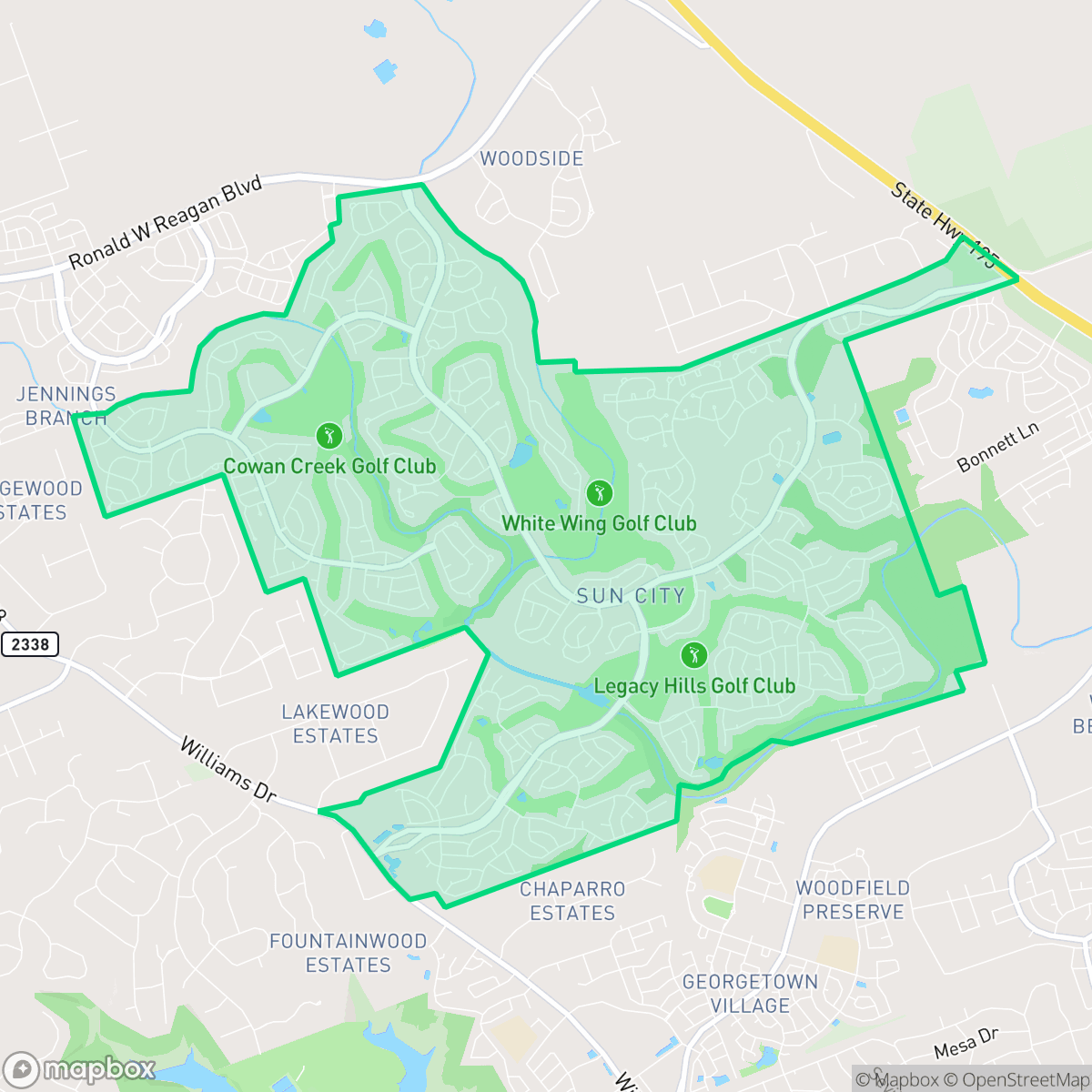
Launched in 1994, Sun City Texas (originally Sun City Georgetown) is a premier age-restricted active adult community situated on the western edge of Georgetown. The neighborhood originated when the Del Webb Company acquired over 7,000 acres of rolling ranch land, commencing home construction in October 1995. The first residents moved in by spring 1996, and the community celebrated its 30th anniversary in 2026. Composed primarily of single-family homes and duplexes, the master-planned neighborhood is renowned for its resort-style amenities. Key local landmarks include three championship golf courses—Legacy Hills, White Wing, and Cowan Creek—alongside the Cowan Creek Activity Center and over 14 miles of nature trails. Designed specifically for residents aged 55 and older, the neighborhood's active lifestyle is defined by numerous hobby clubs and recreational facilities.
The neighborhood functions as a quiet residential enclave on the western edge of Georgetown, characterized by its expansive green spaces and a deliberate lack of commercial density. Residents benefit from a highly walkable layout that connects scattered housing blocks to essential leisure spots and local amenities like the Sun City Farmers' Market. The acoustic environment remains relatively calm, with low levels of aviation and rail noise, contributing to the area's reputation as a peaceful retreat.
While the area excels in visual appeal and pedestrian accessibility, it lacks a traditional urban pulse, making it better suited for those seeking a quiet, predictable lifestyle rather than proximity to a bustling city center. Prospective residents should note that while the community is well-maintained, it is geographically isolated from diverse commercial services, and the surrounding school districts currently face challenges with academic consistency and fiscal realignment. It remains an ideal choice for retirees who value a cohesive, age-specific environment with consistent access to golf and outdoor exercise.
Neighborhood Scores Across 15 Qualities
Homes in this area feature mixed spacing with some distance between neighbors, providing a level of seclusion that is roughly in line with the Georgetown average.
Pedestrian access is well-supported by sidewalks on one side of the street and safe crossings. This level of walkability is higher than the Georgetown average according to iHuus data.
Large homes and frequent upscale amenities provide a landscape that is more aesthetically pleasing than the Georgetown average. According to iHuus data, the area features spacious driveways and well-maintained properties.
Connected green spaces and wide, traffic-safe paths make this area more dog friendly than the Georgetown average, according to iHuus data.
Open land and scattered homes amid woodlands characterize this area, offering a more semi-rural atmosphere than the Georgetown average according to iHuus data.
Low-density residential pockets and vast open spaces create a peaceful atmosphere with very little commercial activity. This area is slightly more tranquil than the Georgetown average, as most daily needs require car-oriented travel due to the lack of concentrated business hubs.
Steady traffic sounds from nearby busy streets are present, though acoustic levels remain more favorable than the Georgetown average according to iHuus data.
Air quality fluctuates between acceptable and unhealthy levels, presenting occasional concerns for sensitive groups. This neighborhood experiences lower air quality than the Georgetown average, according to iHuus data.
Industrial activity and warehouses are entirely absent from this area, offering a cleaner environment than the Georgetown average. Residents can expect quiet streets and open green spaces without proximity to manufacturing or hazard sites.
Health insurance enrollment among residents is high, though it sits slightly below the Georgetown average according to iHuus data.
Political leanings in this area are notably more conservative than the Georgetown average, according to iHuus data.
Older adults make up the majority of the population in Sun City, representing a significantly higher concentration of seniors than the Georgetown average. This demographic profile, according to iHuus data, indicates a much more mature community with a limited number of younger residents.
Flood risk in this area is higher than the Georgetown average due to its location within a 500-year floodplain. Some residual flood risk exists, according to iHuus data.
Address-Level Insights for Sun City


iHuus Neighborhood Intelligence Insights
Get address-level neighborhood insights for Sun City
- Street-level scores — see how individual blocks compare, not just neighborhood averages
- Micro-zone boundaries — identify quiet pockets, flood boundaries, and walkable clusters before you visit
- 15 dimensions in full — walkability, noise, air quality, school quality, insurance coverage, population age profile, urban/rural index, and more
- Boundary risk alerts — know if your address sits near a block boundary where scores drop, the kind of detail no listing will ever mention
- School insights — individual school ratings and insights, not just district-level data
- Compare before you commit — side-by-side data across neighborhoods, down to block precision
No credit card required
Compare with Any Neighborhood
| Dimension | Sun City | Fountainwood Estates |
|---|---|---|
| 🚶 Walkabilityavg 7.04 | ||
| 🔊 Acoustic Comfortavg 4.36 | ||
| 🤫 Privacy Indexavg 6.33 | ||
| 🎨 Visual Appealavg 7.32 | ||
| 🐕 Dog Friendlinessavg 7.12 | ||
| 🗺️ Urban-Rural Indexavg 8.14 | ||
| ✨ Neighborhood Vibeavg 3.66 | ||
| 🏥 Health Insurance Coverageavg 7.32 | ||
| 🌿 Air Qualityavg 7.21 | ||
| 🏭 Industrial Proximityavg 9.14 | ||
| 🌊 Flood Safetyavg 5.94 | ||
| 🗳️ Ideological Leanavg 2.62 | ||
| 👥 Population Age Profileavg 5.64 | ||
| 🔥 Fire Safety | ||
| 🏫 School Quality |
Sun City Rankings
School Districts Serving Sun City
School Insights for Sun City
Below average outcomes; significant attendance and academic challenges.
School Insights
See what's really behind every school rating near Sun City
- Individual school ratings — each school's own score with outcome context, not just a district average
- Enrollment & class size data — student-to-teacher ratio and how it compares to the state average
- Full demographics breakdown — ethnicity and gender composition for every school in the enrollment zone
- Every school in the district — all schools within the enrollment boundary ranked by rating, not just the closest one
- Grade levels & benchmarks — elementary through high school, with below/above state-average flags
No credit card required