Fountainwood Estates, Georgetown
Updated · 928 residents
Fountainwood Estates is a secluded, nature-focused community in northwest Georgetown defined by large, wooded homesites and traditional custom architecture. While it offers a serene, private environment, residents should anticipate frequent noise from nearby transit infrastructure and a reliance on personal vehicles for daily errands.
Key Highlights
About Fountainwood Estates
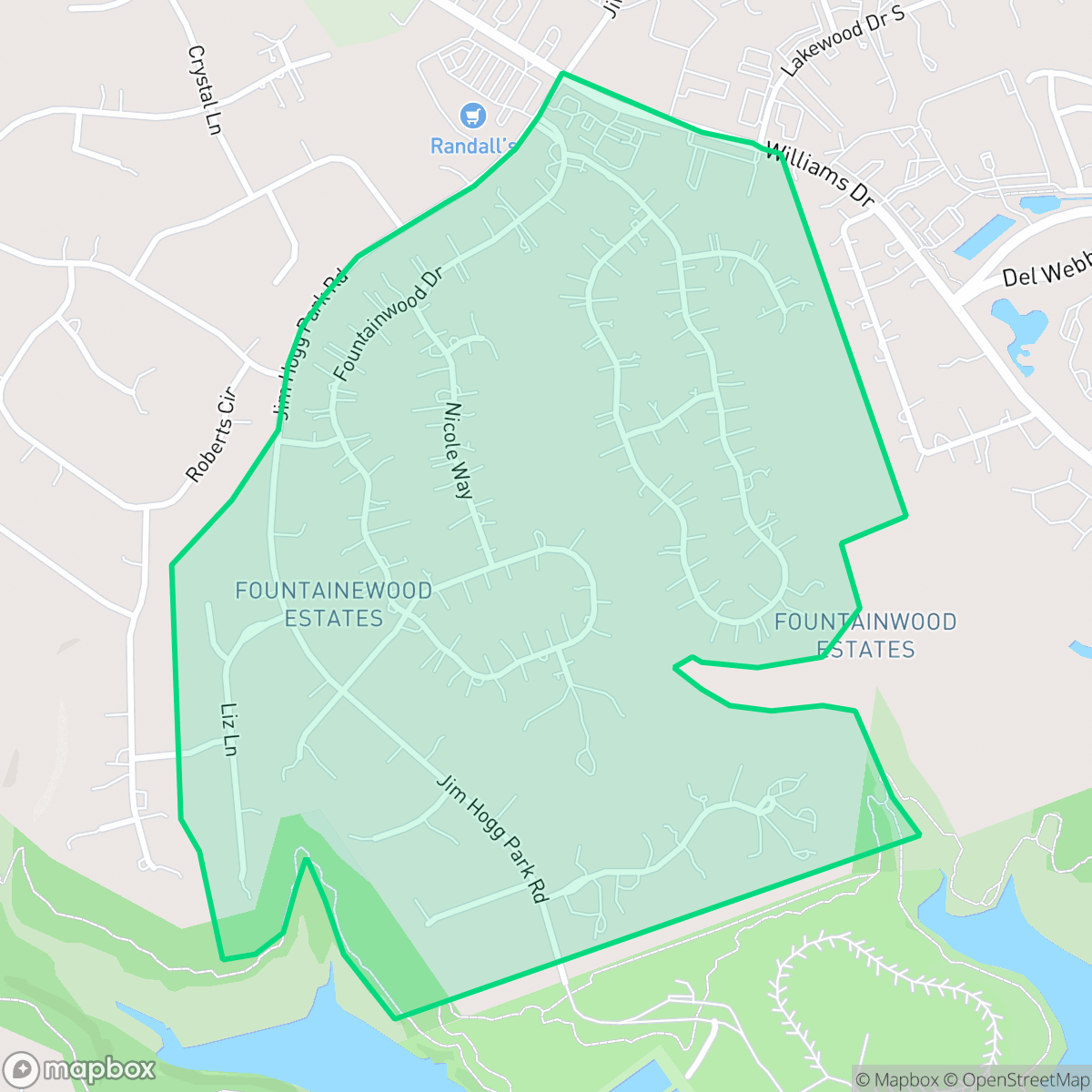
Fountainwood Estates, located in northwest Georgetown near Lake Georgetown and the San Gabriel River basin, is an established residential community developed primarily in the late 1990s and early 2000s. Originally positioned on the outskirts of the city, the neighborhood was designed to capitalize on the rolling Texas Hill Country landscape. It is characterized by heavily wooded, acre-plus homesites that provide a rural, nature-focused aesthetic. Architecturally, the area features traditional custom homes, often with brick exteriors, designed to offer privacy and a peaceful, semi-rural environment. While it lacks centralized community amenities like clubhouses, the neighborhood is recognized for its deed-restricted quality and proximity to Jim Hogg Park, which serves as a significant local landmark for hiking, fishing, and outdoor recreation.
The area is characterized by a deep rural aesthetic and a spacious property layout, which provides a high degree of privacy between homes. The landscape is visually appealing, featuring mature trees and a sense of openness that distinguishes it from more densely populated suburban developments. Residents benefit from the total absence of industrial facilities, ensuring that the community remains strictly residential and maintains a consistent visual character.
Living here requires a trade-off between the tranquil, rural atmosphere and the practical realities of the location. The neighborhood experiences persistent noise from nearby transit corridors, and air quality can occasionally fluctuate. While the community is served by the Georgetown Independent School District, families should note that the district is currently navigating fiscal and academic transitions. This location is best suited for those who prioritize expansive, private living spaces and a connection to nature over immediate access to urban amenities.
Neighborhood Scores Across 15 Qualities
Residential lots feature significant separation between homes, providing more privacy than the Georgetown average. According to iHuus data, the spacing between properties helps minimize direct views between neighbors.
Sidewalks are available on one side of the street and include safe crossings, though overall connectivity is slightly lower than the Georgetown average.
Large-scale residences and premium amenities define the local landscape. According to iHuus data, the area features a higher level of aesthetic quality and spaciousness compared to the Georgetown average.
Opportunities for pet exercise are somewhat restricted due to fewer green verges and less direct park access than is typical for Georgetown. According to iHuus data, the area offers fewer dedicated walking spaces for dogs compared to the city average.
Extensive natural landscape and farmland characterize this area, providing a much more secluded environment than the Georgetown average according to iHuus data.
A tranquil and largely rural landscape defines this area, though its low density of local businesses makes it less active than the Georgetown average. Most residents will find the environment serene, but daily errands typically require a vehicle due to the lack of concentrated commercial character.
Frequent noise from nearby transit infrastructure, such as a busy freeway or railroad, makes this area significantly louder than the Georgetown average. According to iHuus data, residents can expect persistent acoustic disturbances throughout the day.
Air quality in this area fluctuates between acceptable and unhealthy levels, presenting more frequent concerns for sensitive groups than the Georgetown average. According to iHuus data, residents may experience periods of diminished air clarity.
Industrial facilities and warehouses are absent from this area, which maintains a slightly higher level of separation from heavy industry than the Georgetown average. According to iHuus data, the neighborhood consists primarily of quiet streets and open green spaces.
Health insurance enrollment among residents is notably higher than the Georgetown average, according to iHuus data.
Voting and census indicators show a predominantly conservative leaning, which is significantly more pronounced than the Georgetown city average according to iHuus data.
Residents will experience a balanced demographic mix of young professionals, families, and seniors; according to iHuus data, this distribution is slightly more varied than the Georgetown average.
Flood safety in this area is notably higher than the Georgetown average, though some residual risk remains due to its location within a minor floodplain. According to iHuus data, the area is situated within a zone that is generally considered stable during extreme weather events.
Address-Level Insights for Fountainwood Estates


iHuus Neighborhood Intelligence Insights
Get address-level neighborhood insights for Fountainwood Estates
- Street-level scores — see how individual blocks compare, not just neighborhood averages
- Micro-zone boundaries — identify quiet pockets, flood boundaries, and walkable clusters before you visit
- 15 dimensions in full — walkability, noise, air quality, school quality, insurance coverage, population age profile, urban/rural index, and more
- Boundary risk alerts — know if your address sits near a block boundary where scores drop, the kind of detail no listing will ever mention
- School insights — individual school ratings and insights, not just district-level data
- Compare before you commit — side-by-side data across neighborhoods, down to block precision
No credit card required
Compare with Any Neighborhood
| Dimension | Fountainwood Estates | Georgetown Village |
|---|---|---|
| 🚶 Walkabilityavg 7.04 | ||
| 🔊 Acoustic Comfortavg 4.36 | ||
| 🤫 Privacy Indexavg 6.33 | ||
| 🎨 Visual Appealavg 7.32 | ||
| 🐕 Dog Friendlinessavg 7.12 | ||
| 🗺️ Urban-Rural Indexavg 8.14 | ||
| ✨ Neighborhood Vibeavg 3.66 | ||
| 🏥 Health Insurance Coverageavg 7.32 | ||
| 🌿 Air Qualityavg 7.21 | ||
| 🏭 Industrial Proximityavg 9.14 | ||
| 🌊 Flood Safetyavg 5.94 | ||
| 🗳️ Ideological Leanavg 2.62 | ||
| 👥 Population Age Profileavg 5.64 | ||
| 🔥 Fire Safety | ||
| 🏫 School Quality |
Fountainwood Estates Rankings
School Districts Serving Fountainwood Estates
School Insights for Fountainwood Estates
Below average outcomes; significant attendance and academic challenges.
School Insights
See what's really behind every school rating near Fountainwood Estates
- Individual school ratings — each school's own score with outcome context, not just a district average
- Enrollment & class size data — student-to-teacher ratio and how it compares to the state average
- Full demographics breakdown — ethnicity and gender composition for every school in the enrollment zone
- Every school in the district — all schools within the enrollment boundary ranked by rating, not just the closest one
- Grade levels & benchmarks — elementary through high school, with below/above state-average flags
No credit card required