Spring Park, Garland
Updated · 1,837 residents
Spring Park is a highly walkable and dog-friendly neighborhood defined by its extensive greenbelts and suburban tranquility. Residents benefit from a quiet environment with minimal noise interference, making it an ideal setting for those seeking a peaceful, nature-oriented lifestyle within the Garland area.
Key Highlights
About Spring Park
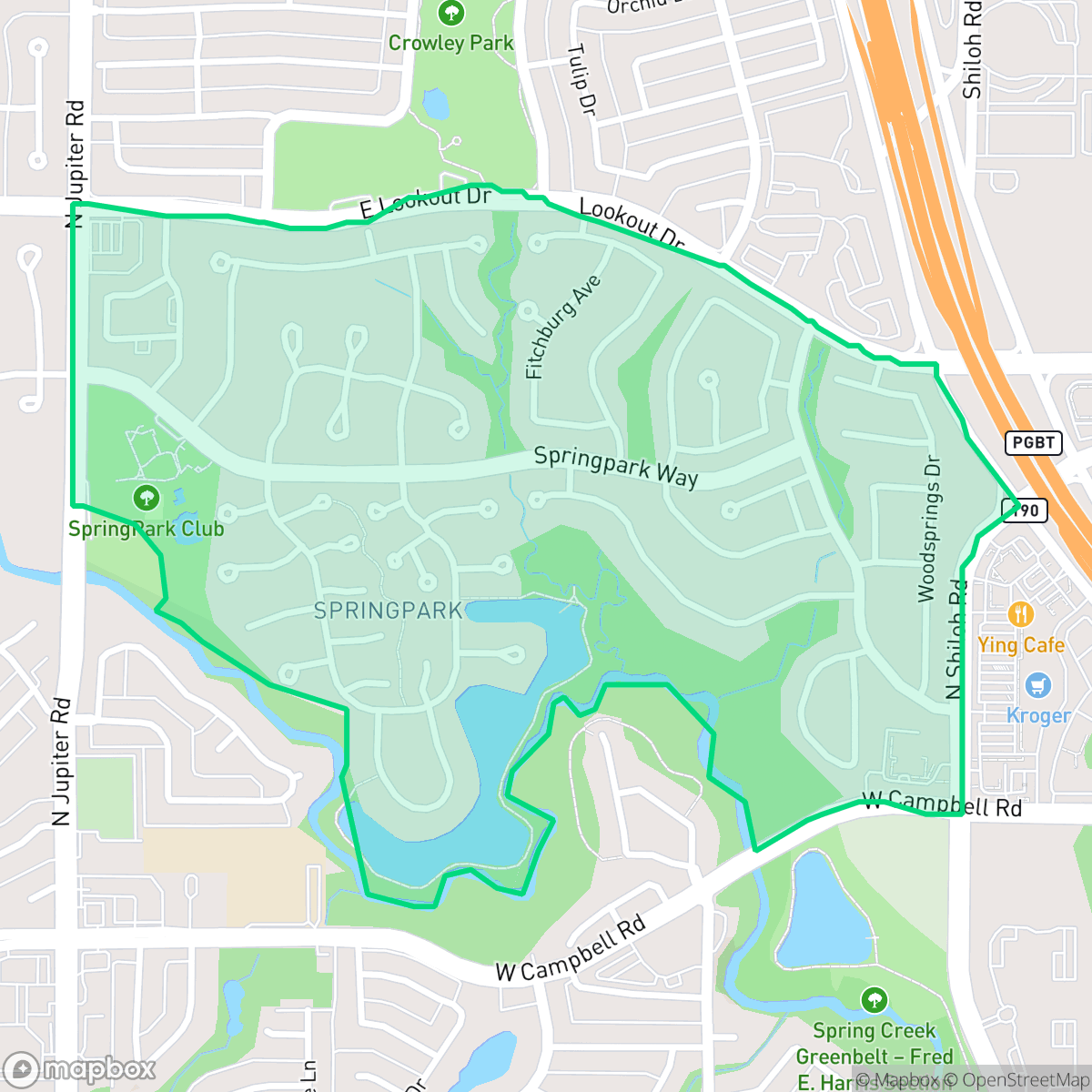
Straddling northwestern Garland and northeastern Richardson, SpringPark is a master-planned, open-space community originally developed in the 1970s by the Ray Nasher Company, the prominent developer behind Dallas’s iconic NorthPark Center. Designed as a model for shared green space, the neighborhood of roughly 865 homes is integrated with over 130 acres of common areas, wooded greenbelts, and walking and bridle trails. Key local landmarks include the 17-acre SpringPark Lake, a scenic pond, a central community clubhouse, and the "Band Field"—a shared grassy common area that serves as a hub for neighborhood gatherings. Bordered by Crowley Park and the scenic Spring Creek, SpringPark maintains a distinct, nature-oriented identity focused on community-shared recreation and environmental preservation.
This community offers a unique residential experience characterized by its high walkability and strong commitment to outdoor recreation. With a focus on residential comfort, the area maintains a peaceful atmosphere where road traffic noise is kept to a moderate level. According to iHuus data, the neighborhood excels in dog friendliness and provides a stable environment with high rates of health insurance coverage among its residents. Its proximity to local dining options and well-maintained public spaces creates a cohesive environment that prioritizes resident well-being and ease of movement.
While the neighborhood provides a serene setting, prospective residents should note that the area has specific flood safety considerations. It is best suited for families, pet owners, and individuals who value a quiet, pedestrian-friendly lifestyle over the high-energy atmosphere of an urban center. The surrounding school districts, including Garland, Plano, and Richardson, offer varied academic pathways, providing families with multiple educational options in the North Texas region.
Neighborhood Scores Across 15 Qualities
Residential spacing provides some buffer between neighbors, though the density is largely consistent with the Garland average. According to iHuus data, properties feature a mix of varied distances between adjacent homes.
Pedestrian access is well-supported by sidewalks and safe crossings, offering better walkability than the Garland average. Most local trips can be completed on foot with ease according to iHuus data.
Large homes and frequent upscale amenities create a landscape that is more visually polished than the Garland average, according to iHuus data.
Connected green spaces and wide, traffic-safe paths make this area significantly more dog friendly than the Garland average, according to iHuus data.
Frequent open land and scattered homes amid fields or woodland provide a more open atmosphere than much of Garland. While some areas feature dense suburban development and large commercial footprints, the neighborhood maintains a slightly more rural character than the city average.
Local activity is subdued, with a landscape consisting mostly of established housing and limited commercial presence. This area is notably less active than the Garland average, offering a peaceful environment with very few nearby amenities or social hubs.
Steady traffic noise from nearby busy streets is a common feature here, matching the typical levels found across Garland. Residents can expect a consistent ambient hum throughout the day.
Air quality fluctuates between acceptable and unhealthy levels, though conditions remain slightly better than the Garland average according to iHuus data. Sensitive groups should monitor occasional periods of concern.
Residential tranquility is well-maintained here with a lack of heavy industrial facilities or hazard sites, making the area even more free of industrial proximity than the Garland average. According to iHuus data, the neighborhood consists primarily of quiet streets and open green spaces.
Health insurance accessibility is notably higher here than in the rest of Garland. According to iHuus data, a significant majority of the local population maintains medical coverage.
Political perspectives are distributed fairly evenly throughout the area, mirroring the broader political landscape found across Garland.
Residents live alongside a balanced mix of young adults, families, and older populations. This demographic variety is slightly more varied than the average found across Garland, according to iHuus data.
Flood risk is notable in this area as portions of the neighborhood fall within the 100-year floodplain. According to iHuus data, this level of risk is slightly higher than the Garland city average and may necessitate flood insurance.
Address-Level Insights for Spring Park


iHuus Neighborhood Intelligence Insights
Get address-level neighborhood insights for Spring Park
- Street-level scores — see how individual blocks compare, not just neighborhood averages
- Micro-zone boundaries — identify quiet pockets, flood boundaries, and walkable clusters before you visit
- 15 dimensions in full — walkability, noise, air quality, school quality, insurance coverage, population age profile, urban/rural index, and more
- Boundary risk alerts — know if your address sits near a block boundary where scores drop, the kind of detail no listing will ever mention
- School insights — individual school ratings and insights, not just district-level data
- Compare before you commit — side-by-side data across neighborhoods, down to block precision
No credit card required
Compare with Any Neighborhood
| Dimension | Spring Park | Almeta,Bonita, Bella Vista |
|---|---|---|
| 🚶 Walkabilityavg 7.61 | ||
| 🔊 Acoustic Comfortavg 4.47 | ||
| 🤫 Privacy Indexavg 5.66 | ||
| 🎨 Visual Appealavg 6.66 | ||
| 🐕 Dog Friendlinessavg 6.45 | ||
| 🗺️ Urban-Rural Indexavg 6.72 | ||
| ✨ Neighborhood Vibeavg 4.25 | ||
| 🏥 Health Insurance Coverageavg 4.8 | ||
| 🌿 Air Qualityavg 3.41 | ||
| 🏭 Industrial Proximityavg 8.38 | ||
| 🌊 Flood Safetyavg 3.27 | ||
| 🗳️ Ideological Leanavg 6.34 | ||
| 👥 Population Age Profileavg 4.65 | ||
| 🔥 Fire Safety | ||
| 🏫 School Quality |
Spring Park Rankings
School Districts Serving Spring Park
School Insights for Spring Park
Below average outcomes; significant attendance and academic challenges.
School Insights
See what's really behind every school rating near Spring Park
- Individual school ratings — each school's own score with outcome context, not just a district average
- Enrollment & class size data — student-to-teacher ratio and how it compares to the state average
- Full demographics breakdown — ethnicity and gender composition for every school in the enrollment zone
- Every school in the district — all schools within the enrollment boundary ranked by rating, not just the closest one
- Grade levels & benchmarks — elementary through high school, with below/above state-average flags
No credit card required