Orchard Hills, Garland
Updated · 1,253 residents
Orchard Hills is a quiet, residential enclave in Garland defined by its mid-century architectural roots and serene, tree-lined streets. According to iHuus data, the area offers a peaceful acoustic environment for residents, though its car-dependent layout and limited commercial amenities make it best suited for those prioritizing suburban tranquility over walkability.
Key Highlights
About Orchard Hills
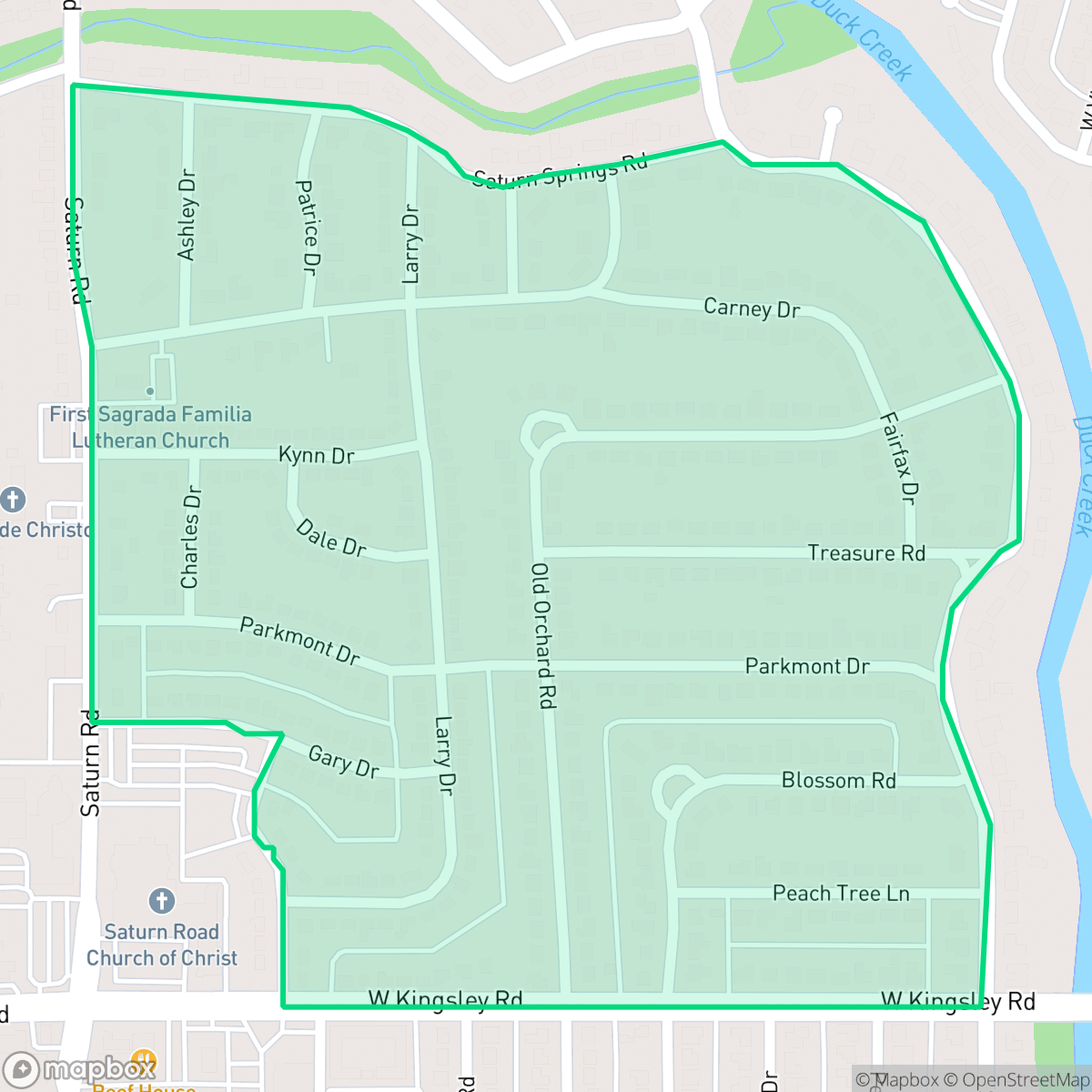
In 1947, the Orchard Hills neighborhood in Garland, Texas, consisted of open cotton fields and a pecan orchard. The area’s development began when the Axe family purchased land along Axe Branch Creek, and the Cooper brothers constructed the neighborhood’s first custom homes using native white stone with six-inch-thick walls. Between 1940 and 1969, Orchard Hills rapidly expanded with a mix of custom, semi-custom, and tract homes, which today comprise over 93% of its housing stock. Notable local figures, including Mayor Billy Earl Tomlinson, built custom homes along Glenbrook Drive. The neighborhood is bounded by Overhill Drive, Kingsley Road, Saturn Road, and Glenbrook Drive, and is culturally anchored by local landmarks like the Saturn Road Church of Christ and the award-winning Saturn Hills Community Garden.
The neighborhood maintains a consistent suburban aesthetic with ample green space, making it a stable environment for families and long-term residents. It is characterized by low noise levels and a high degree of industrial separation, providing a natural buffer from the busier parts of the city. The proximity to Garland Independent School District facilities adds to its appeal, as the district is recognized for its robust magnet programs and stable infrastructure.
The area is primarily car-oriented, requiring residents to travel for most daily errands and services. While the quiet streets and low noise levels are a significant benefit, potential residents should be aware of the limited local commercial activity and the necessity of vehicle ownership. According to iHuus, those seeking a low-key, residential atmosphere will find the area well-suited to their needs, provided they are comfortable with a suburban lifestyle that prioritizes privacy and calm over high-density convenience.
Neighborhood Scores Across 15 Qualities
Suburban spacing provides a moderate level of separation between homes, which is slightly higher than the Garland average. According to iHuus data, houses are typically positioned with a functional buffer between neighbors.
Residential streets offer safe crossings and sidewalks on one side of the road, though tree canopy occasionally obscures the paths. Walkability in this area is slightly lower than the Garland average.
Uniform rooflines and functional yards characterize much of the area, resulting in a visual appeal that is slightly below the Garland average. Streetscapes primarily consist of standard tract housing and mid-density apartment complexes, according to iHuus data.
Private fenced backyards are common, but the area lacks public parks and wide green verges found more frequently elsewhere in Garland. According to iHuus data, walking pets on the street is limited by narrow grass strips.
Residential pockets feature a mix of single-family homes and apartment complexes interspersed with commercial zones. According to iHuus data, this landscape is slightly more developed than the typical semi-rural surroundings found elsewhere in Garland.
Suburban streets and green spaces offer a steady but low-intensity atmosphere that is slightly more active than the Garland average. While scattered dining and religious sites are present, the area remains primarily residential and often requires a car to reach various services.
Acoustic levels are notably lower than the Garland average, consisting primarily of infrequent and distant traffic or train sounds. According to iHuus data, this provides a more peaceful environment for residents compared to other parts of the city.
Air quality levels fluctuate between acceptable and unhealthy periods, which may pose occasional concerns for sensitive groups. According to iHuus data, the air quality in Orchard Hills is slightly better than the Garland city average.
No warehouses, heavy industry, or hazardous facilities are present within the area. This lack of industrial presence is even more pronounced than the typical Garland average, providing a landscape composed of residential streets and open green spaces.
Health insurance access is notably low in this area, falling well below the Garland average according to iHuus data.
Political leanings in this area are relatively balanced, showing a more even split between conservative and liberal views than the Garland average according to iHuus data.
Residents will find a balanced mix of young adults, families, and older populations. According to iHuus data, the age distribution in Orchard Hills is very similar to the broader Garland area.
Significant flood risks exist here, with much higher vulnerability to hazards compared to the Garland average. Residents should anticipate elevated or potentially prohibitive flood insurance costs according to iHuus data.
Address-Level Insights for Orchard Hills


iHuus Neighborhood Intelligence Insights
Get address-level neighborhood insights for Orchard Hills
- Street-level scores — see how individual blocks compare, not just neighborhood averages
- Micro-zone boundaries — identify quiet pockets, flood boundaries, and walkable clusters before you visit
- 15 dimensions in full — walkability, noise, air quality, school quality, insurance coverage, population age profile, urban/rural index, and more
- Boundary risk alerts — know if your address sits near a block boundary where scores drop, the kind of detail no listing will ever mention
- School insights — individual school ratings and insights, not just district-level data
- Compare before you commit — side-by-side data across neighborhoods, down to block precision
No credit card required
Compare with Any Neighborhood
| Dimension | Orchard Hills | Almeta,Bonita, Bella Vista |
|---|---|---|
| 🚶 Walkabilityavg 7.61 | ||
| 🔊 Acoustic Comfortavg 4.47 | ||
| 🤫 Privacy Indexavg 5.66 | ||
| 🎨 Visual Appealavg 6.66 | ||
| 🐕 Dog Friendlinessavg 6.45 | ||
| 🗺️ Urban-Rural Indexavg 6.72 | ||
| ✨ Neighborhood Vibeavg 4.25 | ||
| 🏥 Health Insurance Coverageavg 4.8 | ||
| 🌿 Air Qualityavg 3.41 | ||
| 🏭 Industrial Proximityavg 8.38 | ||
| 🌊 Flood Safetyavg 3.27 | ||
| 🗳️ Ideological Leanavg 6.34 | ||
| 👥 Population Age Profileavg 4.65 | ||
| 🔥 Fire Safety | ||
| 🏫 School Quality |
Orchard Hills Rankings
School Districts Serving Orchard Hills
School Insights for Orchard Hills
Below average outcomes; significant attendance and academic challenges.
School Insights
See what's really behind every school rating near Orchard Hills
- Individual school ratings — each school's own score with outcome context, not just a district average
- Enrollment & class size data — student-to-teacher ratio and how it compares to the state average
- Full demographics breakdown — ethnicity and gender composition for every school in the enrollment zone
- Every school in the district — all schools within the enrollment boundary ranked by rating, not just the closest one
- Grade levels & benchmarks — elementary through high school, with below/above state-average flags
No credit card required