Holford, Garland
Updated · 2,055 residents
Holford is a highly walkable and dog-friendly neighborhood in north Garland, defined by its extensive green spaces and established residential streets. Residents enjoy a quiet, suburban atmosphere with immediate access to significant recreational facilities, though the area experiences notable noise levels from surrounding road traffic.
Key Highlights
About Holford
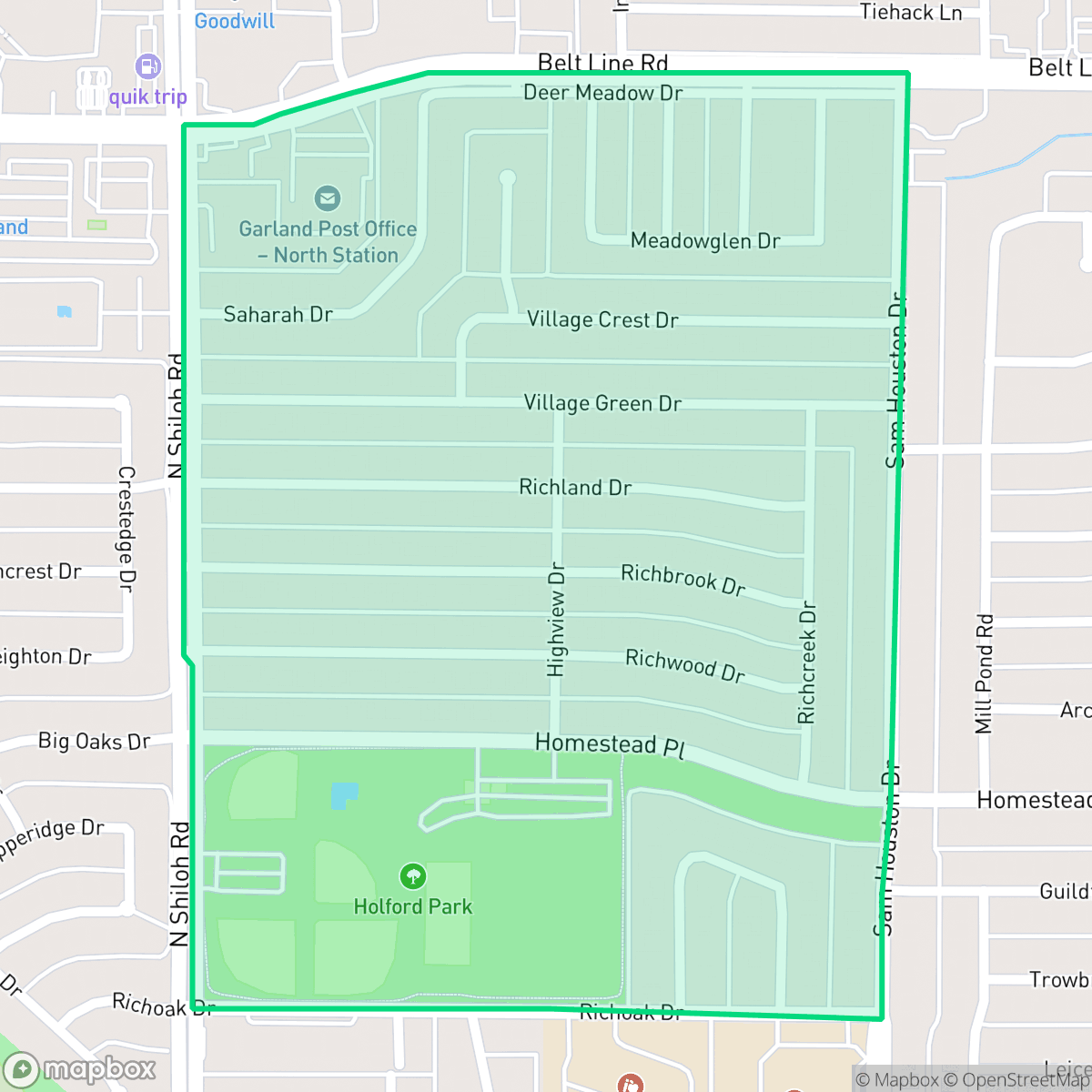
The Holford neighborhood in north Garland, Texas, is centered around the 31-acre Holford Park, which was named in honor of William Asa Holford (1871–1941), a prominent local advocate and long-time owner and editor of the *Garland News*. The neighborhood's development gained momentum in the mid-to-late 20th century; the landmark Holford Recreation Center broke ground in 1966 and was formally dedicated in September 1968. Most of the residential housing stock was established between 1970 and 1999, with some homes dating back to the 1940s. Today, the neighborhood is characterized by its extensive recreational amenities, including the Holford Aquatic Center, the Holford Sports Complex, and the adjacent Duck Creek Golf Club.
The area functions as a residential anchor in north Garland, characterized by a high degree of walkability and exceptional access to outdoor amenities. The presence of sprawling green space and recreation centers encourages an active lifestyle, making the neighborhood a popular choice for pet owners and those who value pedestrian connectivity. According to iHuus data, the environment maintains a consistent, quiet suburban character that prioritizes outdoor recreation over dense commercial development.
Prospective residents should consider specific environmental factors when evaluating the area. While the neighborhood offers a serene atmosphere, it is subject to road traffic noise that contributes to lower acoustic comfort. Additionally, the area faces challenges regarding flood safety, and those considering a move should review local flood maps carefully. The neighborhood is well-served by the Garland Independent School District, which provides stable educational options through its choice-based model.
Neighborhood Scores Across 15 Qualities
Residential density is average for the city, featuring a combination of detached homes with moderate buffers and denser apartment blocks with shared walls. According to iHuus data, some areas feature closely packed lots with limited private separation between neighbors.
A well-established sidewalk network and safe crossings facilitate easy movement, making this area slightly more walkable than the Garland average. Most residential streets feature comprehensive pedestrian infrastructure, although high-traffic arterial roads can interrupt continuous routes.
Streetscapes range from affluent estates with private pools and manicured lawns to denser tract housing and apartment complexes. According to iHuus data, the overall visual character is largely consistent with the Garland average.
Private fenced backyards and nearby school athletic fields provide decent exercise opportunities for pets, though the area has slightly less accessible public green space than the Garland average. Street-side verges are relatively narrow, making larger public green belts less common within the residential grid according to iHuus data.
Primarily composed of single-family homes and apartment complexes, this area presents a dense suburban fabric that is very similar to the Garland average. According to iHuus data, the landscape features a high ratio of developed infrastructure to open green space.
Suburban streets and green spaces provide a serene atmosphere, though limited local business density makes most errands a driving task. This area offers a slightly more subdued rhythm than the Garland average, characterized by quiet blocks and a sparse concentration of dining and service options.
Persistent sound from nearby busy streets defines the acoustic environment. This level of ambient noise is slightly higher than the Garland average, according to iHuus data.
Air quality levels fluctuate between acceptable and unhealthy conditions, though conditions in Holford are slightly better than the Garland average according to iHuus data. Sensitive groups may experience occasional concern during certain periods.
Residential and educational zones dominate the area, though some larger storage and warehouse facilities are located along the eastern and western edges. This level of industrial presence is slightly lower than the Garland average according to iHuus data.
Health insurance access is slightly above the Garland average. According to iHuus data, a notable portion of the population lacks coverage, which may impact local healthcare accessibility.
Political leanings in this area are relatively evenly split between conservative and liberal residents. This represents a slightly more moderate ideological landscape compared to the Garland average, according to iHuus data.
Residents live alongside a balanced mix of young adults, families, and older individuals. This age distribution is largely consistent with the broader Garland area, according to iHuus data.
Flood risk in this area is higher than the Garland average, though FEMA has not yet completed a detailed study to determine the precise level of uncertainty. Residents should remain aware of potential vulnerabilities as the area lacks a definitive flood study classification.
Address-Level Insights for Holford


iHuus Neighborhood Intelligence Insights
Get address-level neighborhood insights for Holford
- Street-level scores — see how individual blocks compare, not just neighborhood averages
- Micro-zone boundaries — identify quiet pockets, flood boundaries, and walkable clusters before you visit
- 15 dimensions in full — walkability, noise, air quality, school quality, insurance coverage, population age profile, urban/rural index, and more
- Boundary risk alerts — know if your address sits near a block boundary where scores drop, the kind of detail no listing will ever mention
- School insights — individual school ratings and insights, not just district-level data
- Compare before you commit — side-by-side data across neighborhoods, down to block precision
No credit card required
Compare with Any Neighborhood
| Dimension | Holford | Almeta,Bonita, Bella Vista |
|---|---|---|
| 🚶 Walkabilityavg 7.61 | ||
| 🔊 Acoustic Comfortavg 4.47 | ||
| 🤫 Privacy Indexavg 5.66 | ||
| 🎨 Visual Appealavg 6.66 | ||
| 🐕 Dog Friendlinessavg 6.45 | ||
| 🗺️ Urban-Rural Indexavg 6.72 | ||
| ✨ Neighborhood Vibeavg 4.25 | ||
| 🏥 Health Insurance Coverageavg 4.8 | ||
| 🌿 Air Qualityavg 3.41 | ||
| 🏭 Industrial Proximityavg 8.38 | ||
| 🌊 Flood Safetyavg 3.27 | ||
| 🗳️ Ideological Leanavg 6.34 | ||
| 👥 Population Age Profileavg 4.65 | ||
| 🔥 Fire Safety | ||
| 🏫 School Quality |
Holford Rankings
School Districts Serving Holford
School Insights for Holford
Below average outcomes; significant attendance and academic challenges.
School Insights
See what's really behind every school rating near Holford
- Individual school ratings — each school's own score with outcome context, not just a district average
- Enrollment & class size data — student-to-teacher ratio and how it compares to the state average
- Full demographics breakdown — ethnicity and gender composition for every school in the enrollment zone
- Every school in the district — all schools within the enrollment boundary ranked by rating, not just the closest one
- Grade levels & benchmarks — elementary through high school, with below/above state-average flags
No credit card required