First Centerville, Garland
Updated · 471 residents
First Centerville is a residential enclave in Garland defined by its mid-century housing and a surprisingly vibrant local dining scene. While the area offers a quiet, suburban atmosphere with minimal industrial presence, prospective residents should note the limited access to health insurance and the necessity of flood awareness in this established community.
Key Highlights
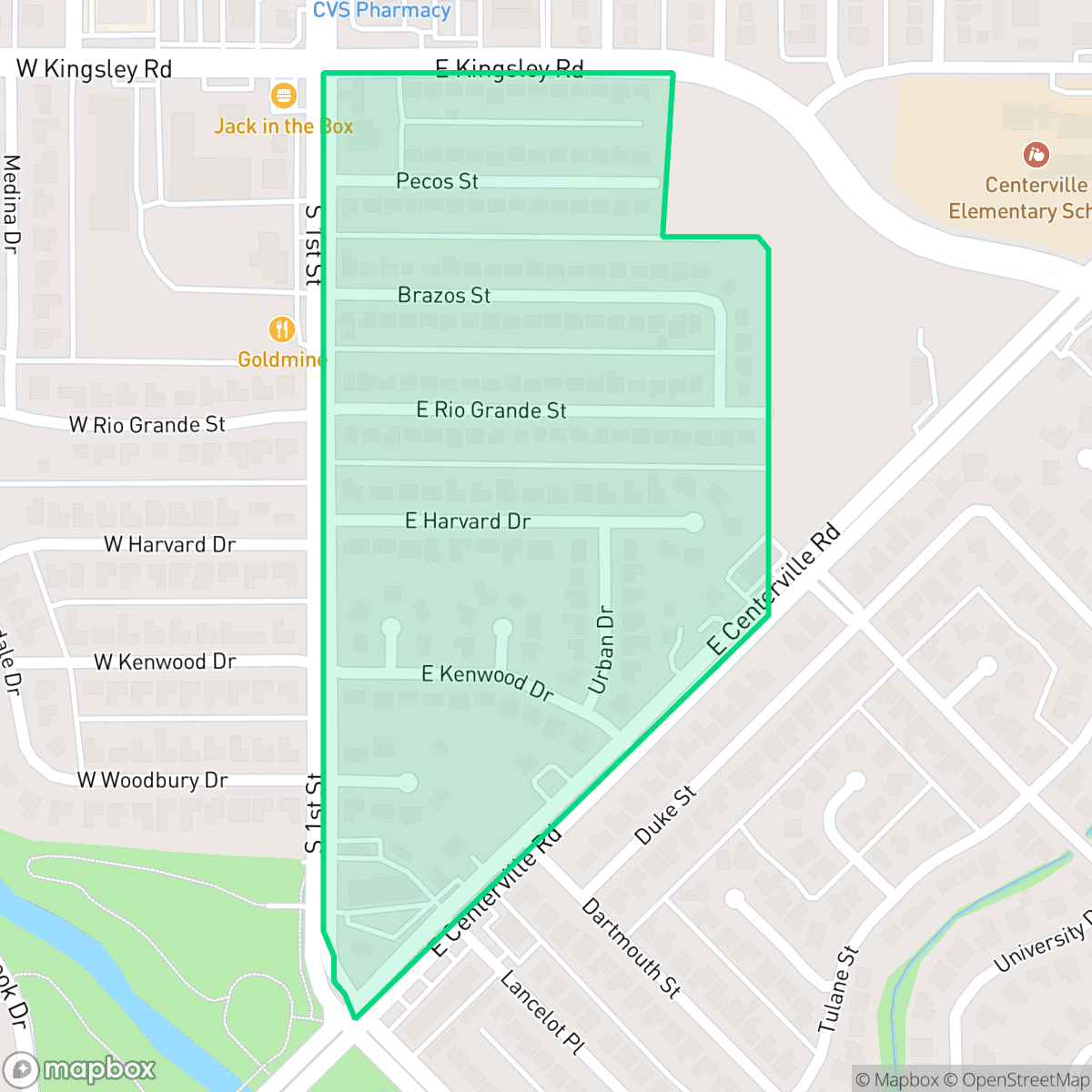
About First Centerville
The historical community of Centerville was settled in the 1850s on the original land grants of John Little, J. Mills, and J. W. Keen along Duck Creek. Centerville Road, a key local thoroughfare, still traces the old community's location. Centerville established a local school by the late 19th century but remained a tiny rural settlement, reporting a population of just ten residents by the 1930s and 1940s. As Garland rapidly expanded and industrialized in the mid-20th century, it absorbed the rural community. Today, the residential neighborhood of First Centerville features mid-century housing stock, with many of its single-family homes dating back to the mid-1950s, preserving the name of the pioneer settlement that preceded modern suburban development.
The neighborhood maintains a distinct suburban identity, characterized by its mid-century single-family homes and a lively social atmosphere that exceeds the city average. Residents have convenient access to diverse culinary options, including local favorites like Del Rancho and Market Latina, which contribute to the area's high livability score regarding community engagement. The layout favors a quieter, residential lifestyle with minimal industrial intrusion, making it a stable environment for those seeking a traditional suburban experience.
Living in the area involves specific trade-offs. While acoustic comfort is generally favorable with manageable traffic noise, the neighborhood faces challenges regarding environmental factors, including air quality and significant flood risk. Additionally, the area shows very low health insurance coverage among residents, which may be a consideration for families or individuals prioritizing healthcare access. With the support of the Garland Independent School District, which offers a flexible choice-based enrollment model, the neighborhood remains a practical option for those who value established community roots over modern, high-density developments.
Neighborhood Scores Across 15 Qualities
Residential spacing is mixed, providing some buffer between neighbors. According to iHuus data, this level of privacy is slightly higher than the Garland city average.
Sidewalks are available on one side of the street alongside safe pedestrian crossings, though overall ease of walking is slightly below the Garland average according to iHuus data.
Large residences and frequent upscale amenities contribute to a landscape that is more visually appealing than the Garland average, according to iHuus data.
Connected green spaces and wide, traffic-safe paths provide decent opportunities for pet owners; however, the area is slightly below the Garland average for dog-friendly infrastructure.
Open land and scattered homes amidst fields or woodland characterize this area. The landscape is slightly less developed than the typical Garland neighborhood, according to iHuus data.
Local dining and community spaces provide a much higher level of activity than the typical Garland neighborhood. Residents can access a concentrated mix of social hubs and diverse eateries, including Market Latina and local churches, set against a backdrop of suburban streets and green space.
Local traffic from nearby busy streets creates a consistent level of ambient noise. This acoustic environment is slightly more active than the typical experience found across Garland.
Frequent unhealthy air quality levels pose a significant risk to sensitive groups. According to iHuus data, conditions in this area are slightly worse than the Garland city average.
Industrial activity and heavy warehouses are entirely absent from this area, providing a much cleaner environment than the Garland average. According to iHuus data, the neighborhood consists solely of residential streets and light commercial zones with no detected hazards.
Health insurance access is notably lower in this area than the Garland average, according to iHuus data. Most residents in the neighborhood lack comprehensive medical coverage.
Political leanings in this area skew slightly more liberal than the Garland average. Residents may notice a modest presence of opposing viewpoints alongside a liberal majority.
Residents will find a balanced demographic spread of young adults, families, and older individuals. This age distribution is consistent with the broader Garland area according to iHuus data.
Properties in this area are located within a designated floodplain, which carries a higher risk of flooding than the Garland average. According to iHuus data, residents may find that flood insurance is typically required for homes in this neighborhood.
Address-Level Insights for First Centerville


iHuus Neighborhood Intelligence Insights
Get address-level neighborhood insights for First Centerville
- Street-level scores — see how individual blocks compare, not just neighborhood averages
- Micro-zone boundaries — identify quiet pockets, flood boundaries, and walkable clusters before you visit
- 15 dimensions in full — walkability, noise, air quality, school quality, insurance coverage, population age profile, urban/rural index, and more
- Boundary risk alerts — know if your address sits near a block boundary where scores drop, the kind of detail no listing will ever mention
- School insights — individual school ratings and insights, not just district-level data
- Compare before you commit — side-by-side data across neighborhoods, down to block precision
No credit card required
Compare with Any Neighborhood
| Dimension | First Centerville | Almeta,Bonita, Bella Vista |
|---|---|---|
| 🚶 Walkabilityavg 7.61 | ||
| 🔊 Acoustic Comfortavg 4.47 | ||
| 🤫 Privacy Indexavg 5.66 | ||
| 🎨 Visual Appealavg 6.66 | ||
| 🐕 Dog Friendlinessavg 6.45 | ||
| 🗺️ Urban-Rural Indexavg 6.72 | ||
| ✨ Neighborhood Vibeavg 4.25 | ||
| 🏥 Health Insurance Coverageavg 4.8 | ||
| 🌿 Air Qualityavg 3.41 | ||
| 🏭 Industrial Proximityavg 8.38 | ||
| 🌊 Flood Safetyavg 3.27 | ||
| 🗳️ Ideological Leanavg 6.34 | ||
| 👥 Population Age Profileavg 4.65 | ||
| 🔥 Fire Safety | ||
| 🏫 School Quality |
First Centerville Rankings
School Districts Serving First Centerville
School Insights for First Centerville
Below average outcomes; significant attendance and academic challenges.
School Insights
See what's really behind every school rating near First Centerville
- Individual school ratings — each school's own score with outcome context, not just a district average
- Enrollment & class size data — student-to-teacher ratio and how it compares to the state average
- Full demographics breakdown — ethnicity and gender composition for every school in the enrollment zone
- Every school in the district — all schools within the enrollment boundary ranked by rating, not just the closest one
- Grade levels & benchmarks — elementary through high school, with below/above state-average flags
No credit card required