Apollo Arapaho & Camelot, Garland
Updated · 4,573 residents
Apollo Arapaho & Camelot is a well-established suburban community in Garland known for its highly walkable infrastructure and proximity to the Spring Creek Forest Preserve. While residents enjoy easy access to local parks and pedestrian-friendly streets, the area experiences a steady hum of traffic noise from nearby busy roadways.
Key Highlights
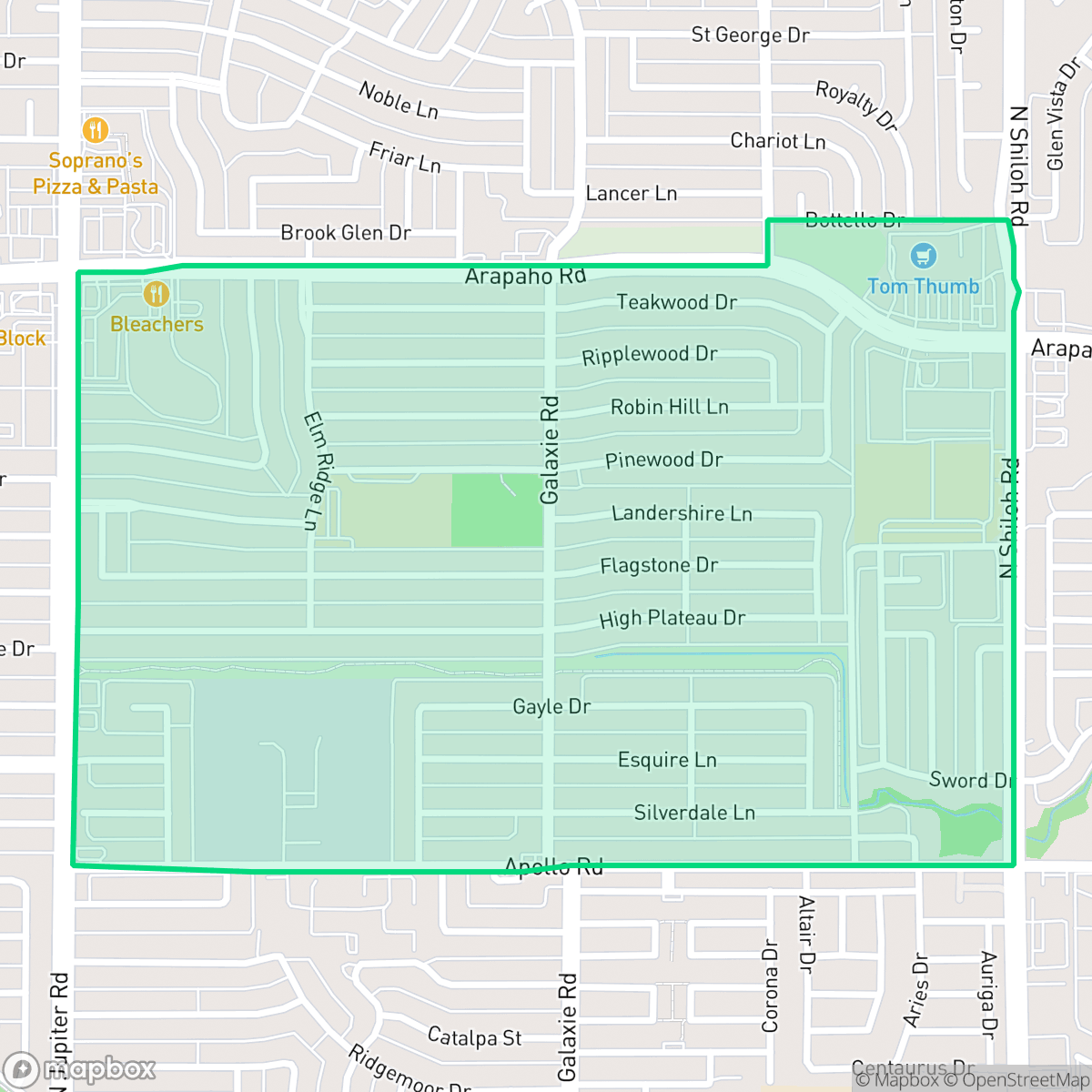
About Apollo Arapaho & Camelot
The Apollo, Arapaho, and Camelot areas in Garland, Texas, are suburban residential neighborhoods primarily developed between the 1970s and 1990s. The Camelot section, established in the 1970s, is defined by its organized community identity, supported by the Camelot Neighborhood Association (formed in 1980 as the Camelot Homeowners Association). Historically, this region transitioned from undeveloped land into a dense residential hub, characterized by mid-to-large single-family homes and a consistent architectural style reflecting its late 20th-century development period. The area is noted for its proximity to the Spring Creek Forest Preserve and local greenbelts, which serve as significant natural landmarks. While these neighborhoods lack a singular, deep-rooted historical founding era compared to older parts of Garland, they are recognized for their stable suburban character, diverse demographics, and long-standing community-led efforts to maintain local residential quality.
The area is defined by a consistent suburban layout that balances residential comfort with functional urban design. Its high walkability is a standout feature, as continuous sidewalks and marked crosswalks create a safe environment for pedestrians to navigate between residential zones and essential local services. The landscape is visually diverse, ranging from large single-family homes to more dense housing options, all supported by a strong sense of community that has evolved over several decades.
Prospective residents should consider that the neighborhood experiences a persistent hum of traffic noise due to its proximity to major arterials. While the area offers excellent access to green spaces, it also faces moderate flood risks and fluctuating air quality levels. It is well-suited for families and individuals who prioritize pedestrian access and a stable, established suburban atmosphere over absolute quiet or seclusion.
Neighborhood Scores Across 15 Qualities
Residential spacing is typical for the area, featuring a mix of closely packed lots and moderate backyard buffers. According to iHuus data, the density is roughly comparable to the Garland average.
Continuous sidewalks and marked crosswalks facilitate easy pedestrian movement through both residential streets and major arterials. This neighborhood offers a much more walkable environment than the Garland average, featuring dedicated pedestrian-priority zones and connected infrastructure near local schools.
Residential views range from affluent properties with large homes and private pools to more dense, standard suburban tract housing. This level of visual variety is consistent with the average seen across Garland.
Accessible green spaces and wide, grassy sidewalks provide more convenient walking options for pets than the Garland average. Large private yards and a central park area offer ample space for outdoor activity.
Dense suburban development characterizes this area, featuring a mix of single-family homes and multi-family apartment complexes. This residential fabric is slightly more developed than the surrounding Garland average, with a higher concentration of built structures and retail centers.
A steady rhythm of residential life and essential services defines this area, offering a slightly more active atmosphere than the Garland average. While various dining and social spots exist near green spaces and water, most businesses are not within easy walking distance.
Continuous noise from nearby busy streets is common in this area. According to iHuus data, acoustic comfort is slightly lower than the Garland average due to this persistent traffic sound.
Air quality levels fluctuate between acceptable and unhealthy periods, presenting occasional concerns for sensitive groups. According to iHuus data, conditions in this area are slightly better than the Garland city average.
Industrial presence is minimal across the area, though a wastewater treatment facility and some large storage units on the eastern edge introduce localized traffic and noise. While mostly composed of residential and light commercial uses, this area sits slightly below the Garland average for industrial-free living due to these specific utility and warehouse facilities.
Health insurance accessibility is notably higher than the Garland average, according to iHuus data. While coverage is present for a significant portion of the population, a substantial number of residents remain uninsured.
Political leanings in this area lean toward the liberal side, representing a slightly more progressive tilt than the Garland average.
Residents live alongside a balanced mix of young adults, families, and older populations. According to iHuus data, this demographic spread is slightly more varied than the Garland average.
Flood risk in this area is higher than the Garland average, though the specific level of danger remains undetermined due to a lack of detailed federal studies. According to iHuus data, the area sits in a category where flood patterns have not been fully mapped.
Address-Level Insights for Apollo Arapaho & Camelot


iHuus Neighborhood Intelligence Insights
Get address-level neighborhood insights for Apollo Arapaho & Camelot
- Street-level scores — see how individual blocks compare, not just neighborhood averages
- Micro-zone boundaries — identify quiet pockets, flood boundaries, and walkable clusters before you visit
- 15 dimensions in full — walkability, noise, air quality, school quality, insurance coverage, population age profile, urban/rural index, and more
- Boundary risk alerts — know if your address sits near a block boundary where scores drop, the kind of detail no listing will ever mention
- School insights — individual school ratings and insights, not just district-level data
- Compare before you commit — side-by-side data across neighborhoods, down to block precision
No credit card required
Compare with Any Neighborhood
| Dimension | Apollo Arapaho & Camelot | Almeta,Bonita, Bella Vista |
|---|---|---|
| 🚶 Walkabilityavg 7.61 | ||
| 🔊 Acoustic Comfortavg 4.47 | ||
| 🤫 Privacy Indexavg 5.66 | ||
| 🎨 Visual Appealavg 6.66 | ||
| 🐕 Dog Friendlinessavg 6.45 | ||
| 🗺️ Urban-Rural Indexavg 6.72 | ||
| ✨ Neighborhood Vibeavg 4.25 | ||
| 🏥 Health Insurance Coverageavg 4.8 | ||
| 🌿 Air Qualityavg 3.41 | ||
| 🏭 Industrial Proximityavg 8.38 | ||
| 🌊 Flood Safetyavg 3.27 | ||
| 🗳️ Ideological Leanavg 6.34 | ||
| 👥 Population Age Profileavg 4.65 | ||
| 🔥 Fire Safety | ||
| 🏫 School Quality |
Apollo Arapaho & Camelot Rankings
School Districts Serving Apollo Arapaho & Camelot
School Insights for Apollo Arapaho & Camelot
Below average outcomes; significant attendance and academic challenges.
School Insights
See what's really behind every school rating near Apollo Arapaho & Camelot
- Individual school ratings — each school's own score with outcome context, not just a district average
- Enrollment & class size data — student-to-teacher ratio and how it compares to the state average
- Full demographics breakdown — ethnicity and gender composition for every school in the enrollment zone
- Every school in the district — all schools within the enrollment boundary ranked by rating, not just the closest one
- Grade levels & benchmarks — elementary through high school, with below/above state-average flags
No credit card required