Woodhaven, Fort Worth
Updated · 9,801 residents
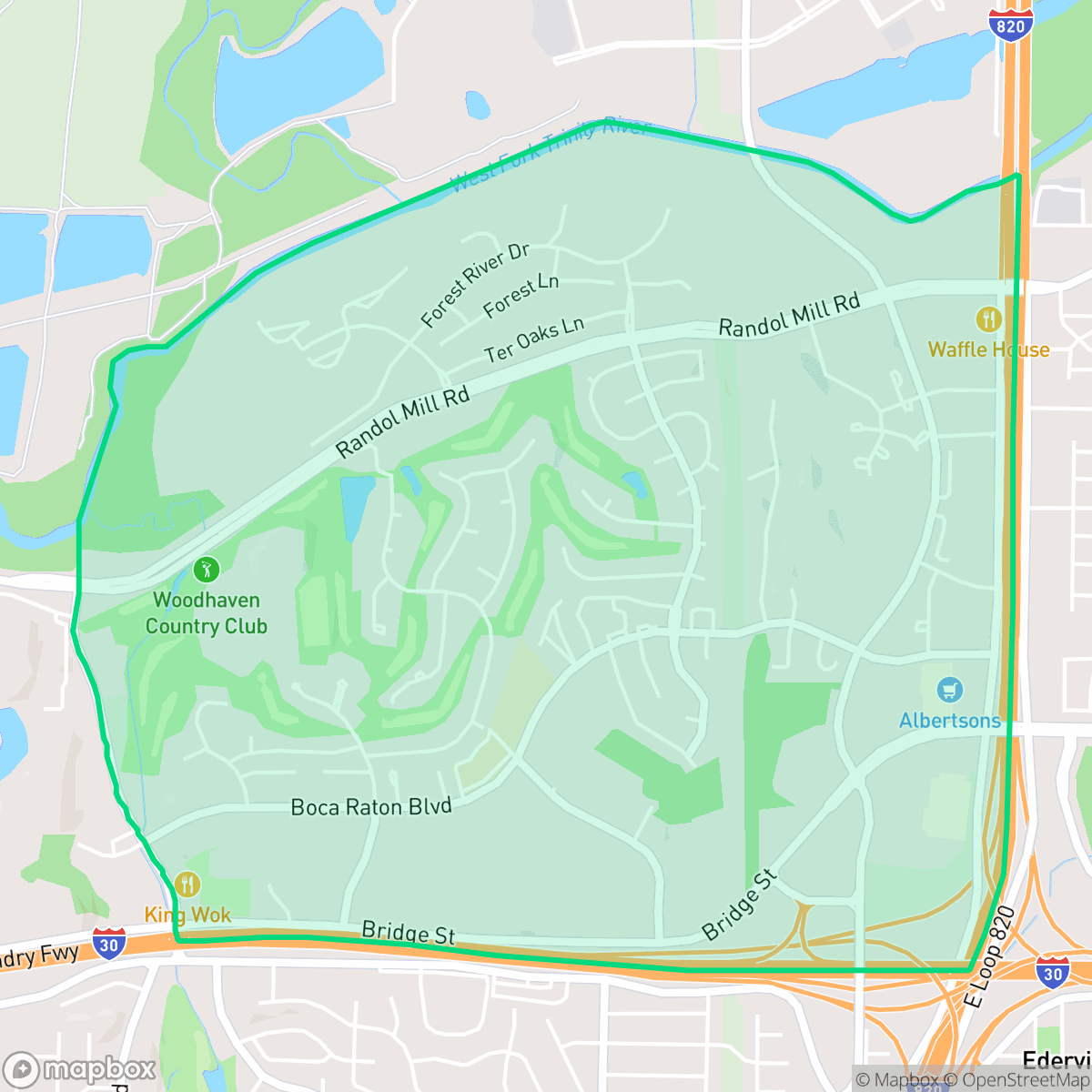
Woodhaven is a distinct east Fort Worth enclave defined by its abundant green space, mature trees, and a mix of mid-century residential styles. The area offers high walkability and exceptional dog friendliness, making it a quiet suburban retreat with convenient access to local dining and major transit corridors.
Key Highlights
About Woodhaven
Located in east Fort Worth, Woodhaven originated in 1969 when a group of prominent investors, including former Texas Governor John Connally and oil magnates Perry and Sid Bass, purchased a portion of the historic 1860s Boaz Ranch Estate. Envisioned as an exclusive, golf-oriented suburban enclave, development of upscale single-family homes began in the 1970s. The neighborhood centered around the 149-acre Woodhaven Country Club, which opened in 1973 with a course co-designed by professional golfer Terry Dill. Notable architecture includes a 1981 home designed by Elbert Spence for prominent Black community leader Joseph "Joe" Breedlove. After the country club closed in 2021 following years of decline, plans were approved in early 2025 to redevelop the former course into a mixed-use project of homes, apartments, and retail to revitalize the community.
The area is characterized by its visual appeal, featuring custom homes, private pools, and extensive wooded buffers that contribute to a serene atmosphere. Residents benefit from a layout that balances residential privacy with proximity to light commercial services, including diverse dining options along major thoroughfares. According to iHuus data, the neighborhood maintains a strong suburban identity with significant greenery that supports a high level of dog friendliness and outdoor accessibility. Prospective residents should note that the area experiences moderate noise levels primarily from road traffic, though it remains insulated from heavy industrial activity. While the neighborhood provides a quiet environment, it is important to consider that local school performance varies significantly depending on the district, and flood safety remains a factor to evaluate. It is well-suited for those who prioritize an established, greenery-rich suburban setting over a high-density urban lifestyle.
Neighborhood Scores Across 15 Qualities
Residential density varies from compact townhomes to larger estates with wooded buffers. This level of privacy and separation is slightly higher than the Fort Worth average, according to iHuus data.
Residential streets and cul-de-sacs offer safe paths for pedestrians, though a major high-traffic highway limits connectivity compared to the Fort Worth average. According to iHuus data, sidewalks are present on most roads and main thoroughfares.
Manicured landscapes, custom homes, and golf course frontage contribute to a visual quality that is notably higher than the Fort Worth average. According to iHuus data, the presence of private pools and expansive driveways characterizes much of the area.
Abundant green corridors, golf course fairways, and wooded patches provide ample space for pets. According to iHuus data, the availability of connected trails and wide grassy buffers makes this area significantly more dog-friendly than the Fort Worth average.
Open land and wooded areas are common throughout the neighborhood, offering a slightly more rural atmosphere than the Fort Worth average. According to iHuus data, the area serves as a transition zone where residential clusters meet undeveloped green space.
A mix of quiet residential pockets and more active commercial corridors provides a level of activity that is higher than the Fort Worth average. While some areas offer accessible dining and social hubs, much of the neighborhood's vitality is concentrated near major highways and remains primarily car-dependent.
Frequent noise from nearby railroad lines and major freeways characterizes the area. According to iHuus data, acoustic comfort levels in Woodhaven are slightly lower than the Fort Worth average.
Frequent unhealthy air quality levels pose a significant risk to sensitive groups. According to iHuus data, the air quality in Woodhaven is notably worse than the Fort Worth average.
Industrial presence is minimal within the neighborhood, offering a landscape composed almost entirely of residential and light commercial spaces. This area maintains a higher level of separation from heavy industry than the Fort Worth average, according to iHuus data.
Health insurance accessibility in Woodhaven is slightly below the Fort Worth average, according to iHuus data. Residents may find fewer neighbors with comprehensive coverage compared to the rest of the city.
Political leanings in this area trend significantly more liberal than the Fort Worth average. According to iHuus data, residents here inhabit a community with a liberal majority and a modest opposing presence.
A balanced mix of young adults, families, and older residents defines the area. This demographic spread is slightly more varied than the Fort Worth average, according to iHuus data.
Property located within a designated 100-year floodplain, which means flood insurance is typically required for residents. According to iHuus data, this level of risk is higher than the Fort Worth average.
Address-Level Insights for Woodhaven


iHuus Neighborhood Intelligence Insights
Get address-level neighborhood insights for Woodhaven
- Street-level scores — see how individual blocks compare, not just neighborhood averages
- Micro-zone boundaries — identify quiet pockets, flood boundaries, and walkable clusters before you visit
- 15 dimensions in full — walkability, noise, air quality, school quality, insurance coverage, population age profile, urban/rural index, and more
- Boundary risk alerts — know if your address sits near a block boundary where scores drop, the kind of detail no listing will ever mention
- School insights — individual school ratings and insights, not just district-level data
- Compare before you commit — side-by-side data across neighborhoods, down to block precision
No credit card required
Compare with Any Neighborhood
| Dimension | Woodhaven | Alamo Heights |
|---|---|---|
| 🚶 Walkabilityavg 7.5 | ||
| 🔊 Acoustic Comfortavg 4.12 | ||
| 🤫 Privacy Indexavg 5.64 | ||
| 🎨 Visual Appealavg 6.38 | ||
| 🐕 Dog Friendlinessavg 6.57 | ||
| 🗺️ Urban-Rural Indexavg 6.92 | ||
| ✨ Neighborhood Vibeavg 4.56 | ||
| 🏥 Health Insurance Coverageavg 5.8 | ||
| 🌿 Air Qualityavg 3.68 | ||
| 🏭 Industrial Proximityavg 8.13 | ||
| 🌊 Flood Safetyavg 3.61 | ||
| 🗳️ Ideological Leanavg 5.62 | ||
| 👥 Population Age Profileavg 4.51 | ||
| 🔥 Fire Safety | ||
| 🏫 School Quality |
Woodhaven Rankings
School Districts Serving Woodhaven
School Insights for Woodhaven
Below average outcomes; significant attendance and academic challenges.
School Insights
See what's really behind every school rating near Woodhaven
- Individual school ratings — each school's own score with outcome context, not just a district average
- Enrollment & class size data — student-to-teacher ratio and how it compares to the state average
- Full demographics breakdown — ethnicity and gender composition for every school in the enrollment zone
- Every school in the district — all schools within the enrollment boundary ranked by rating, not just the closest one
- Grade levels & benchmarks — elementary through high school, with below/above state-average flags
No credit card required