Westland, Fort Worth
Updated · 727 residents
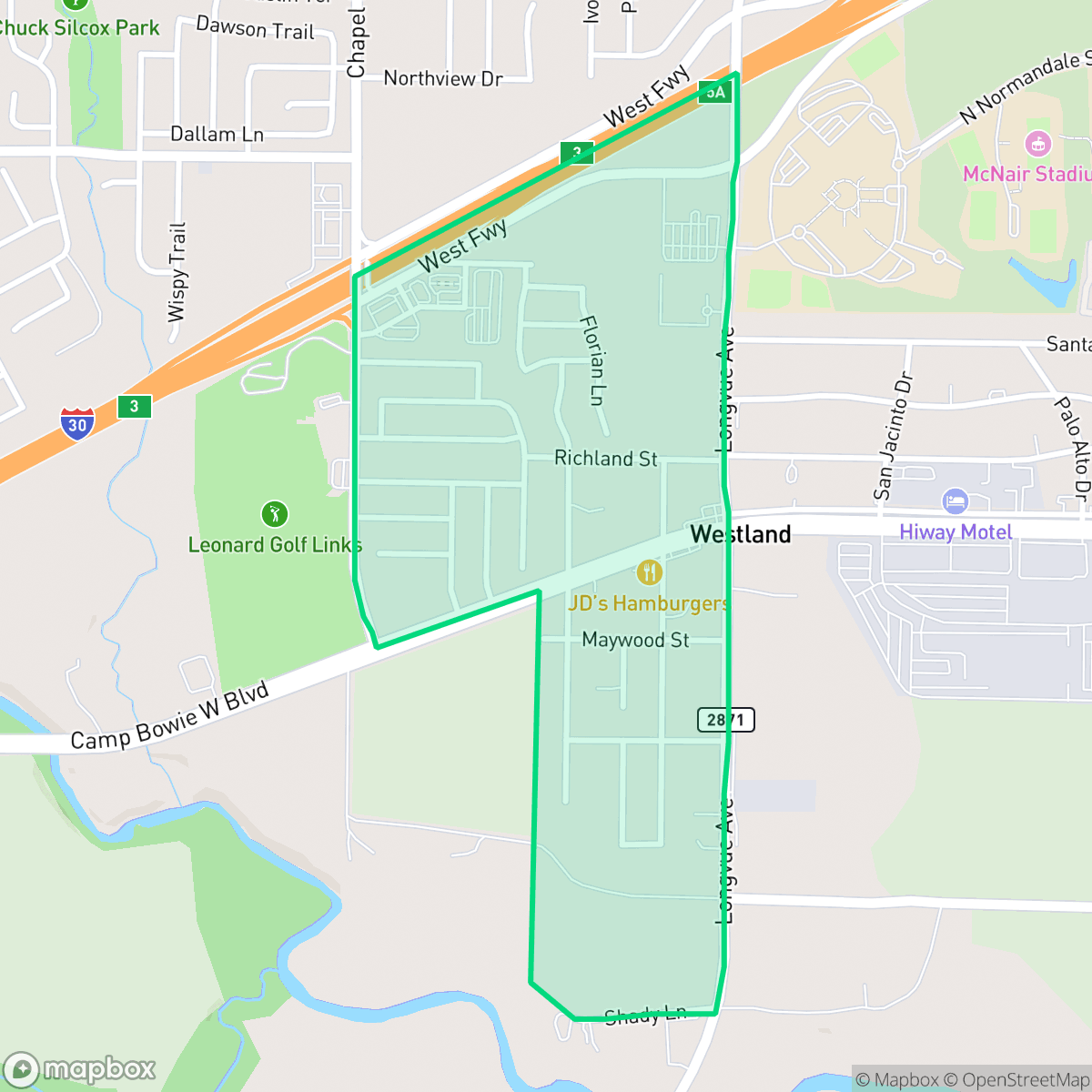
Westland is a quiet suburban community in western Fort Worth defined by its mix of residential streets and light industrial corridors. While the area offers a unique cultural identity anchored by historic dining spots, residents should be prepared for significant road noise from nearby highways and limited walkability.
Key Highlights
About Westland
Originally a rural community in western Tarrant County, Westland developed as a suburban neighborhood following the platting of the area and its subsequent annexation by Fort Worth in 1962. Historically situated along a bustling six-mile stretch of Highway 80 (part of the historic Bankhead Highway), Westland was a vibrant hub of activity in the mid-20th century before new interstate routes redirected traffic away. The neighborhood's cultural character is anchored by local landmarks like Margie’s Italian Gardens (originally Margie’s Original Italian Kitchen), a beloved dining institution founded in 1953 by Italian immigrants Tina Lozzi and Margie Walters. In recent years, Westland has experienced a cultural renaissance, driven by local restaurateurs revitalizing historic spaces along Camp Bowie West Boulevard with new dining destinations.
The neighborhood functions as a blend of residential living and active commercial zones, characterized by a suburban layout that prioritizes vehicle access over pedestrian infrastructure. Residents benefit from higher than average health insurance coverage rates compared to the broader city, though the area faces challenges regarding flood safety and acoustic comfort due to its proximity to major traffic arteries. The environment is marked by a moderate urban-rural balance, offering a distinct suburban feel that remains connected to the city's commercial pulse.
Prospective residents should weigh the appeal of revitalized local dining and a modest, quiet atmosphere against the realities of the local school district, which currently faces significant operational and financial hurdles. The community is best suited for those who prioritize proximity to major travel routes and a suburban lifestyle over high walkability or secluded environments. Given the current infrastructure and district conditions, it remains a location where residents typically rely on personal vehicles for daily needs.
Neighborhood Scores Across 15 Qualities
Residential spacing provides a balanced level of separation between neighbors, offering slightly more privacy than the Fort Worth average. According to iHuus data, the area features a mix of density that maintains some buffer between adjacent properties.
Quiet streets make for low-traffic walking, but the lack of sidewalks makes this area less walkable than the Fort Worth average. According to iHuus data, pedestrian infrastructure is minimal in this neighborhood.
Standard tract housing defines the landscape, characterized by uniform rooflines and modest yards. This visual profile is slightly below the Fort Worth average according to iHuus data.
Wide paths and connected green spaces provide ample space for exercise; according to iHuus data, this area offers greater accessibility for dogs than the Fort Worth average.
Frequent open land and scattered homes provide a more semi-rural atmosphere than much of Fort Worth. This exurban transition zone features a mix of low-density residential areas, industrial warehouses, and open fields according to iHuus data.
Low commercial density and a prevalence of industrial corridors mean that most daily needs require a vehicle. According to iHuus data, the area lacks the active street life and frequent amenities found throughout much of Fort Worth.
Frequent sounds from nearby major freeways and railroad lines characterize the area. According to iHuus data, acoustic comfort in Westland is lower than the Fort Worth average.
Air quality levels fluctuate between acceptable and unhealthy, presenting occasional concerns for sensitive groups. This reflects a status slightly higher than the Fort Worth average, according to iHuus data.
Primarily residential streets and green spaces define the area, though some large logistics warehouses and truck docks are present. According to iHuus data, industrial proximity is lower than the Fort Worth average due to the absence of significant heavy industrial zones.
Health insurance access is more prevalent in Westland than in the rest of Fort Worth, according to iHuus data.
Political leanings in Westland lean significantly toward conservative values, representing a notable departure from the more politically balanced average seen across Fort Worth.
A balanced distribution of young adults, families, and older residents defines the local community. This demographic spread is largely consistent with the broader Fort Worth area, according to iHuus data.
Property located within a 100-year floodplain face significant flooding risks, which is notably higher than the Fort Worth average. According to iHuus data, residents should anticipate the potential requirement for flood insurance.
Address-Level Insights for Westland


iHuus Neighborhood Intelligence Insights
Get address-level neighborhood insights for Westland
- Street-level scores — see how individual blocks compare, not just neighborhood averages
- Micro-zone boundaries — identify quiet pockets, flood boundaries, and walkable clusters before you visit
- 15 dimensions in full — walkability, noise, air quality, school quality, insurance coverage, population age profile, urban/rural index, and more
- Boundary risk alerts — know if your address sits near a block boundary where scores drop, the kind of detail no listing will ever mention
- School insights — individual school ratings and insights, not just district-level data
- Compare before you commit — side-by-side data across neighborhoods, down to block precision
No credit card required
Compare with Any Neighborhood
| Dimension | Westland | Alamo Heights |
|---|---|---|
| 🚶 Walkabilityavg 7.5 | ||
| 🔊 Acoustic Comfortavg 4.12 | ||
| 🤫 Privacy Indexavg 5.64 | ||
| 🎨 Visual Appealavg 6.38 | ||
| 🐕 Dog Friendlinessavg 6.57 | ||
| 🗺️ Urban-Rural Indexavg 6.92 | ||
| ✨ Neighborhood Vibeavg 4.56 | ||
| 🏥 Health Insurance Coverageavg 5.8 | ||
| 🌿 Air Qualityavg 3.68 | ||
| 🏭 Industrial Proximityavg 8.13 | ||
| 🌊 Flood Safetyavg 3.61 | ||
| 🗳️ Ideological Leanavg 5.62 | ||
| 👥 Population Age Profileavg 4.51 | ||
| 🔥 Fire Safety | ||
| 🏫 School Quality |
Westland Rankings
School Districts Serving Westland
School Insights for Westland
Below average outcomes; significant attendance and academic challenges.
School Insights
See what's really behind every school rating near Westland
- Individual school ratings — each school's own score with outcome context, not just a district average
- Enrollment & class size data — student-to-teacher ratio and how it compares to the state average
- Full demographics breakdown — ethnicity and gender composition for every school in the enrollment zone
- Every school in the district — all schools within the enrollment boundary ranked by rating, not just the closest one
- Grade levels & benchmarks — elementary through high school, with below/above state-average flags
No credit card required