Western Hills North, Fort Worth
Updated · 5,189 residents
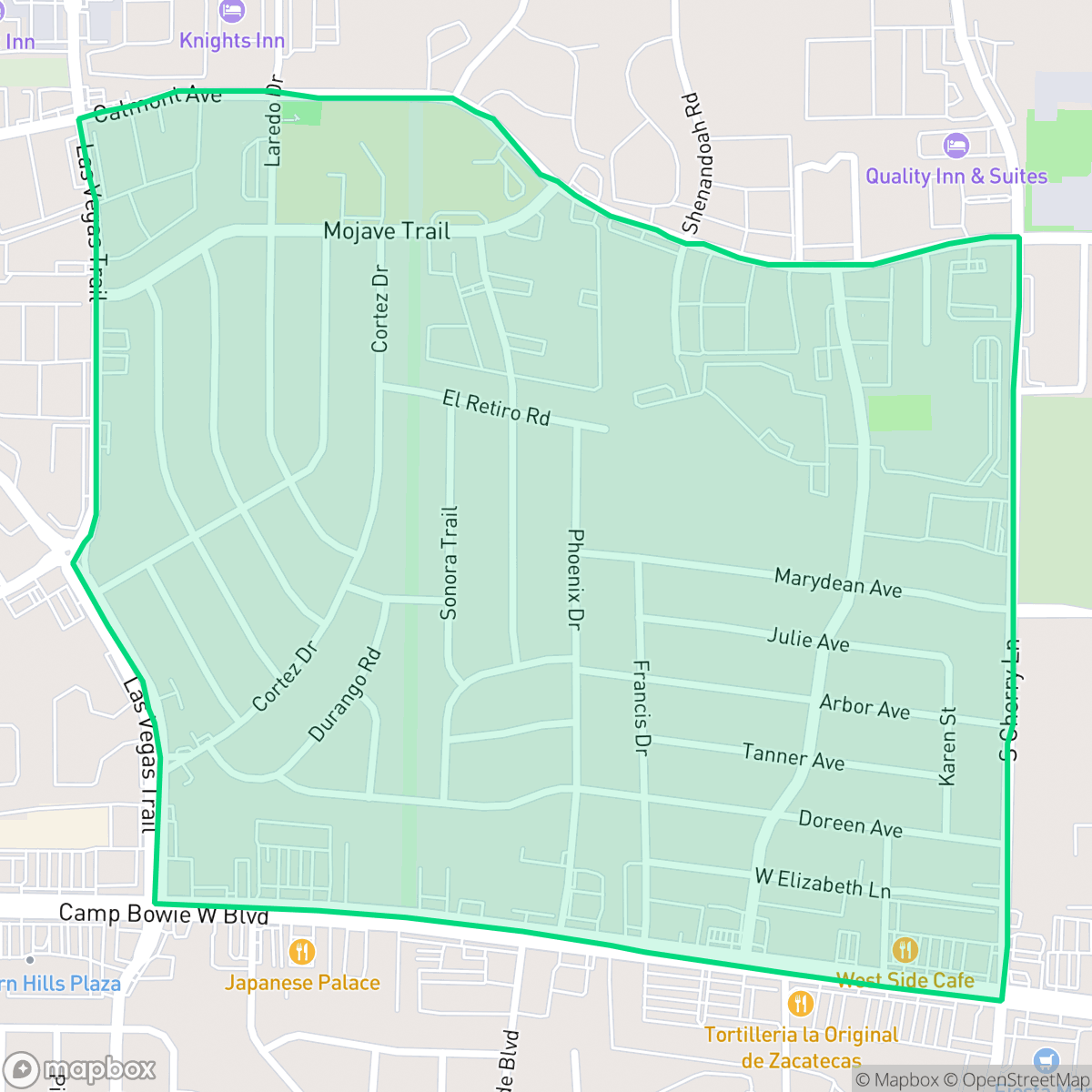
Western Hills North is a lively suburban enclave in Fort Worth characterized by its mid-century architectural roots and high walkability. Residents enjoy convenient access to daily essentials and local dining, though the area experiences moderate noise levels from nearby highway traffic.
Key Highlights
About Western Hills North
Western Hills North emerged during Fort Worth's post-war expansion in the mid-1950s, developed to support the growing workforce of the nearby Naval Air Station and Lockheed Martin (then Convair). The neighborhood took its name from the iconic Western Hills Hotel, a glamorous 1950s motor inn on Camp Bowie Boulevard celebrated for its celebrity guests and Polynesian-themed pool. Developed primarily between 1955 and 1965, the residential enclave is defined by its mid-century architectural identity, characterized by single-story, brick ranch-style homes with classic low-pitched roofs. The community's residential character was further solidified in 1965 with the dedication of the Western Hills Neighborhood Park, which remains a central hub for the neighborhood.
The neighborhood functions as a dense suburban hub that blends residential comfort with active commercial convenience. According to iHuus data, the area boasts exceptional walkability, with continuous sidewalk infrastructure that connects homes to local social anchors like the Light Connection Church and various dining establishments such as Terrebonne's and Tortilleria La Original. While the landscape is defined by a mix of single-family brick ranch homes and multi-story apartment complexes, the community maintains a consistent, active atmosphere that benefits from its proximity to major transit corridors.
Prospective residents should consider the trade-offs between accessibility and environmental factors. While the location offers high walkability and a strong sense of community, the proximity to major highways results in consistent road noise that averages 56 decibels. Families may find the educational landscape varied, as the area is served by both the stable White Settlement Independent School District and the more volatile Fort Worth Independent School District. This neighborhood is best suited for individuals who prioritize daily convenience and a social, suburban environment over complete acoustic isolation.
Neighborhood Scores Across 15 Qualities
Residential spacing varies between shared apartment walls and typical suburban yards, offering a level of privacy comparable to the Fort Worth average.
Continuous sidewalks on both sides of residential and arterial roads facilitate safe pedestrian movement. Connectivity across major roads and low-traffic streets is slightly above the Fort Worth average, according to iHuus data.
Typical tract housing and apartment clusters define the area, featuring uniform rooflines and modest yards. This visual landscape is slightly less varied than the Fort Worth average.
Available green spaces and large grassy fields offer decent areas for exercise, though overall dog friendliness is slightly below the Fort Worth average. Consistent sidewalk verges and accessible detention basins provide reliable routes for daily walks.
Open land and woodland areas are interspersed with denser suburban developments, providing a landscape slightly less rural than the Fort Worth average. According to iHuus data, the area features a blend of single-family homes, apartment complexes, and undeveloped parcels.
A variety of social hubs and dining options provide more activity than the typical Fort Worth neighborhood, though the area remains primarily suburban and car-dependent. While diverse eateries and community spaces exist, the landscape consists of a mix of residential blocks, green spaces, and light industrial units.
Steady hum from nearby busy streets defines the acoustic environment. According to iHuus data, noise levels are slightly higher than the Fort Worth average.
Air quality levels in Western Hills North vary between acceptable and unhealthy, with occasional concerns for sensitive groups. According to iHuus data, these conditions are slightly better than the Fort Worth city average.
Industrial presence is minimal throughout the area, though some large warehouses and logistics hubs are located near the southern edge. According to iHuus data, the neighborhood maintains a slightly higher level of industrial proximity compared to the Fort Worth average.
Health insurance accessibility in this area is slightly above the Fort Worth average, according to iHuus data.
Political leanings in this area are more liberal than the Fort Worth average, characterized by a liberal majority with a modest opposing presence according to iHuus data.
Residents live alongside a balanced mix of young adults, families, and older populations. This demographic variety is slightly more diverse than the average seen across Fort Worth, according to iHuus data.
Properties in this area are located within a known floodplain, making flood insurance a likely requirement for residents. According to iHuus data, the risk of flooding in Western Hills North is significantly higher than the Fort Worth average.
Address-Level Insights for Western Hills North


iHuus Neighborhood Intelligence Insights
Get address-level neighborhood insights for Western Hills North
- Street-level scores — see how individual blocks compare, not just neighborhood averages
- Micro-zone boundaries — identify quiet pockets, flood boundaries, and walkable clusters before you visit
- 15 dimensions in full — walkability, noise, air quality, school quality, insurance coverage, population age profile, urban/rural index, and more
- Boundary risk alerts — know if your address sits near a block boundary where scores drop, the kind of detail no listing will ever mention
- School insights — individual school ratings and insights, not just district-level data
- Compare before you commit — side-by-side data across neighborhoods, down to block precision
No credit card required
Compare with Any Neighborhood
| Dimension | Western Hills North | Alamo Heights |
|---|---|---|
| 🚶 Walkabilityavg 7.5 | ||
| 🔊 Acoustic Comfortavg 4.12 | ||
| 🤫 Privacy Indexavg 5.64 | ||
| 🎨 Visual Appealavg 6.38 | ||
| 🐕 Dog Friendlinessavg 6.57 | ||
| 🗺️ Urban-Rural Indexavg 6.92 | ||
| ✨ Neighborhood Vibeavg 4.56 | ||
| 🏥 Health Insurance Coverageavg 5.8 | ||
| 🌿 Air Qualityavg 3.68 | ||
| 🏭 Industrial Proximityavg 8.13 | ||
| 🌊 Flood Safetyavg 3.61 | ||
| 🗳️ Ideological Leanavg 5.62 | ||
| 👥 Population Age Profileavg 4.51 | ||
| 🔥 Fire Safety | ||
| 🏫 School Quality |
Western Hills North Rankings
School Districts Serving Western Hills North
School Insights for Western Hills North
Below average outcomes; significant attendance and academic challenges.
School Insights
See what's really behind every school rating near Western Hills North
- Individual school ratings — each school's own score with outcome context, not just a district average
- Enrollment & class size data — student-to-teacher ratio and how it compares to the state average
- Full demographics breakdown — ethnicity and gender composition for every school in the enrollment zone
- Every school in the district — all schools within the enrollment boundary ranked by rating, not just the closest one
- Grade levels & benchmarks — elementary through high school, with below/above state-average flags
No credit card required