Westcliff West, Fort Worth
Updated · 1,759 residents
Westcliff West is a quiet, low-density residential enclave in Fort Worth, defined by its exceptional visual appeal and well-preserved mid-century ranch architecture. While the area offers a serene, peaceful atmosphere with minimal noise, residents should expect limited walkability and a reliance on personal vehicles for daily errands.
Key Highlights
About Westcliff West
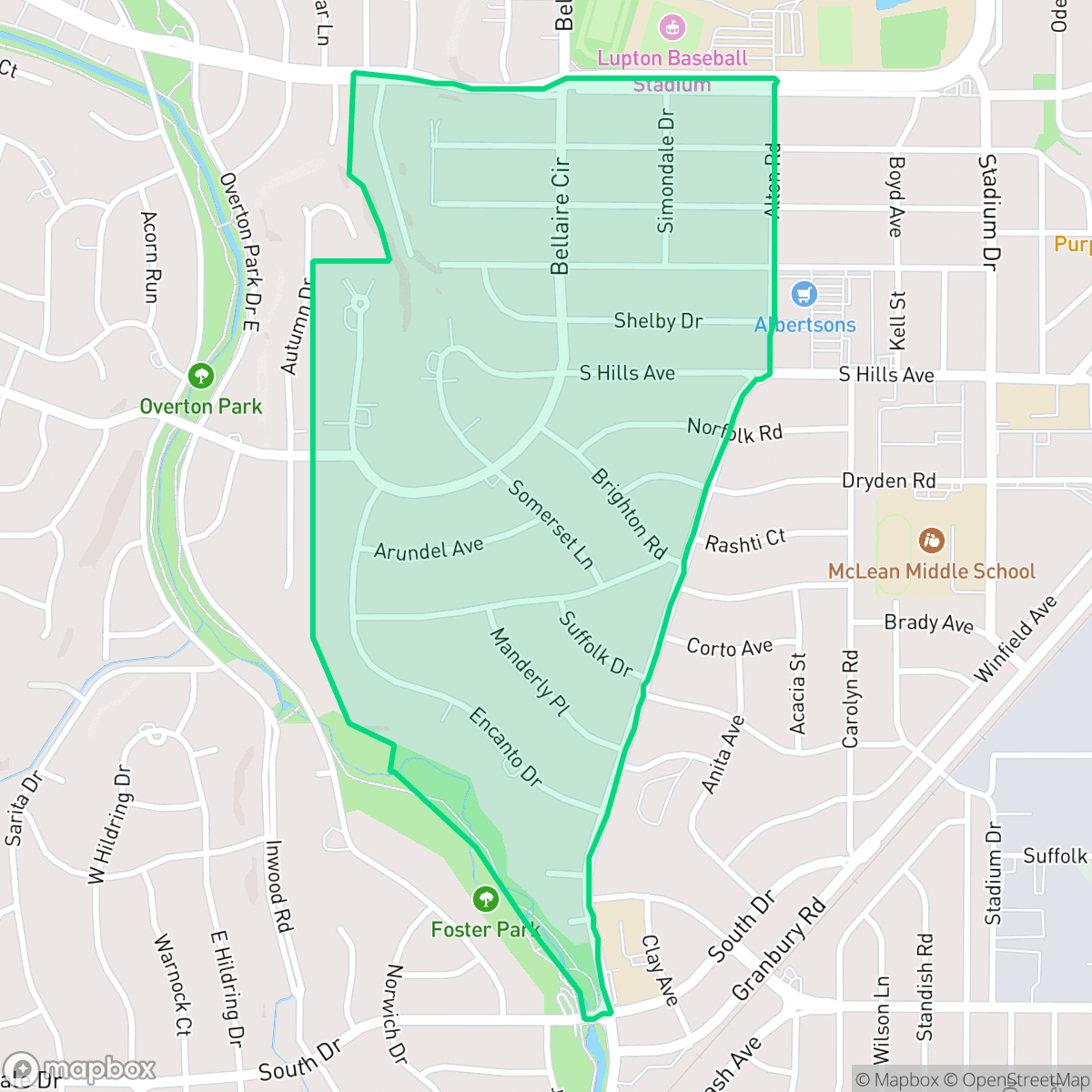
Located south of Texas Christian University (TCU) in Fort Worth, Westcliff West is a historic neighborhood that evolved from the 1867 Thomas B. Taylor Survey and the historic Edwards Ranch. Developed primarily from the late 1940s through the 1960s, the neighborhood saw expansion along streets like Encanto Drive and Manderly Place starting in 1949. The area is characterized by its quiet, tree-lined streets, large lots, and mid-century ranch-style homes. Local life centers around Foster Park on its southern boundary and the nearby Westcliff Shopping Center. Built in 1945, the shopping center was recently restored to uncover its original 1950s cast-stone facade. The active Westcliff West Neighborhood Association preserves the community’s mid-century character and hosts long-standing traditions like the annual Independence Day parade.
This neighborhood stands out for its high visual appeal and tranquil environment, offering a sense of privacy that is rare in more densely populated urban sections. According to iHuus data, the area maintains a high level of acoustic comfort, making it an ideal choice for those who prioritize a quiet living space over the bustle of city life. The low density and open green spaces contribute to a rural-like feel within the city limits, providing a distinct aesthetic character that remains consistent across its established residential blocks.
Prospective residents should consider that the area has moderate walkability, meaning most daily services require a short drive. Families should be aware that the local school district currently faces significant operational and financial challenges, which may influence long-term planning. Despite these factors, the neighborhood boasts high rates of health insurance coverage and a stable, mature demographic, making it well-suited for professionals and retirees who value a peaceful, aesthetically pleasing environment above proximity to high-energy commercial districts.
Neighborhood Scores Across 15 Qualities
Housing density is moderate with mixed spacing between properties, offering slightly more buffer between neighbors than the Fort Worth average according to iHuus data.
Pedestrian travel is supported by safe crossings and sidewalks present on one side of the street, making the area consistent with the Fort Worth average.
Large residences and frequent upscale amenities create a landscape that is notably more aesthetically pleasing than the Fort Worth average. According to iHuus data, the area features spacious driveways and well-maintained property characteristics.
Access to connected green spaces and wide, low-traffic paths makes this area more suitable for pet owners than the Fort Worth average. According to iHuus data, the neighborhood provides safe environments for walking dogs away from heavy traffic.
Open land and scattered homes among woodlands define this area. This landscape is more rural than most of Fort Worth, according to iHuus data.
Low density and limited commercial activity create a peaceful environment, though residents will find the area less active than the Fort Worth average. Most daily needs require a vehicle, as local services and small businesses are scattered throughout a primarily suburban landscape.
Acoustic levels remain low with only infrequent sounds from distant traffic or trains. This area is significantly quieter than the Fort Worth average, according to iHuus data.
Air quality levels fluctuate between acceptable and unhealthy, presenting occasional concerns for sensitive groups. This area maintains a slightly better air quality profile than the Fort Worth average according to iHuus data.
Industrial activity is virtually nonexistent here, offering a much higher level of separation from warehouses and manufacturing sites than the Fort Worth average. According to iHuus data, the area is composed of residential streets and local services without any detected hazard sites or heavy industrial facilities.
Health insurance accessibility is notably higher here than the Fort Worth average, according to iHuus data. Residents in this area benefit from significantly greater rates of coverage compared to the rest of the city.
Conservative voters form a significant majority in this area, representing a notable shift from the more politically balanced average found across Fort Worth.
Residents live alongside a varied mix of young adults, families, and older populations. This age distribution is largely in line with the broader Fort Worth area, according to iHuus data.
Flood safety levels in Westcliff West are notably higher than the Fort Worth average, though the area remains under a moderate risk designation. According to iHuus data, a detailed study from FEMA is currently unavailable for this specific location.
Address-Level Insights for Westcliff West


iHuus Neighborhood Intelligence Insights
Get address-level neighborhood insights for Westcliff West
- Street-level scores — see how individual blocks compare, not just neighborhood averages
- Micro-zone boundaries — identify quiet pockets, flood boundaries, and walkable clusters before you visit
- 15 dimensions in full — walkability, noise, air quality, school quality, insurance coverage, population age profile, urban/rural index, and more
- Boundary risk alerts — know if your address sits near a block boundary where scores drop, the kind of detail no listing will ever mention
- School insights — individual school ratings and insights, not just district-level data
- Compare before you commit — side-by-side data across neighborhoods, down to block precision
No credit card required
Compare with Any Neighborhood
| Dimension | Westcliff West | Alamo Heights |
|---|---|---|
| 🚶 Walkabilityavg 7.5 | ||
| 🔊 Acoustic Comfortavg 4.12 | ||
| 🤫 Privacy Indexavg 5.64 | ||
| 🎨 Visual Appealavg 6.38 | ||
| 🐕 Dog Friendlinessavg 6.57 | ||
| 🗺️ Urban-Rural Indexavg 6.92 | ||
| ✨ Neighborhood Vibeavg 4.56 | ||
| 🏥 Health Insurance Coverageavg 5.8 | ||
| 🌿 Air Qualityavg 3.68 | ||
| 🏭 Industrial Proximityavg 8.13 | ||
| 🌊 Flood Safetyavg 3.61 | ||
| 🗳️ Ideological Leanavg 5.62 | ||
| 👥 Population Age Profileavg 4.51 | ||
| 🔥 Fire Safety | ||
| 🏫 School Quality |
Westcliff West Rankings
School Districts Serving Westcliff West
School Insights for Westcliff West
Below average outcomes; significant attendance and academic challenges.
School Insights
See what's really behind every school rating near Westcliff West
- Individual school ratings — each school's own score with outcome context, not just a district average
- Enrollment & class size data — student-to-teacher ratio and how it compares to the state average
- Full demographics breakdown — ethnicity and gender composition for every school in the enrollment zone
- Every school in the district — all schools within the enrollment boundary ranked by rating, not just the closest one
- Grade levels & benchmarks — elementary through high school, with below/above state-average flags
No credit card required