West Meadowbrook, Fort Worth
Updated · 10,331 residents
West Meadowbrook is a dense, suburban-urban mix in east Fort Worth that blends historic residential streets with active commercial corridors. While the area provides access to significant nature preserves and diverse local dining, residents rely primarily on vehicles for daily travel due to a layout that prioritizes connectivity for cars over pedestrians.
Key Highlights
About West Meadowbrook
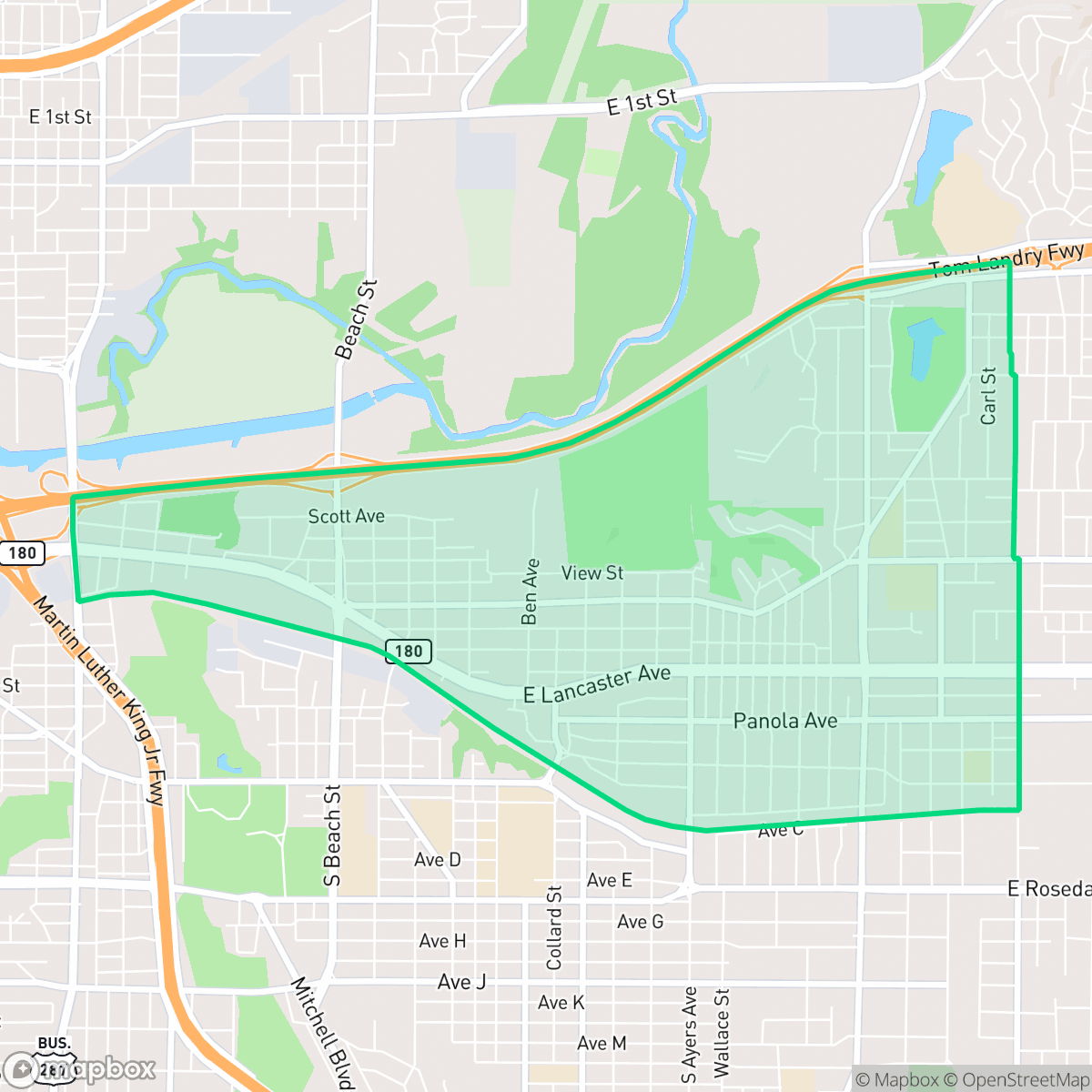
West Meadowbrook, located in east Fort Worth, Texas, traces its origins to the early 20th century when George E. Tandy, a descendant of the area's pioneer settlers, platted and developed the neighborhood along the local streetcar line. The historic streetcar route ran along East Lancaster Avenue and Meadowbrook Drive, terminating at Ayers Street, where a small historic commercial hub still stands. Annexed by Fort Worth in 1922, the scenic, tree-lined neighborhood features well-preserved historic homes, including impressive 1910s Craftsman bungalows like the Tandy House, alongside mid-century residences. West Meadowbrook is defined by its abundant green spaces, notably the Tandy Hills Nature Preserve, Oakland Lake Park, and Gateway Park, which offer extensive trail systems and preserve the area’s rolling, hilly topography.
This neighborhood functions as a transition zone where quiet residential blocks meet light industrial activity, including printing services and warehouse storage near the railway. The local atmosphere is defined by a steady rhythm of daily life, supported by a variety of dining options ranging from casual taco spots to long-standing cafes. According to iHuus data, the area maintains a distinct identity through its consistent grid layout and proximity to green space, though the proximity to major roads creates a noticeable acoustic environment with average noise levels around 60 decibels.
Prospective residents should consider that while the neighborhood offers an established community feel, the overall walkability is limited by industrial zones and major thoroughfares. Families often look toward Meadowbrook Elementary, which maintains an 8/10 rating, though the broader Fort Worth Independent School District currently faces fiscal and operational instability. With a higher-than-average density and tight lot spacing, privacy is a notable trade-off for those seeking a more secluded suburban experience. According to iHuus, the area remains a practical choice for those prioritizing access to regional landmarks over high-density urban walkability.
Neighborhood Scores Across 15 Qualities
Housing density is moderate with some buffering between neighbors, though certain areas feature closely packed homes and small side yards. This level of privacy is slightly higher than the Fort Worth average according to iHuus data.
Low traffic volumes and quiet streets make for pleasant strolls, though the lack of consistent sidewalks and the presence of a central rail line make it less walkable than the Fort Worth average.
Standard tract housing dominates the landscape, featuring uniform rooflines and modest yards. According to iHuus data, the visual variety in this area is lower than the Fort Worth average.
Narrow sidewalk verges and private fencing characterize the residential blocks, with no parks visible within the immediate neighborhood area. According to iHuus data, the accessibility of public green space for pets is slightly below the Fort Worth average.
Expansive green spaces and river corridors blend with low-density residential pockets and industrial areas. This landscape provides a mix of open land and suburban infrastructure that is consistent with the Fort Worth average.
Local activity is steady but mild, providing a balanced mix of residential life and essential services that is slightly more active than the Fort Worth average. While many neighborhoods offer diverse dining and social hubs, much of the area remains quiet and car-dependent due to the presence of industrial units and highway corridors.
Frequent noise from nearby freeways and railroad tracks defines the local acoustic environment. This level of disturbance is higher than the average for Fort Worth, according to iHuus data.
Air quality in this area fluctuates between acceptable and unhealthy levels, though it remains slightly better than the Fort Worth average. Sensitive individuals may experience occasional concerns during certain periods according to iHuus data.
Residential tranquility is maintained by a lack of heavy industry, as the area is largely free of large-scale logistics hubs or significant warehouse activity. According to iHuus data, the neighborhood experience is consistent with the Fort Worth average for industrial proximity.
Health insurance access is notably lower in West Meadowbrook than in the broader Fort Worth area. According to iHuus data, a smaller proportion of the local population maintains health coverage compared to the city average.
Political leanings in this area skew significantly toward liberal values, representing a notable departure from the broader Fort Worth average according to iHuus data.
Residents live alongside a balanced variety of young adults, families, and older neighbors. This age distribution is consistent with the broader Fort Worth area according to iHuus data.
Properties in this area are situated within a known floodplain, meaning flood insurance is typically required for residents. According to iHuus data, the risk level is comparable to the broader Fort Worth area.
Address-Level Insights for West Meadowbrook


iHuus Neighborhood Intelligence Insights
Get address-level neighborhood insights for West Meadowbrook
- Street-level scores — see how individual blocks compare, not just neighborhood averages
- Micro-zone boundaries — identify quiet pockets, flood boundaries, and walkable clusters before you visit
- 15 dimensions in full — walkability, noise, air quality, school quality, insurance coverage, population age profile, urban/rural index, and more
- Boundary risk alerts — know if your address sits near a block boundary where scores drop, the kind of detail no listing will ever mention
- School insights — individual school ratings and insights, not just district-level data
- Compare before you commit — side-by-side data across neighborhoods, down to block precision
No credit card required
Compare with Any Neighborhood
| Dimension | West Meadowbrook | Alamo Heights |
|---|---|---|
| 🚶 Walkabilityavg 7.5 | ||
| 🔊 Acoustic Comfortavg 4.12 | ||
| 🤫 Privacy Indexavg 5.64 | ||
| 🎨 Visual Appealavg 6.38 | ||
| 🐕 Dog Friendlinessavg 6.57 | ||
| 🗺️ Urban-Rural Indexavg 6.92 | ||
| ✨ Neighborhood Vibeavg 4.56 | ||
| 🏥 Health Insurance Coverageavg 5.8 | ||
| 🌿 Air Qualityavg 3.68 | ||
| 🏭 Industrial Proximityavg 8.13 | ||
| 🌊 Flood Safetyavg 3.61 | ||
| 🗳️ Ideological Leanavg 5.62 | ||
| 👥 Population Age Profileavg 4.51 | ||
| 🔥 Fire Safety | ||
| 🏫 School Quality |
West Meadowbrook Rankings
School Districts Serving West Meadowbrook
School Insights for West Meadowbrook
Below average outcomes; significant attendance and academic challenges.
School Insights
See what's really behind every school rating near West Meadowbrook
- Individual school ratings — each school's own score with outcome context, not just a district average
- Enrollment & class size data — student-to-teacher ratio and how it compares to the state average
- Full demographics breakdown — ethnicity and gender composition for every school in the enrollment zone
- Every school in the district — all schools within the enrollment boundary ranked by rating, not just the closest one
- Grade levels & benchmarks — elementary through high school, with below/above state-average flags
No credit card required