Wedgwood, Fort Worth
Updated · 20,635 residents
Wedgwood is a dense suburban community in southwest Fort Worth known for its mid-century architectural charm and quiet residential atmosphere. Residents benefit from a consistent sidewalk network and proximity to local parks, though daily errands often require a vehicle due to limited walkable retail options.
Key Highlights
About Wedgwood
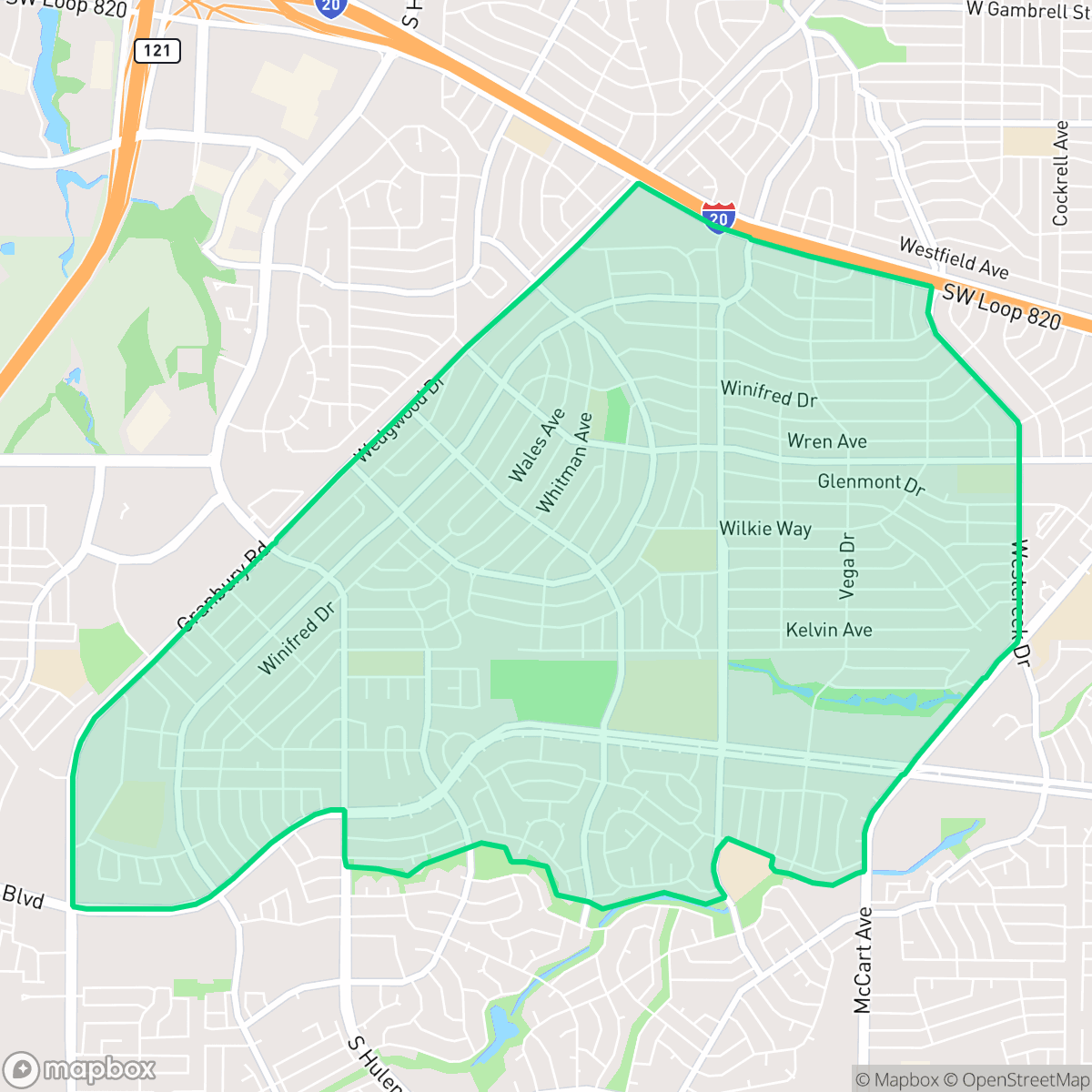
Developed between the 1950s and 1970s by E. L. Baker, Irwin Krauss, and S. G. Payte, Wedgwood is a master-planned midcentury neighborhood in southwest Fort Worth, Texas. Envisioned as a "prestige suburb" embodying the post-WWII American Dream, the neighborhood stands out for its winding, hilly roads—many starting with the letter "W"—and a diverse stock of ranch-style and mid-century modern homes that famously pioneered central air conditioning as a standard amenity. Local architectural firm Kneer & Hamm designed several of Wedgwood's signature midcentury landmarks, including the Wedgwood Country Club, Wedgwood Shopping Village, and Wedgwood Bowl. Today, the neighborhood's distinct architectural heritage and civic spirit are preserved by the active Wedgwood Historical Association.
The neighborhood maintains a calm, residential character defined by its mid-century ranch homes and mature landscaping. It offers a stable environment with minimal industrial presence, focusing instead on community green spaces like Rosenthal Park. While the area is largely quiet, it features a variety of local dining spots that provide a steady rhythm to the daily experience for residents. The layout is characteristically dense, with homes often featuring private pools and close proximity to one another, which creates a classic suburban aesthetic.
Prospective residents should consider that while the area is walkable for leisure, the proximity to major roadways contributes to a moderate noise level. The housing stock consists of closely spaced lots, balancing the aesthetic appeal of private trees and structures with a compact sense of privacy. According to iHuus data, families may find the local school options varied, as the area is split between the Crowley and Fort Worth Independent School Districts, each offering different academic outcomes and programming.
Neighborhood Scores Across 15 Qualities
Residential spacing is typical for a suburban area, offering a mix of closely packed homes and standard side-yard buffers. This level of density is roughly in line with the Fort Worth average according to iHuus data.
Continuous sidewalk networks and safe street crossings make pedestrian travel easy throughout most residential blocks. According to iHuus data, the accessibility of these pathways is slightly above the Fort Worth average.
Large homes with well-manicured lawns and frequent private backyard pools create an aesthetically pleasing environment. According to iHuus data, the density of premium amenities and expansive residential structures is higher than the Fort Worth average.
Access to large public parks and winding greenbelts provides ample space for pets, though some residential streets feature narrower sidewalk verges. Overall, pet-friendly amenities in Wedgwood are slightly below the Fort Worth average.
Residential areas feature a dense suburban layout with single-family homes and commercial corridors. This level of development is slightly less open than the Fort Worth average, according to iHuus data.
A blend of quiet residential pockets and active social hubs provides a more vibrant atmosphere than the Fort Worth average. While some areas feature accessible dining and parks, other sections remain primarily car-oriented with limited commercial density.
A consistent hum of local traffic from nearby busy streets is present. This level of acoustic activity is slightly higher than the average found across Fort Worth.
Air quality levels in Wedgwood fluctuate between acceptable and unhealthy, representing a slight increase in occasional respiratory concern compared to the Fort Worth average according to iHuus data.
Residential and retail uses dominate the area with no heavy industry or hazardous facilities detected. This neighborhood offers a significantly cleaner environment regarding industrial proximity than the Fort Worth average, according to iHuus data.
Health insurance access is more prevalent in Wedgwood than in the rest of Fort Worth, according to iHuus data.
Political leanings in this area are relatively split between conservative and liberal perspectives; this reflects a more balanced ideological landscape than the average for Fort Worth.
A balanced variety of age groups resides here, including young adults, families, and older residents. This demographic spread is slightly more diverse than the average found across Fort Worth, according to iHuus data.
Flood risk in this area is somewhat uncertain because official FEMA studies for the neighborhood have not been completed. According to iHuus data, the level of risk is slightly higher than the Fort Worth average.
Address-Level Insights for Wedgwood


iHuus Neighborhood Intelligence Insights
Get address-level neighborhood insights for Wedgwood
- Street-level scores — see how individual blocks compare, not just neighborhood averages
- Micro-zone boundaries — identify quiet pockets, flood boundaries, and walkable clusters before you visit
- 15 dimensions in full — walkability, noise, air quality, school quality, insurance coverage, population age profile, urban/rural index, and more
- Boundary risk alerts — know if your address sits near a block boundary where scores drop, the kind of detail no listing will ever mention
- School insights — individual school ratings and insights, not just district-level data
- Compare before you commit — side-by-side data across neighborhoods, down to block precision
No credit card required
Compare with Any Neighborhood
| Dimension | Wedgwood | Alamo Heights |
|---|---|---|
| 🚶 Walkabilityavg 7.5 | ||
| 🔊 Acoustic Comfortavg 4.12 | ||
| 🤫 Privacy Indexavg 5.64 | ||
| 🎨 Visual Appealavg 6.38 | ||
| 🐕 Dog Friendlinessavg 6.57 | ||
| 🗺️ Urban-Rural Indexavg 6.92 | ||
| ✨ Neighborhood Vibeavg 4.56 | ||
| 🏥 Health Insurance Coverageavg 5.8 | ||
| 🌿 Air Qualityavg 3.68 | ||
| 🏭 Industrial Proximityavg 8.13 | ||
| 🌊 Flood Safetyavg 3.61 | ||
| 🗳️ Ideological Leanavg 5.62 | ||
| 👥 Population Age Profileavg 4.51 | ||
| 🔥 Fire Safety | ||
| 🏫 School Quality |
Wedgwood Rankings
School Districts Serving Wedgwood
School Insights for Wedgwood
Below average outcomes; significant attendance and academic challenges.
School Insights
See what's really behind every school rating near Wedgwood
- Individual school ratings — each school's own score with outcome context, not just a district average
- Enrollment & class size data — student-to-teacher ratio and how it compares to the state average
- Full demographics breakdown — ethnicity and gender composition for every school in the enrollment zone
- Every school in the district — all schools within the enrollment boundary ranked by rating, not just the closest one
- Grade levels & benchmarks — elementary through high school, with below/above state-average flags
No credit card required