Villages of Woodland Springs, Fort Worth
Updated · 13,632 residents
Villages of Woodland Springs is a highly walkable community in North Fort Worth known for its extensive sidewalk network and scenic ponds. While the area offers a quiet, suburban atmosphere with exceptional air quality, residents primarily rely on vehicles for daily errands and commercial needs.
Key Highlights
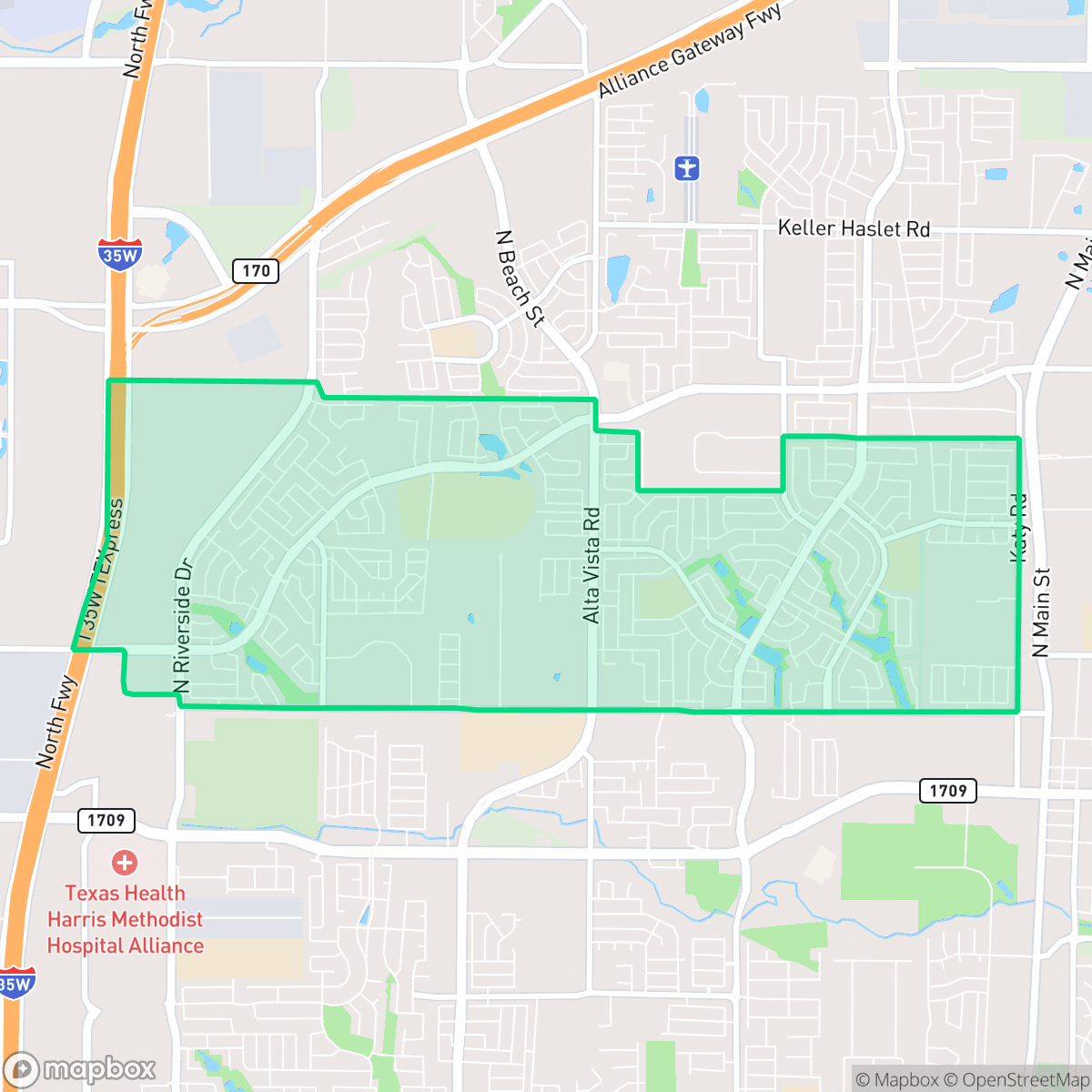
About Villages of Woodland Springs
Established in 2000, the Villages of Woodland Springs is a sprawling 1,300-acre master-planned community in North Fort Worth, near the Keller border. Developed over a twenty-year period, it grew to become one of the city's largest residential developments, featuring over 4,500 single-family homes and earning recognition from the Dallas Business Journal as Fort Worth's fastest-growing community for three consecutive years. The neighborhood's layout is defined by its extensive network of walking trails, six community amenity centers, and 14 scenic catch-and-release ponds. Its original section, located near the intersection of Park Vista Boulevard and Keller-Hicks Road, is marked by a signature stone tower entrance that serves as a prominent local landmark.
The neighborhood is characterized by a dense suburban layout that prioritizes pedestrian access, featuring sidewalks on both sides of most residential streets. Residents benefit from a quiet, serene environment with high air quality and consistent visual appeal, defined by large homes and private pools. While the area provides a peaceful living experience, it functions primarily as a residential enclave with limited commercial density, requiring residents to travel by car for most daily services and retail needs. According to iHuus data, the area maintains a balanced acoustic environment, though some sections near the southern borders experience proximity to light industrial facilities and warehouses.
Families are drawn to the area for its access to both the Keller and Northwest Independent School Districts, which remain popular choices despite ongoing fiscal and administrative challenges. The community is best suited for those who value a structured, quiet environment with well-maintained public spaces and outdoor recreation opportunities, such as the numerous catch-and-release ponds. While the neighborhood lacks a bustling urban core, its high walkability and strong health insurance coverage rates contribute to a stable and desirable suburban lifestyle.
Neighborhood Scores Across 15 Qualities
Residential spacing varies throughout the community, featuring some larger estate lots alongside newer sections where homes are positioned closer together. According to iHuus data, this level of density offers slightly more buffer between neighbors than the Fort Worth average.
Pedestrian infrastructure is exceptionally well-developed, featuring consistent sidewalks on both sides of residential streets and dedicated crossings near commercial zones. According to iHuus data, this level of connectivity and sidewalk availability is significantly higher than the Fort Worth average.
Large homes and frequent private amenities create a landscape that is more visually polished than the Fort Worth average. According to iHuus data, the presence of spacious driveways and manicured properties contributes to a more premium aesthetic across much of the area.
Continuous green verges, sidewalks, and central park areas provide ample space for walking pets. According to iHuus data, these interconnected natural spaces offer a level of accessibility for dogs that is roughly in line with the Fort Worth average.
Open land and scattered greenery characterize this area, providing a landscape that is very similar to the Fort Worth average. Residents will find a mix of newer residential tracts and larger lots bordering undeveloped spaces.
A balanced mix of residential streets and green spaces provides a consistent level of activity, staying in line with the Fort Worth average. While some pockets offer accessible dining and social hubs, other areas remain quiet and more reliant on vehicle travel for essential services.
Continuous noise from nearby busy streets is present, though acoustic comfort levels remain slightly higher than the Fort Worth average according to iHuus data.
Air quality is consistently high and presents little to no health concern, standing significantly above the Fort Worth average according to iHuus data.
Industrial presence is minimal throughout most of the area, though some lower sections contain warehouses and logistics hubs that may contribute to increased truck traffic. This level of industrial proximity is roughly in line with the Fort Worth average.
Health insurance enrollment is notably higher than the Fort Worth average, providing residents with greater access to medical services. According to iHuus data, the majority of the population in this area maintains active coverage.
Political leanings in this area are significantly more conservative than the Fort Worth average. Residents will find a community with a strong conservative majority and a small presence of opposing viewpoints, according to iHuus data.
Residents live alongside a diverse range of age demographics, including young adults, families, and older populations. This age distribution is slightly more varied than the typical profile found across Fort Worth, according to iHuus data.
Flood risk in this area is higher than the Fort Worth average, though precise risk levels remain undetermined because FEMA has not completed a detailed study for this location.
Address-Level Insights for Villages of Woodland Springs


iHuus Neighborhood Intelligence Insights
Get address-level neighborhood insights for Villages of Woodland Springs
- Street-level scores — see how individual blocks compare, not just neighborhood averages
- Micro-zone boundaries — identify quiet pockets, flood boundaries, and walkable clusters before you visit
- 15 dimensions in full — walkability, noise, air quality, school quality, insurance coverage, population age profile, urban/rural index, and more
- Boundary risk alerts — know if your address sits near a block boundary where scores drop, the kind of detail no listing will ever mention
- School insights — individual school ratings and insights, not just district-level data
- Compare before you commit — side-by-side data across neighborhoods, down to block precision
No credit card required
Compare with Any Neighborhood
| Dimension | Villages of Woodland Springs | Alamo Heights |
|---|---|---|
| 🚶 Walkabilityavg 7.5 | ||
| 🔊 Acoustic Comfortavg 4.12 | ||
| 🤫 Privacy Indexavg 5.64 | ||
| 🎨 Visual Appealavg 6.38 | ||
| 🐕 Dog Friendlinessavg 6.57 | ||
| 🗺️ Urban-Rural Indexavg 6.92 | ||
| ✨ Neighborhood Vibeavg 4.56 | ||
| 🏥 Health Insurance Coverageavg 5.8 | ||
| 🌿 Air Qualityavg 3.68 | ||
| 🏭 Industrial Proximityavg 8.13 | ||
| 🌊 Flood Safetyavg 3.61 | ||
| 🗳️ Ideological Leanavg 5.62 | ||
| 👥 Population Age Profileavg 4.51 | ||
| 🔥 Fire Safety | ||
| 🏫 School Quality |
Villages of Woodland Springs Rankings
School Districts Serving Villages of Woodland Springs
School Insights for Villages of Woodland Springs
Below average outcomes; significant attendance and academic challenges.
School Insights
See what's really behind every school rating near Villages of Woodland Springs
- Individual school ratings — each school's own score with outcome context, not just a district average
- Enrollment & class size data — student-to-teacher ratio and how it compares to the state average
- Full demographics breakdown — ethnicity and gender composition for every school in the enrollment zone
- Every school in the district — all schools within the enrollment boundary ranked by rating, not just the closest one
- Grade levels & benchmarks — elementary through high school, with below/above state-average flags
No credit card required