Villages of Stonegate, Fort Worth
Updated · 493 residents
The Villages of Stonegate is a quiet, gated residential enclave in southwest Fort Worth known for its high visual appeal and well-maintained green spaces. The area offers a notably walkable environment for residents, though it maintains a subdued, low-key atmosphere with limited local commercial activity.
Key Highlights
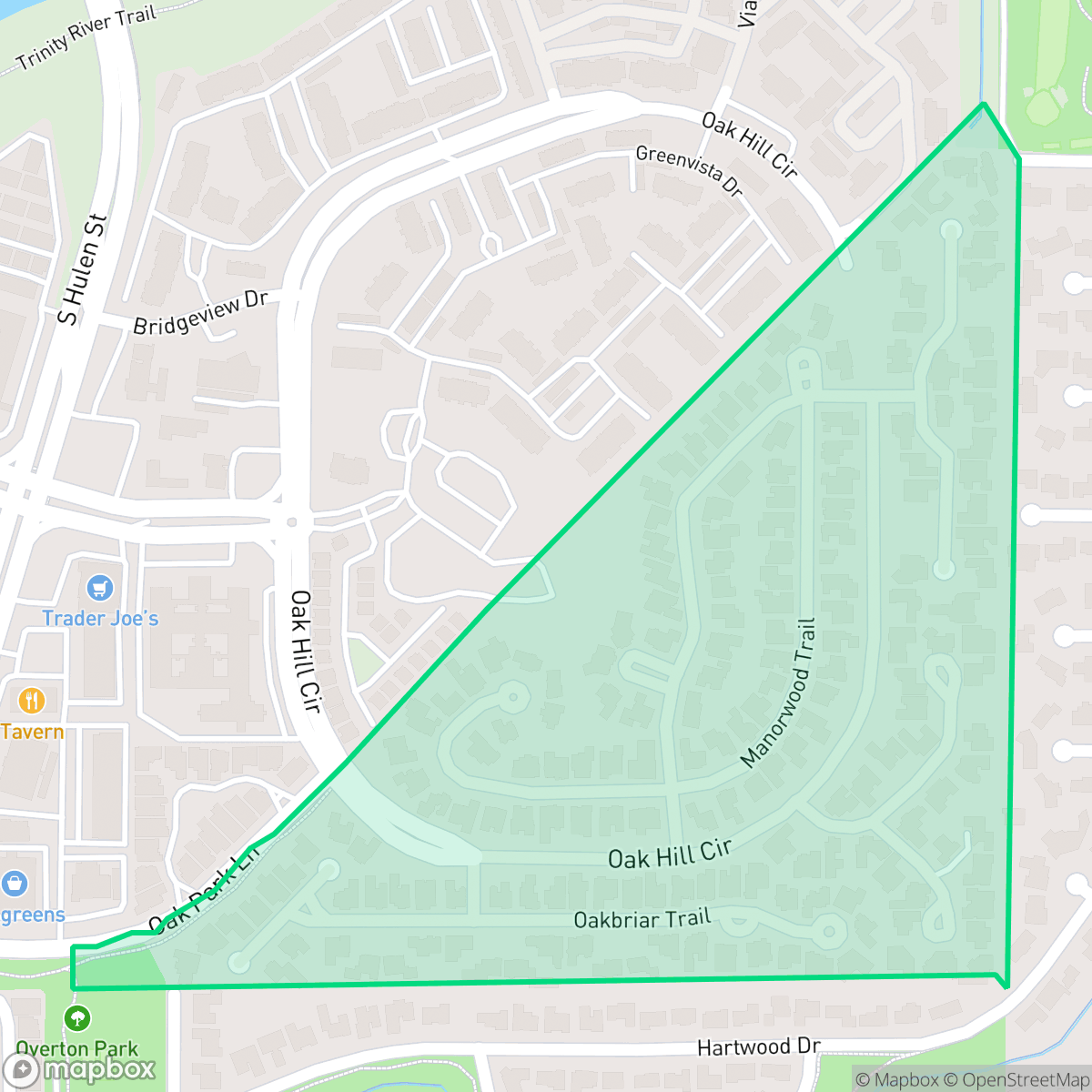
About Villages of Stonegate
The Villages of Stonegate, located in southwest Fort Worth near the Clear Fork of the Trinity River, developed from former ranchland that was part of the 1854 Samuel C. Inman Survey. In 1940, the land was acquired by oilman Kenneth W. Davis. His son, T. Cullen Davis, built the infamous, ultra-luxurious 13,000-square-foot Stonegate Mansion on the property in 1972, designed by architect Albert S. Komatsu. The mansion became the site of a notorious, unresolved double murder in 1976. Following foreclosure in 1988, the land was purchased by members of the Fort Worth Bass family in 1991. It was subsequently developed in the mid-1990s into a series of gated residential "villages" featuring North Dallas-style architecture. The landmark Stonegate Mansion was ultimately demolished in late 2021 to make way for new single-family homes.
This neighborhood serves as a peaceful residential retreat, characterized by its structured layout and focus on suburban tranquility. Residents benefit from a high degree of visual appeal and a layout that encourages walking, making it a pleasant environment for dog owners and those who value outdoor aesthetics. The area maintains a strong sense of privacy and safety, supported by its gated nature and proximity to the Clear Fork of the Trinity River.
Prospective residents should consider the trade-offs associated with the location, specifically regarding acoustic comfort and the local school district. While the neighborhood provides a serene residential experience, it is situated within the Fort Worth Independent School District, which currently faces significant operational and financial challenges. The area is best suited for those prioritizing a quiet, aesthetically pleasing environment over immediate access to dense retail or nightlife, and who are prepared to navigate the complexities of the local educational landscape.
Neighborhood Scores Across 15 Qualities
Residential spacing offers a moderate level of separation between neighbors, which is slightly higher than the Fort Worth average according to iHuus data.
Sidewalks and safe crossings are available on much of the street network, providing better pedestrian accessibility than the Fort Worth average according to iHuus data.
Large residential properties and frequent upscale amenities create a highly aesthetic environment that is notably more visually appealing than the Fort Worth average. According to iHuus data, the area is characterized by spacious driveways and well-maintained landscapes.
Extensive trail systems and large parks provide ample space for pets. This availability of open greenery and recreational area is significantly higher than the Fort Worth average, according to iHuus data.
Open land and scattered homes characterize this area, providing a more spacious environment than the typical Fort Worth urban landscape according to iHuus data.
Low-density residential streets and green spaces provide a peaceful atmosphere, though the area is less active than the Fort Worth average. While some wellness businesses and dining options are accessible via local paths, the neighborhood remains largely car-dependent for most errands.
Local traffic from nearby busy streets creates a consistent level of ambient noise. This acoustic profile is typical for the area and aligns with the city average.
Air quality levels fluctuate between acceptable and unhealthy periods, presenting occasional concerns for sensitive groups. According to iHuus data, these conditions are slightly worse than the Fort Worth average.
Industrial presence is virtually non-existent here, providing a quieter environment than most parts of Fort Worth. Residents can enjoy a landscape composed of residential streets and green spaces without the intrusion of warehouses or heavy manufacturing facilities.
Health insurance access is significantly higher here than the Fort Worth average, according to iHuus data. Most residents in this community are covered by a health insurance plan.
Political leanings in this area are notably more conservative than the Fort Worth average. According to iHuus data, the community maintains a conservative majority with a small opposing presence.
Residents live among a diverse range of age groups, including young adults, families, and older adults. This demographic spread is slightly more varied than the average found across Fort Worth, according to iHuus data.
Flood risk in this area is notably higher than the Fort Worth average. According to iHuus data, the lack of a detailed FEMA study means residents should remain aware of potential undetermined risks during heavy rain events.
Address-Level Insights for Villages of Stonegate


iHuus Neighborhood Intelligence Insights
Get address-level neighborhood insights for Villages of Stonegate
- Street-level scores — see how individual blocks compare, not just neighborhood averages
- Micro-zone boundaries — identify quiet pockets, flood boundaries, and walkable clusters before you visit
- 15 dimensions in full — walkability, noise, air quality, school quality, insurance coverage, population age profile, urban/rural index, and more
- Boundary risk alerts — know if your address sits near a block boundary where scores drop, the kind of detail no listing will ever mention
- School insights — individual school ratings and insights, not just district-level data
- Compare before you commit — side-by-side data across neighborhoods, down to block precision
No credit card required
Compare with Any Neighborhood
| Dimension | Villages of Stonegate | Alamo Heights |
|---|---|---|
| 🚶 Walkabilityavg 7.5 | ||
| 🔊 Acoustic Comfortavg 4.12 | ||
| 🤫 Privacy Indexavg 5.64 | ||
| 🎨 Visual Appealavg 6.38 | ||
| 🐕 Dog Friendlinessavg 6.57 | ||
| 🗺️ Urban-Rural Indexavg 6.92 | ||
| ✨ Neighborhood Vibeavg 4.56 | ||
| 🏥 Health Insurance Coverageavg 5.8 | ||
| 🌿 Air Qualityavg 3.68 | ||
| 🏭 Industrial Proximityavg 8.13 | ||
| 🌊 Flood Safetyavg 3.61 | ||
| 🗳️ Ideological Leanavg 5.62 | ||
| 👥 Population Age Profileavg 4.51 | ||
| 🔥 Fire Safety | ||
| 🏫 School Quality |
Villages of Stonegate Rankings
School Districts Serving Villages of Stonegate
School Insights for Villages of Stonegate
Below average outcomes; significant attendance and academic challenges.
School Insights
See what's really behind every school rating near Villages of Stonegate
- Individual school ratings — each school's own score with outcome context, not just a district average
- Enrollment & class size data — student-to-teacher ratio and how it compares to the state average
- Full demographics breakdown — ethnicity and gender composition for every school in the enrollment zone
- Every school in the district — all schools within the enrollment boundary ranked by rating, not just the closest one
- Grade levels & benchmarks — elementary through high school, with below/above state-average flags
No credit card required