Upper West Side, Fort Worth
Updated · 506 residents
The Upper West Side is a highly walkable urban district characterized by a dense, concrete-forward landscape and a vibrant mix of professional offices and residences. While it offers excellent access to downtown amenities, residents experience significant noise from surrounding road traffic and limited residential privacy.
Key Highlights
About Upper West Side
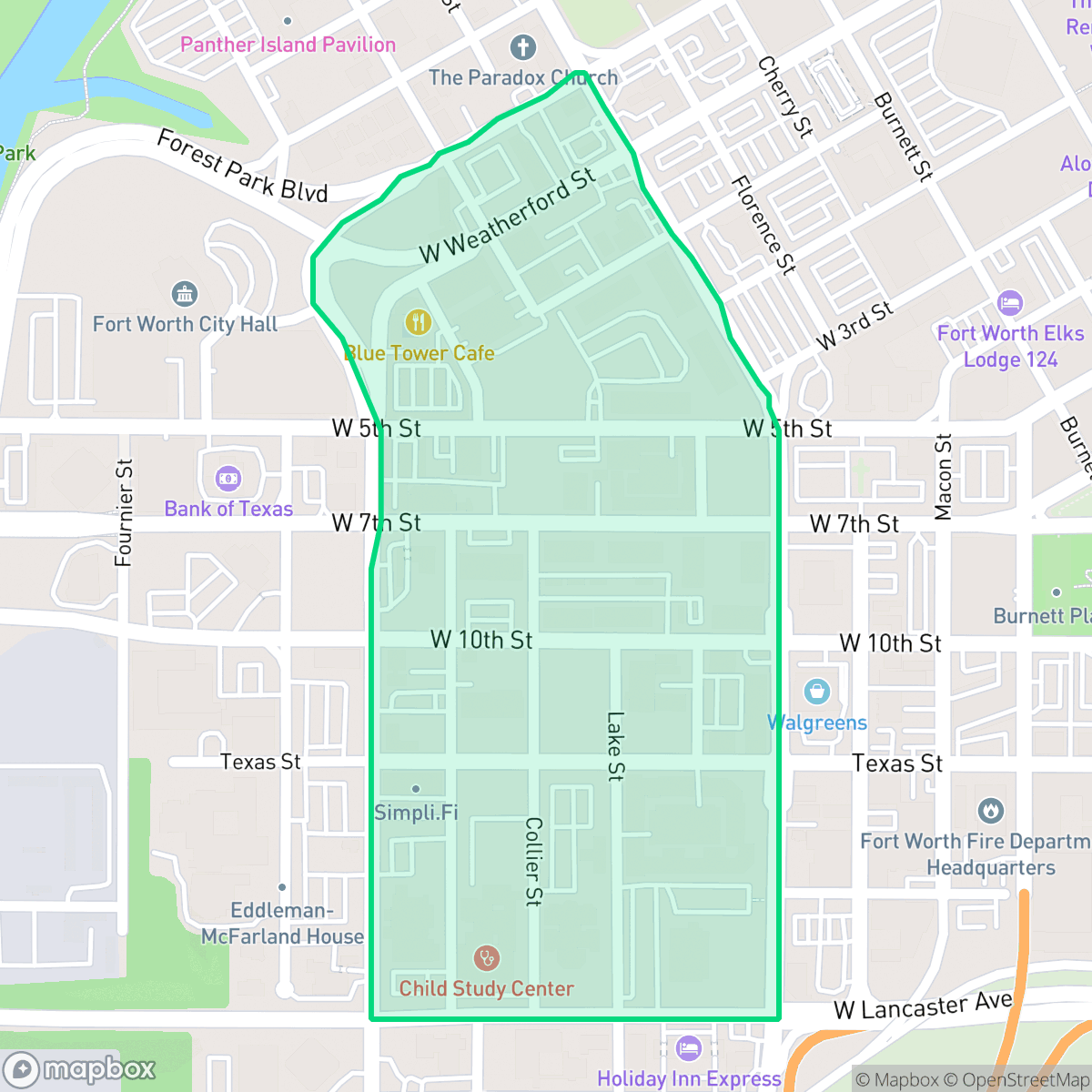
Historically known as "Quality Hill," the Upper West Side of Fort Worth, Texas, emerged in the late 19th century as the city's most prestigious residential enclave. Bounded roughly by Henderson Street, the Trinity River, Interstate 30, and White Settlement Road, the neighborhood became the premier address for wealthy cattle barons, bankers, and entrepreneurs who constructed opulent Victorian-style mansions. Notable surviving landmarks from this golden era include the 1899 Ball-Eddleman-McFarland House on Penn Street and the historic Thistle Hill mansion on Pennsylvania Avenue. While much of the original residential estate stock was replaced by mid-to-late 20th-century commercial development, the district preserves its historic identity alongside a contemporary mix of professional offices and urban residences.
This district serves as a high-energy urban core where modern high-rises and light industrial units sit alongside established commercial spaces. The area benefits from a central location that makes daily errands and dining convenient, fostering a lively atmosphere near landmarks like Burnett Park. It functions as a bridge between historical preservation and contemporary development, catering to those who prioritize immediate proximity to the city center over suburban quiet.
Prospective residents should account for the trade-offs inherent in such a dense environment, including elevated noise levels from nearby highway traffic and a lack of traditional residential privacy. The local school district, Fort Worth ISD, is currently navigating significant financial and operational challenges that may impact families. Consequently, the area is best suited for professionals and individuals seeking an active, car-free lifestyle rather than those prioritizing school quality or acoustic tranquility.
Neighborhood Scores Across 15 Qualities
Residential spacing provides some separation between neighbors, though the area remains quite public. According to iHuus data, privacy levels here are slightly lower than the Fort Worth average.
Extensive sidewalk networks and pedestrian-priority infrastructure make navigating the area on foot easy. According to iHuus data, the connectivity of crosswalks and bridges is significantly higher than the Fort Worth average.
Modern architecture and manicured landscaping create an affluent atmosphere that is more visually polished than the Fort Worth average. High-end amenities and large, well-maintained properties are frequent throughout the district, according to iHuus data.
Expansive public parks and connected green riverbanks provide ample space for pets. According to iHuus data, the availability of wide, safe paths and greenery is significantly higher than the Fort Worth average.
A mix of multi-story apartment complexes and manicured parkland provides an even distribution of street density and green space. This environment is notably less dense than the Fort Worth average, according to iHuus data.
Active street life and a notable concentration of local dining options make this area significantly more vibrant than the Fort Worth average. According to iHuus data, the landscape ranges from high-energy corridors near major highways to balanced suburban pockets with accessible green spaces.
Frequent noise from nearby freeways and railroad tracks makes this area significantly louder than the Fort Worth average. According to iHuus data, residents may experience consistent auditory disturbances throughout the day.
Air quality levels are generally acceptable but fluctuate between healthy and concerning for sensitive groups; however, conditions here remain notably better than the Fort Worth average according to iHuus data.
Industrial presence is minimal, consisting primarily of light commercial uses and a central wastewater treatment facility. This level of industrial proximity is slightly lower than the Fort Worth average, as the area is largely comprised of residential, civic, and park spaces.
Health insurance access is notably lower in this area compared to the Fort Worth average. Residents may face significant challenges accessing medical services without supplemental coverage, according to iHuus data.
Political views in this area are evenly divided between conservative and liberal leaning residents, representing a more balanced ideological landscape than the Fort Worth average according to iHuus data.
Residents experience a balanced demographic mix of young adults, families, and seniors. This distribution is more varied than the typical age profile found across Fort Worth, according to iHuus data.
Some residual flood risk exists within this area due to its location in a 500-year floodplain; however, safety levels remain notably higher than the Fort Worth average according to iHuus data.
Address-Level Insights for Upper West Side


iHuus Neighborhood Intelligence Insights
Get address-level neighborhood insights for Upper West Side
- Street-level scores — see how individual blocks compare, not just neighborhood averages
- Micro-zone boundaries — identify quiet pockets, flood boundaries, and walkable clusters before you visit
- 15 dimensions in full — walkability, noise, air quality, school quality, insurance coverage, population age profile, urban/rural index, and more
- Boundary risk alerts — know if your address sits near a block boundary where scores drop, the kind of detail no listing will ever mention
- School insights — individual school ratings and insights, not just district-level data
- Compare before you commit — side-by-side data across neighborhoods, down to block precision
No credit card required
Compare with Any Neighborhood
| Dimension | Upper West Side | Alamo Heights |
|---|---|---|
| 🚶 Walkabilityavg 7.5 | ||
| 🔊 Acoustic Comfortavg 4.12 | ||
| 🤫 Privacy Indexavg 5.64 | ||
| 🎨 Visual Appealavg 6.38 | ||
| 🐕 Dog Friendlinessavg 6.57 | ||
| 🗺️ Urban-Rural Indexavg 6.92 | ||
| ✨ Neighborhood Vibeavg 4.56 | ||
| 🏥 Health Insurance Coverageavg 5.8 | ||
| 🌿 Air Qualityavg 3.68 | ||
| 🏭 Industrial Proximityavg 8.13 | ||
| 🌊 Flood Safetyavg 3.61 | ||
| 🗳️ Ideological Leanavg 5.62 | ||
| 👥 Population Age Profileavg 4.51 | ||
| 🔥 Fire Safety | ||
| 🏫 School Quality |
Upper West Side Rankings
School Districts Serving Upper West Side
School Insights for Upper West Side
Below average outcomes; significant attendance and academic challenges.
School Insights
See what's really behind every school rating near Upper West Side
- Individual school ratings — each school's own score with outcome context, not just a district average
- Enrollment & class size data — student-to-teacher ratio and how it compares to the state average
- Full demographics breakdown — ethnicity and gender composition for every school in the enrollment zone
- Every school in the district — all schools within the enrollment boundary ranked by rating, not just the closest one
- Grade levels & benchmarks — elementary through high school, with below/above state-average flags
No credit card required