University Place, Fort Worth
Updated · 609 residents
University Place is a highly walkable enclave centered around the Texas Christian University campus, characterized by its historic, tree-lined streets and a vibrant local dining scene. While the area offers exceptional convenience for students and faculty, residents should be prepared for higher noise levels from road traffic and limited privacy due to the dense, urban-adjacent layout.
Key Highlights
About University Place
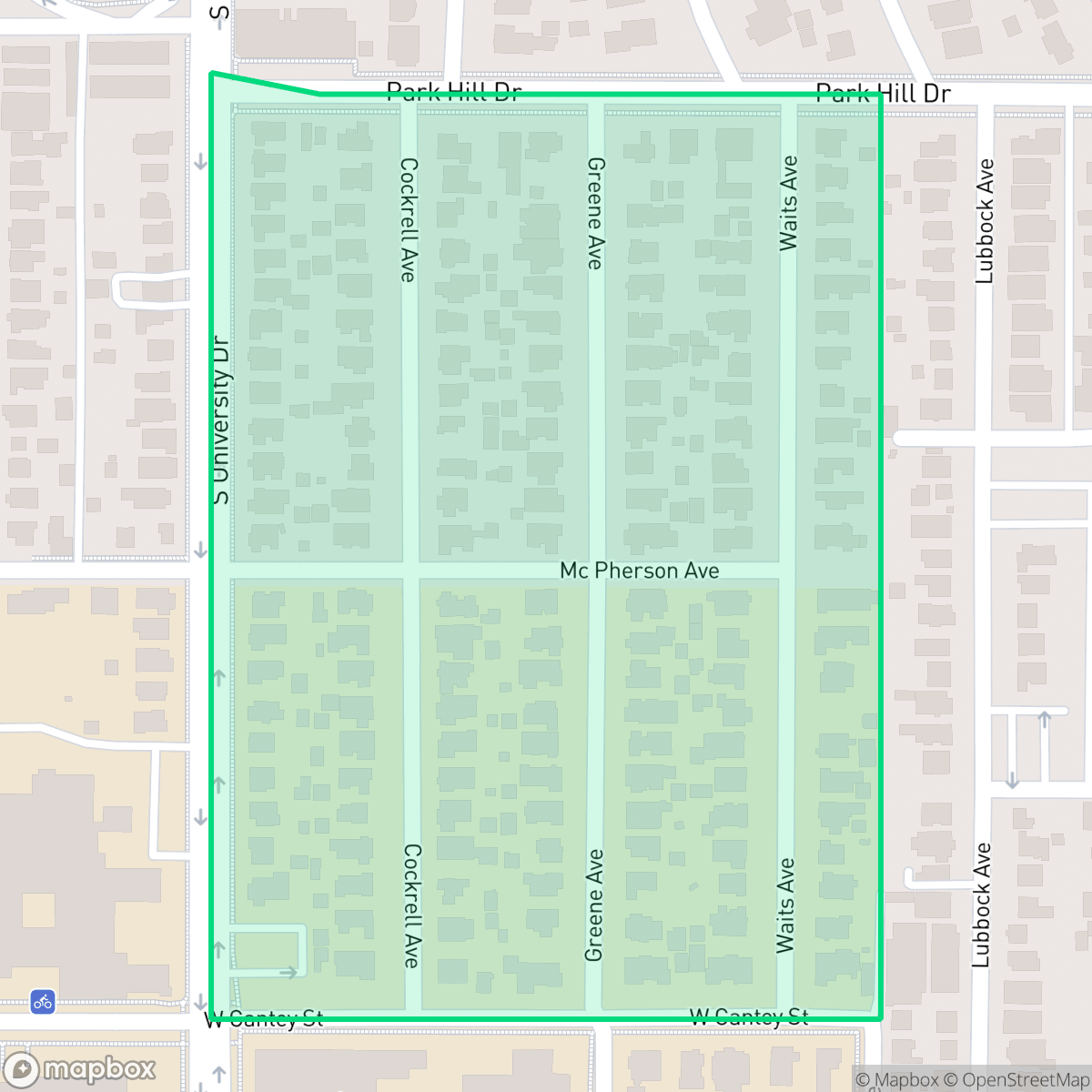
Established after Texas Christian University relocated to southwest Fort Worth in 1911, University Place developed as a scenic, tree-lined residential suburb situated between Forest Park Boulevard and the campus. Originally lacking municipal utilities outside the city limits, the neighborhood initially featured custom-built bungalows. Development accelerated in 1923 when the Carb Land and Building Co. built dozens of brick, tile, and stucco bungalows featuring deep, shaded porches. The neighborhood’s architectural profile expanded in the 1920s and 1930s to include grander multi-story residences, such as the 1926 Mediterranean-style Poston House designed by prominent local architect Wiley G. Clarkson. Culturally, the neighborhood was shaped by the University Place Study Club, founded in the 1920s, which promoted the arts and famously planted a memorial tree in the nearby Bluebonnet traffic circle in 1952.
The neighborhood functions as a lively, low-density urban core defined by its constant activity and proximity to institutional landmarks such as the Robert Carr Chapel. The streetscape is marked by well-maintained homes and campus architecture, creating a distinct visual appeal that blends residential comfort with collegiate energy. With a high concentration of dining options and clear pedestrian paths, the area remains one of the most accessible and active pockets in the city for those who prefer to navigate on foot.
Prospective residents should consider that the area presents specific trade-offs, particularly regarding acoustic comfort, as road traffic contributes to noise levels that exceed the city average. Furthermore, the local school district, Fort Worth ISD, is currently navigating significant financial and operational challenges that may impact long-term planning for families. Despite these factors, the area remains free of industrial hazards and offers a stable, well-connected environment for those seeking a central location with a strong sense of place.
Neighborhood Scores Across 15 Qualities
Neighboring distances vary due to dense residential lots and multi-unit campus housing, resulting in less privacy than the Fort Worth average according to iHuus data.
Pedestrian infrastructure is exceptionally well-developed here, featuring wide sidewalks and clear paths throughout the university campus and surrounding residential streets. This connectivity is significantly higher than the Fort Worth average, making it easy to navigate the area without a vehicle.
Large, well-maintained homes and institutional architecture provide a high level of visual interest. According to iHuus data, the presence of private pools and expansive driveways makes the area notably more aesthetically pleasing than the Fort Worth average.
Expansive campus lawns and accessible parklands offer ample room for walking dogs. According to iHuus data, the availability of connected green spaces and safe, traffic-free paths is significantly higher than the Fort Worth average.
Residential grids and university buildings are interspersed with greenery and surface parking. This area presents a more suburban landscape compared to the more urbanized city average, according to iHuus data.
Diverse dining and established landmarks create a sense of activity that is significantly higher than the Fort Worth average. According to iHuus data, the area ranges from an urban core with constant movement to more relaxed pockets near green spaces and social hubs.
Frequent traffic and transit noise from nearby freeways and railroad tracks characterizes this area. Acoustic comfort is notably lower than the Fort Worth average, according to iHuus data.
Air quality levels in University Place are slightly better than the Fort Worth average, though residents may encounter occasional days that are unhealthy for sensitive groups. Data from iHuus indicates a mix of acceptable and concerning air conditions.
Industrial activity and warehouse facilities are entirely absent from this area, providing a landscape of residential and institutional spaces that is significantly cleaner than the Fort Worth average. According to iHuus data, residents can expect a lack of heavy industrial hazards or nearby manufacturing sites.
Health insurance accessibility is notably higher in University Place than in the rest of Fort Worth. According to iHuus data, a significant majority of residents are covered by health insurance plans.
Political leanings in this area are more conservative than the Fort Worth average, characterized by a conservative majority with a modest opposing presence according to iHuus data.
Residents will find a demographic mix of young adults, families, and seniors. This population distribution is slightly more concentrated toward specific age groups than the Fort Worth average, according to iHuus data.
Flood risk is significantly lower here than the Fort Worth average, though some residual risk remains within the 500-year floodplain. According to iHuus data, the area is situated in a zone with much improved safety compared to most of the city.
Address-Level Insights for University Place


iHuus Neighborhood Intelligence Insights
Get address-level neighborhood insights for University Place
- Street-level scores — see how individual blocks compare, not just neighborhood averages
- Micro-zone boundaries — identify quiet pockets, flood boundaries, and walkable clusters before you visit
- 15 dimensions in full — walkability, noise, air quality, school quality, insurance coverage, population age profile, urban/rural index, and more
- Boundary risk alerts — know if your address sits near a block boundary where scores drop, the kind of detail no listing will ever mention
- School insights — individual school ratings and insights, not just district-level data
- Compare before you commit — side-by-side data across neighborhoods, down to block precision
No credit card required
Compare with Any Neighborhood
| Dimension | University Place | Alamo Heights |
|---|---|---|
| 🚶 Walkabilityavg 7.5 | ||
| 🔊 Acoustic Comfortavg 4.12 | ||
| 🤫 Privacy Indexavg 5.64 | ||
| 🎨 Visual Appealavg 6.38 | ||
| 🐕 Dog Friendlinessavg 6.57 | ||
| 🗺️ Urban-Rural Indexavg 6.92 | ||
| ✨ Neighborhood Vibeavg 4.56 | ||
| 🏥 Health Insurance Coverageavg 5.8 | ||
| 🌿 Air Qualityavg 3.68 | ||
| 🏭 Industrial Proximityavg 8.13 | ||
| 🌊 Flood Safetyavg 3.61 | ||
| 🗳️ Ideological Leanavg 5.62 | ||
| 👥 Population Age Profileavg 4.51 | ||
| 🔥 Fire Safety | ||
| 🏫 School Quality |
University Place Rankings
School Districts Serving University Place
School Insights for University Place
Below average outcomes; significant attendance and academic challenges.
School Insights
See what's really behind every school rating near University Place
- Individual school ratings — each school's own score with outcome context, not just a district average
- Enrollment & class size data — student-to-teacher ratio and how it compares to the state average
- Full demographics breakdown — ethnicity and gender composition for every school in the enrollment zone
- Every school in the district — all schools within the enrollment boundary ranked by rating, not just the closest one
- Grade levels & benchmarks — elementary through high school, with below/above state-average flags
No credit card required