United Riverside, Fort Worth
Updated · 1,473 residents
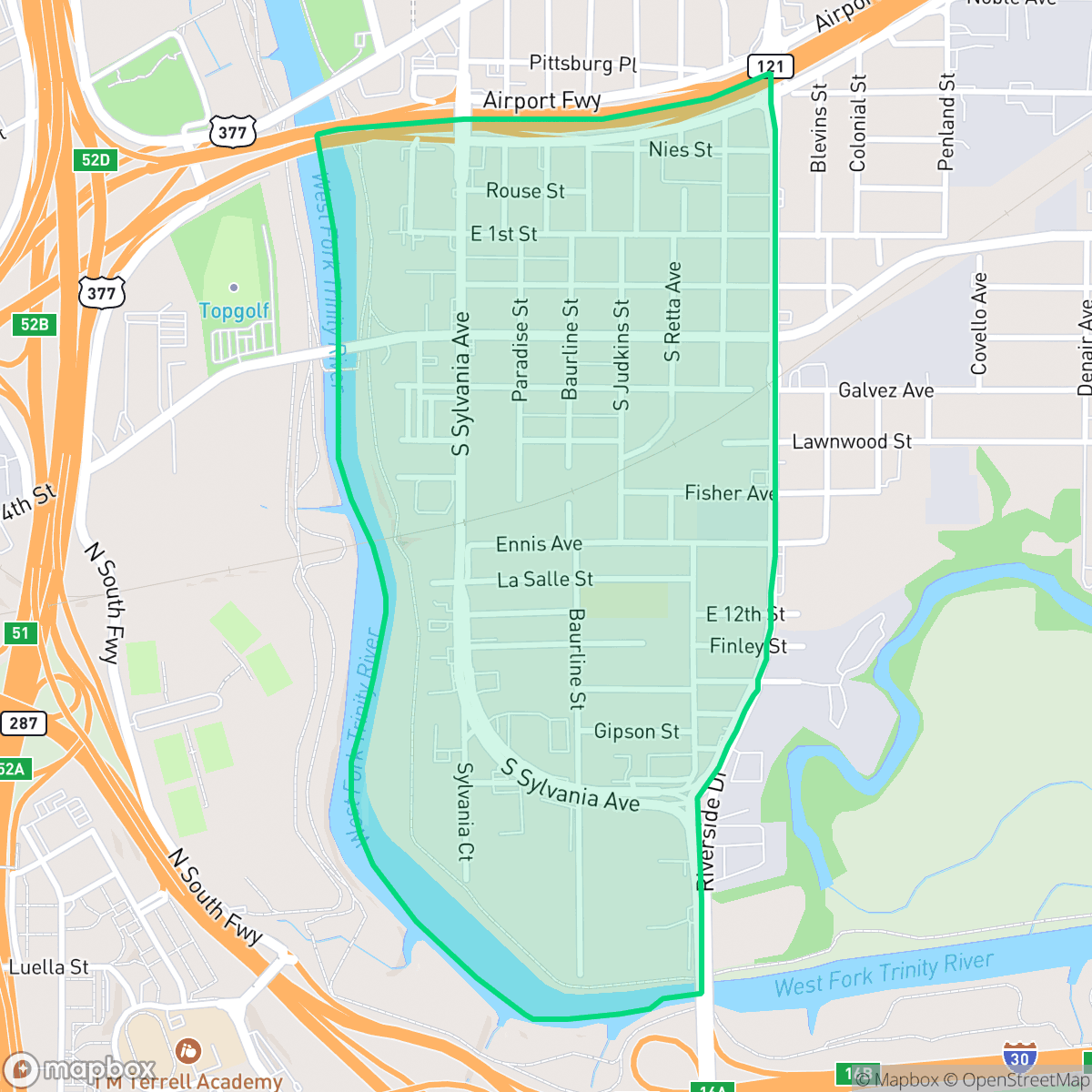
United Riverside is a historically significant community northeast of downtown Fort Worth defined by its deep cultural roots and proximity to local industrial corridors. While the area offers moderate walkability, residents should anticipate a suburban environment characterized by consistent road and rail noise.
Key Highlights
About United Riverside
Located northeast of downtown Fort Worth, the United Riverside neighborhood is historically defined by its deep roots in the city's African American heritage. A central landmark is the historic Riverside Public School (now Versia L. Williams Elementary), which was placed on the National Register of Historic Places in 1999 for its pivotal role in educating Black youth. The school was later renamed in honor of Versia L. Williams, a dedicated student-turned-principal who spent decades serving the community. Local public spaces further commemorate this history, including Gid Hooper Park, named for a prominent early 20th-century Black real estate agent and school trustee. Additionally, the historic Corinth Baptist Church, established in the area in 1892, and the Andrew "Doc" Sessions Community Center serve as enduring cultural anchors for the neighborhood.
United Riverside is a neighborhood northeast of downtown Fort Worth that balances its rich cultural heritage with a functional, suburban landscape. The area features a mix of residential blocks and light industrial zones, creating a practical atmosphere for those who prioritize proximity to major transit routes and established community anchors. According to iHuus data, the area maintains a moderate level of walkability, allowing residents to access local services and schools like the highly regarded Versia Williams Elementary. Residents benefit from being near key cultural landmarks that define the identity of this long-standing community. Prospective residents should weigh the benefits of this established community against several notable trade-offs. The neighborhood experiences significant acoustic challenges due to its proximity to major roads and railways, and iHuus data indicates that flood safety remains a critical concern for the region. Furthermore, while the community benefits from a strong sense of identity, the broader school district faces operational instability. This area is best suited for individuals or families who value historical context and functional access to the city over quiet, low-density living.
Neighborhood Scores Across 15 Qualities
Residents can expect a balance of proximity and separation due to the mixed spacing of homes. According to iHuus data, this level of seclusion is slightly higher than the Fort Worth average.
A lack of sidewalks makes navigating the area on foot difficult, though the quiet streets provide a low-traffic environment for walking. This level of walkability is notably lower than the Fort Worth average, according to iHuus data.
Residential views consist primarily of standard tract housing with minimal landscaping. This area is less visually diverse than the Fort Worth average according to iHuus data.
Accessible green spaces and wide, low-traffic paths make this area highly suitable for pet owners. According to iHuus data, the neighborhood offers significantly better walking conditions for dogs than the Fort Worth average.
Significant portions of the area consist of industrial warehouses and river-adjacent green spaces. This landscape is slightly less open than the typical Fort Worth environment, according to iHuus data.
Low levels of activity and a heavy presence of warehouses and freight corridors create a subdued atmosphere that is less lively than the Fort Worth average. Most social spots and retail services are car-dependent and located near major highway corridors.
Frequent noise from nearby railroad tracks and heavy freeway traffic is a persistent feature here. This level of acoustic disturbance is significantly higher than the Fort Worth average according to iHuus data.
Air quality levels fluctuate between acceptable and unhealthy ranges, though conditions remain slightly better than the Fort Worth average according to iHuus data. Residents with respiratory sensitivities should monitor local reports for occasional periods of concern.
Active logistics hubs, warehouse districts, and heavy truck traffic contribute to a higher level of industrial activity than is typical for Fort Worth. Residents may experience significant noise and heavy vehicle movement near large-scale distribution centers and concrete plants.
Health insurance access is significantly lower here than the Fort Worth average, according to iHuus data. Residents may face greater challenges accessing employer-sponsored or private medical coverage within the area.
Voting patterns and census indicators show a predominantly liberal leaning, which is significantly more pronounced than the average across Fort Worth. According to iHuus data, this area maintains a distinct political identity compared to the rest of the city.
Residents live alongside a balanced mix of young professionals, families, and older adults. This demographic spread is largely consistent with the typical age distribution found across Fort Worth.
Significant flood risk exists here due to the area's location within a high-hazard zone. Residents should prepare for elevated insurance costs, as this level of vulnerability is much higher than the Fort Worth average.
Address-Level Insights for United Riverside


iHuus Neighborhood Intelligence Insights
Get address-level neighborhood insights for United Riverside
- Street-level scores — see how individual blocks compare, not just neighborhood averages
- Micro-zone boundaries — identify quiet pockets, flood boundaries, and walkable clusters before you visit
- 15 dimensions in full — walkability, noise, air quality, school quality, insurance coverage, population age profile, urban/rural index, and more
- Boundary risk alerts — know if your address sits near a block boundary where scores drop, the kind of detail no listing will ever mention
- School insights — individual school ratings and insights, not just district-level data
- Compare before you commit — side-by-side data across neighborhoods, down to block precision
No credit card required
Compare with Any Neighborhood
| Dimension | United Riverside | Alamo Heights |
|---|---|---|
| 🚶 Walkabilityavg 7.5 | ||
| 🔊 Acoustic Comfortavg 4.12 | ||
| 🤫 Privacy Indexavg 5.64 | ||
| 🎨 Visual Appealavg 6.38 | ||
| 🐕 Dog Friendlinessavg 6.57 | ||
| 🗺️ Urban-Rural Indexavg 6.92 | ||
| ✨ Neighborhood Vibeavg 4.56 | ||
| 🏥 Health Insurance Coverageavg 5.8 | ||
| 🌿 Air Qualityavg 3.68 | ||
| 🏭 Industrial Proximityavg 8.13 | ||
| 🌊 Flood Safetyavg 3.61 | ||
| 🗳️ Ideological Leanavg 5.62 | ||
| 👥 Population Age Profileavg 4.51 | ||
| 🔥 Fire Safety | ||
| 🏫 School Quality |
United Riverside Rankings
School Districts Serving United Riverside
School Insights for United Riverside
Below average outcomes; significant attendance and academic challenges.
School Insights
See what's really behind every school rating near United Riverside
- Individual school ratings — each school's own score with outcome context, not just a district average
- Enrollment & class size data — student-to-teacher ratio and how it compares to the state average
- Full demographics breakdown — ethnicity and gender composition for every school in the enrollment zone
- Every school in the district — all schools within the enrollment boundary ranked by rating, not just the closest one
- Grade levels & benchmarks — elementary through high school, with below/above state-average flags
No credit card required