Terrace Landing, Fort Worth
Updated · 1,470 residents
Terrace Landing is a quiet, residential neighborhood in Fort Worth characterized by its high walkability and proximity to community green spaces. The area features modern, densely packed suburban housing with a consistent sidewalk network that makes it convenient for pedestrians and dog owners.
Key Highlights
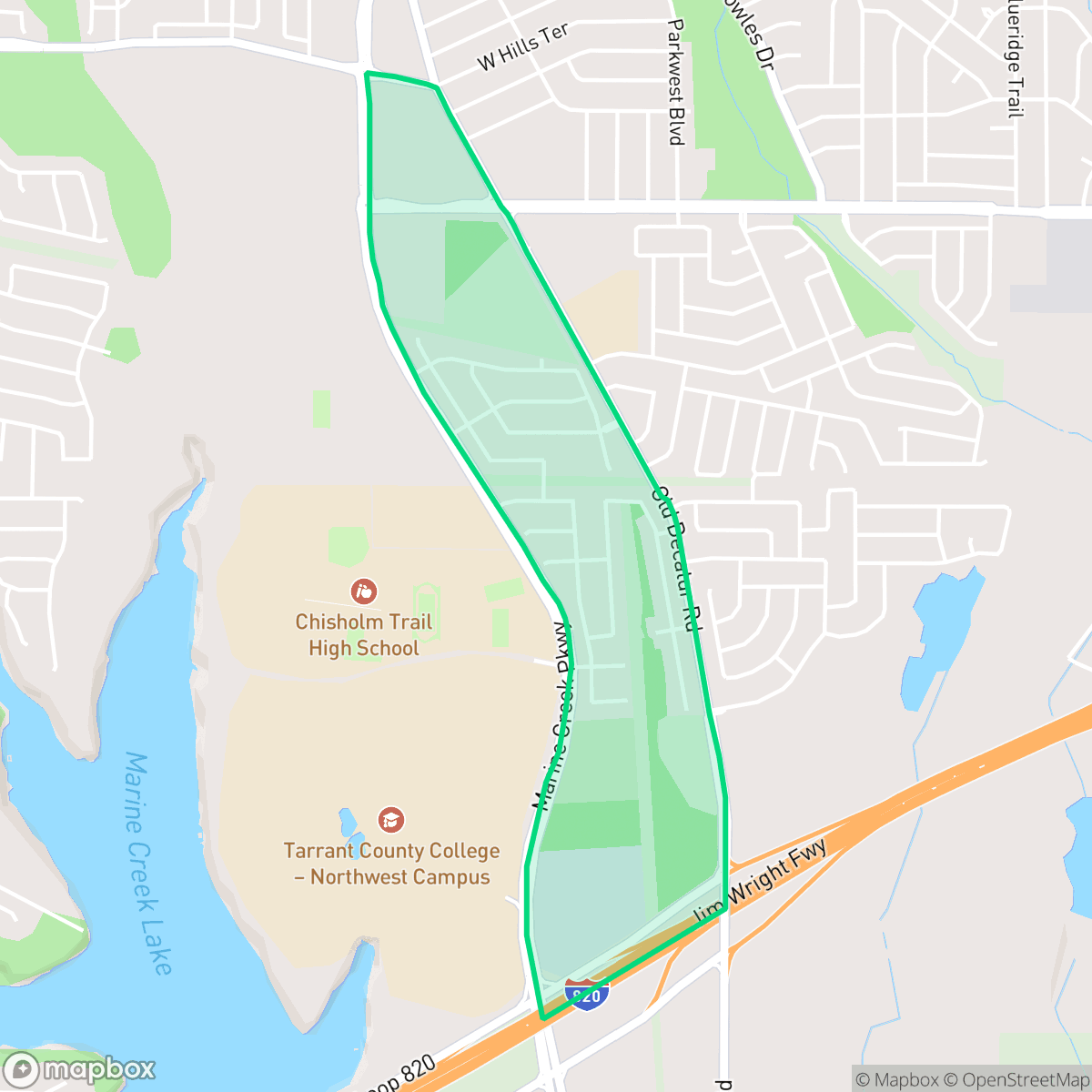
About Terrace Landing
Terrace Landing offers a serene suburban environment defined by its commitment to residential and recreational space. The neighborhood is notably free of industrial activity, providing a peaceful atmosphere for its residents. Its layout emphasizes connectivity, with a well-maintained sidewalk system that allows for easy pedestrian access to local athletic fields and parks. While the housing architecture follows a standard high-density suburban model with closely spaced homes, the area benefits from strong health insurance coverage and a stable, quiet environment that prioritizes neighborhood safety and accessibility.
Prospective residents should note that the neighborhood is a tranquil, low-activity area with limited commercial amenities within its immediate borders. While it lacks a bustling retail or dining scene, it serves as a functional, pedestrian-friendly base for those who value quiet streets and consistent outdoor access. The area is served by the Eagle Mountain-Saginaw Independent School District, which provides a stable academic foundation, though the high-density nature of the housing means that private outdoor space is relatively limited compared to more rural or expansive suburban developments.
Neighborhood Scores Across 15 Qualities
Residential lots feature closely spaced housing and narrow side yards that offer limited separation between neighbors. This density of development is higher than the Fort Worth average, according to iHuus data.
Pedestrian access is well-supported by a continuous sidewalk network on both sides of most residential streets, which is more extensive than the Fort Worth average. While many areas offer safe crossings and dedicated access to sports facilities, some internal complex pathways remain disconnected from nearby services.
Standard tract housing and modern apartment complexes feature uniform rooflines and small yards. This visual character is slightly below the Fort Worth average for aesthetic variety.
Accessible sidewalks with grass verges and adjacent athletic fields provide ample room for walking pets. According to iHuus data, these connected green spaces offer slightly better amenities for dogs than the Fort Worth average.
Expansive open fields and undeveloped land are common features here, providing a more semi-rural atmosphere than the typical Fort Worth urban landscape. According to iHuus data, this area maintains a balance of suburban development and adjacent scrubland or wild spaces.
Low density and significant open space create a serene setting, though the lack of local businesses makes this area less lively than the Fort Worth average. Residents will find few walkable shops or social hubs, as most services are limited to a small number of essential convenience stores and light industrial units.
Local traffic from a nearby busy street creates a consistent level of ambient noise. This acoustic environment is consistent with the average found across Fort Worth.
Frequent unhealthy air quality levels pose a significant risk to sensitive groups. According to iHuus data, conditions in this area are noticeably worse than the Fort Worth average.
Industrial presence is virtually nonexistent here, providing a cleaner environment than the Fort Worth average. According to iHuus data, the area consists of residential streets and open green spaces without the presence of warehouses or manufacturing facilities.
Health insurance accessibility is notably higher than the Fort Worth average, according to iHuus data. Most residents in this area have access to comprehensive medical coverage.
Political leanings in this area are split relatively evenly between conservative and liberal views, appearing slightly more moderate than the Fort Worth average according to iHuus data.
Residents live alongside a broad mix of young adults, families, and seniors. According to iHuus data, this demographic spread is slightly lower than the Fort Worth average.
Flood risk in this area is higher than the Fort Worth average due to a lack of detailed FEMA studies for the zone. Residents should remain aware that the area is currently classified as having an undetermined risk level according to iHuus data.
Address-Level Insights for Terrace Landing


iHuus Neighborhood Intelligence Insights
Get address-level neighborhood insights for Terrace Landing
- Street-level scores — see how individual blocks compare, not just neighborhood averages
- Micro-zone boundaries — identify quiet pockets, flood boundaries, and walkable clusters before you visit
- 15 dimensions in full — walkability, noise, air quality, school quality, insurance coverage, population age profile, urban/rural index, and more
- Boundary risk alerts — know if your address sits near a block boundary where scores drop, the kind of detail no listing will ever mention
- School insights — individual school ratings and insights, not just district-level data
- Compare before you commit — side-by-side data across neighborhoods, down to block precision
No credit card required
Compare with Any Neighborhood
| Dimension | Terrace Landing | Alamo Heights |
|---|---|---|
| 🚶 Walkabilityavg 7.5 | ||
| 🔊 Acoustic Comfortavg 4.12 | ||
| 🤫 Privacy Indexavg 5.64 | ||
| 🎨 Visual Appealavg 6.38 | ||
| 🐕 Dog Friendlinessavg 6.57 | ||
| 🗺️ Urban-Rural Indexavg 6.92 | ||
| ✨ Neighborhood Vibeavg 4.56 | ||
| 🏥 Health Insurance Coverageavg 5.8 | ||
| 🌿 Air Qualityavg 3.68 | ||
| 🏭 Industrial Proximityavg 8.13 | ||
| 🌊 Flood Safetyavg 3.61 | ||
| 🗳️ Ideological Leanavg 5.62 | ||
| 👥 Population Age Profileavg 4.51 | ||
| 🔥 Fire Safety | ||
| 🏫 School Quality |
Terrace Landing Rankings
School Districts Serving Terrace Landing
School Insights for Terrace Landing
Below average outcomes; significant attendance and academic challenges.
School Insights
See what's really behind every school rating near Terrace Landing
- Individual school ratings — each school's own score with outcome context, not just a district average
- Enrollment & class size data — student-to-teacher ratio and how it compares to the state average
- Full demographics breakdown — ethnicity and gender composition for every school in the enrollment zone
- Every school in the district — all schools within the enrollment boundary ranked by rating, not just the closest one
- Grade levels & benchmarks — elementary through high school, with below/above state-average flags
No credit card required