Tanglewood, Fort Worth
Updated · 2,458 residents
Tanglewood is a quiet, leafy residential enclave characterized by its mid-century architecture and abundant green spaces. While the area offers high walkability and exceptional dog-friendliness, it maintains a low-key atmosphere with limited commercial activity. According to iHuus data, residents benefit from high health insurance coverage and proximity to expansive public parks.
Key Highlights
About Tanglewood
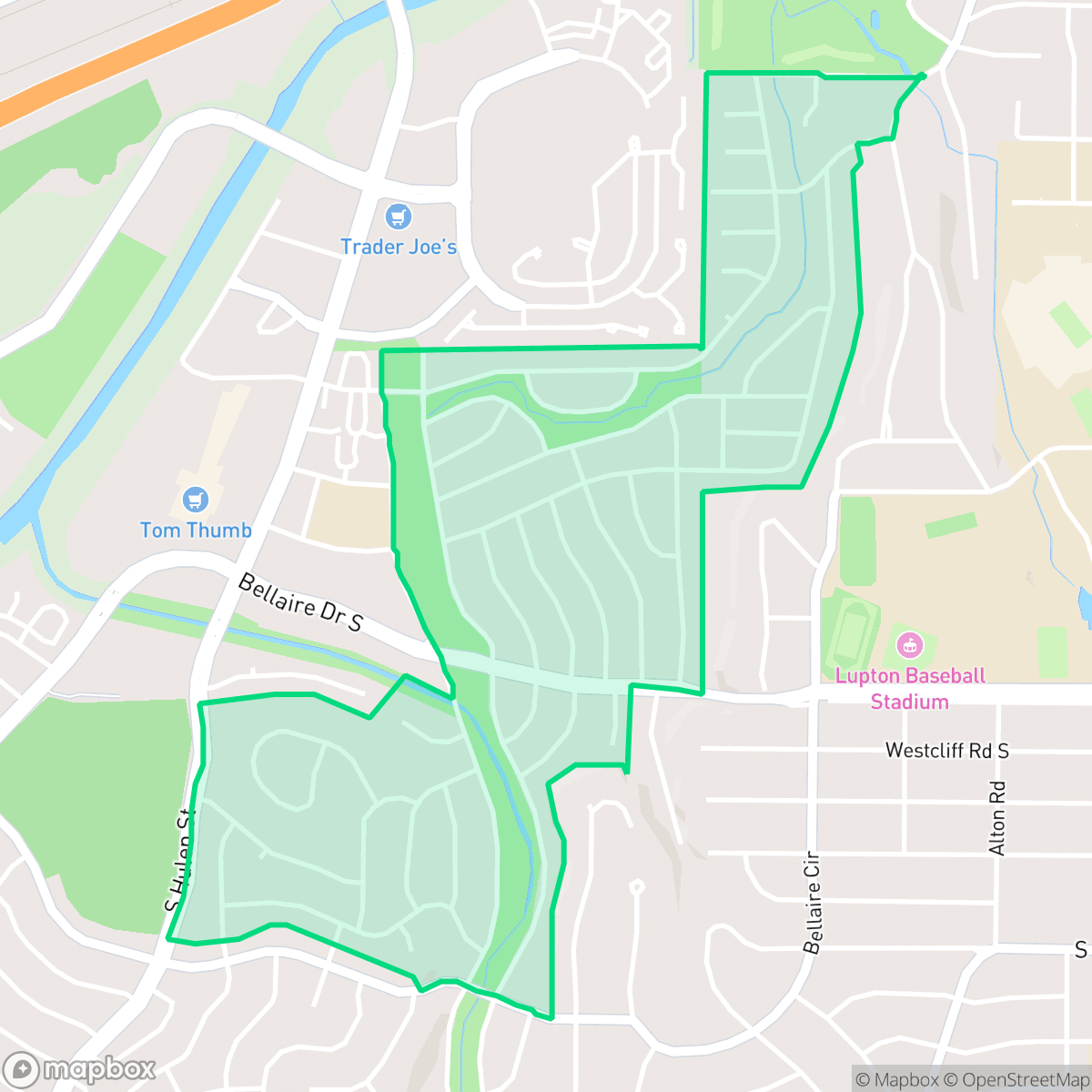
Located southwest of downtown Fort Worth along the Clear Fork of the Trinity River, Tanglewood was developed in the 1950s on land originally encompassing the 1854 Felix G. Beasley Survey, the 1876 James Howard Survey, and a former dairy farm. The neighborhood’s early approach was a simple two-rut dirt road, now Bellaire Drive South. Developers established strict deed restrictions, requiring single-family homes to be constructed of brick or stone, feature attached two-car garages, and preserve the area's mature oak trees. This resulted in a distinct landscape of low-slung mid-century modern and ranch-style homes. At the heart of the community is Overton Park, a 50-acre linear green space established in 1959, and the Tanglewood Trail, a popular bicycle-walking path developed in the early 1970s under the leadership of resident and city councilwoman Margaret Rimmer.
The area is defined by its serene, residential nature and mature tree canopy, which contributes to high visual appeal. It functions as a quiet retreat from the city center, prioritizing single-family living over commercial density. The presence of significant green space, including the 50-acre Overton Park, supports an active outdoor lifestyle, particularly for pet owners who benefit from the neighborhood's high level of dog-friendliness.
Prospective residents should note that while the neighborhood is physically walkable, the limited concentration of local businesses means most daily errands still require a vehicle. The area is best suited for families or individuals seeking a stable, quiet environment, though they should be aware of the current operational challenges facing the local school district. According to iHuus, the neighborhood maintains a distinct, low-energy vibe that favors tranquility over urban nightlife.
Neighborhood Scores Across 15 Qualities
Residential spacing provides a moderate level of seclusion with some buffer between neighboring properties. According to iHuus data, this sense of privacy is slightly higher than the Fort Worth average.
Pedestrian access is well-supported by sidewalks and safe crossings, offering a higher level of walkability than the Fort Worth average. Most daily activities can be reached on foot according to iHuus data.
Large residential properties and frequent upscale amenities contribute to a highly manicured aesthetic that is notably more impressive than the Fort Worth average. According to iHuus data, the area is characterized by spacious driveways and well-maintained landscapes.
Interconnected green spaces and wide, low-traffic paths provide an environment significantly more accommodating to dogs than the Fort Worth average. According to iHuus data, the layout of the area supports easy movement for pet owners.
Frequent open land and scattered homes amid woodlands provide a semi-rural feel that is slightly more developed than the Fort Worth average. According to iHuus data, the area maintains a balance of residential density and accessible green space.
Low business density and a suburban layout make most daily errands dependent on a vehicle. While some wellness and dining options are accessible via walkable paths, the area lacks the social vibrancy found in more active parts of Fort Worth.
A steady hum of local traffic from nearby busy streets is present, though the level of acoustic disturbance is higher than the average for Fort Worth.
Air quality fluctuates between acceptable and unhealthy levels, though conditions are slightly better than the Fort Worth average. Sensitive groups should monitor local reports for occasional periods of concern.
Industrial presence is virtually non-existent here, providing a purely residential environment that is notably cleaner of warehouses and heavy facilities than the Fort Worth average. According to iHuus data, the area is characterized by quiet streets and open green spaces free from industrial hazards.
Health insurance access among residents is exceptionally high, significantly surpassing the Fort Worth average according to iHuus data.
Political leanings in this area are notably more conservative than the Fort Worth average. According to iHuus data, the neighborhood contains a strong conservative majority with a modest opposing presence.
Residents live alongside a balanced mix of young adults, families, and seniors. This demographic distribution is consistent with the average found across Fort Worth.
Flood risk in this area is higher than the Fort Worth average, though detailed studies from FEMA are currently unavailable for this specific location. Residents should remain aware of potential drainage concerns during heavy rainfall events.
Address-Level Insights for Tanglewood


iHuus Neighborhood Intelligence Insights
Get address-level neighborhood insights for Tanglewood
- Street-level scores — see how individual blocks compare, not just neighborhood averages
- Micro-zone boundaries — identify quiet pockets, flood boundaries, and walkable clusters before you visit
- 15 dimensions in full — walkability, noise, air quality, school quality, insurance coverage, population age profile, urban/rural index, and more
- Boundary risk alerts — know if your address sits near a block boundary where scores drop, the kind of detail no listing will ever mention
- School insights — individual school ratings and insights, not just district-level data
- Compare before you commit — side-by-side data across neighborhoods, down to block precision
No credit card required
Compare with Any Neighborhood
| Dimension | Tanglewood | Alamo Heights |
|---|---|---|
| 🚶 Walkabilityavg 7.5 | ||
| 🔊 Acoustic Comfortavg 4.12 | ||
| 🤫 Privacy Indexavg 5.64 | ||
| 🎨 Visual Appealavg 6.38 | ||
| 🐕 Dog Friendlinessavg 6.57 | ||
| 🗺️ Urban-Rural Indexavg 6.92 | ||
| ✨ Neighborhood Vibeavg 4.56 | ||
| 🏥 Health Insurance Coverageavg 5.8 | ||
| 🌿 Air Qualityavg 3.68 | ||
| 🏭 Industrial Proximityavg 8.13 | ||
| 🌊 Flood Safetyavg 3.61 | ||
| 🗳️ Ideological Leanavg 5.62 | ||
| 👥 Population Age Profileavg 4.51 | ||
| 🔥 Fire Safety | ||
| 🏫 School Quality |
Tanglewood Rankings
School Districts Serving Tanglewood
School Insights for Tanglewood
Below average outcomes; significant attendance and academic challenges.
School Insights
See what's really behind every school rating near Tanglewood
- Individual school ratings — each school's own score with outcome context, not just a district average
- Enrollment & class size data — student-to-teacher ratio and how it compares to the state average
- Full demographics breakdown — ethnicity and gender composition for every school in the enrollment zone
- Every school in the district — all schools within the enrollment boundary ranked by rating, not just the closest one
- Grade levels & benchmarks — elementary through high school, with below/above state-average flags
No credit card required