Summer Creek, Fort Worth
Updated · 1,070 residents
Summer Creek is a residential community in southwest Fort Worth defined by its high walkability and consistent suburban aesthetic. Residents enjoy extensive off-street trail networks and proximity to green spaces, while the area remains entirely free from industrial activity.
Key Highlights
About Summer Creek
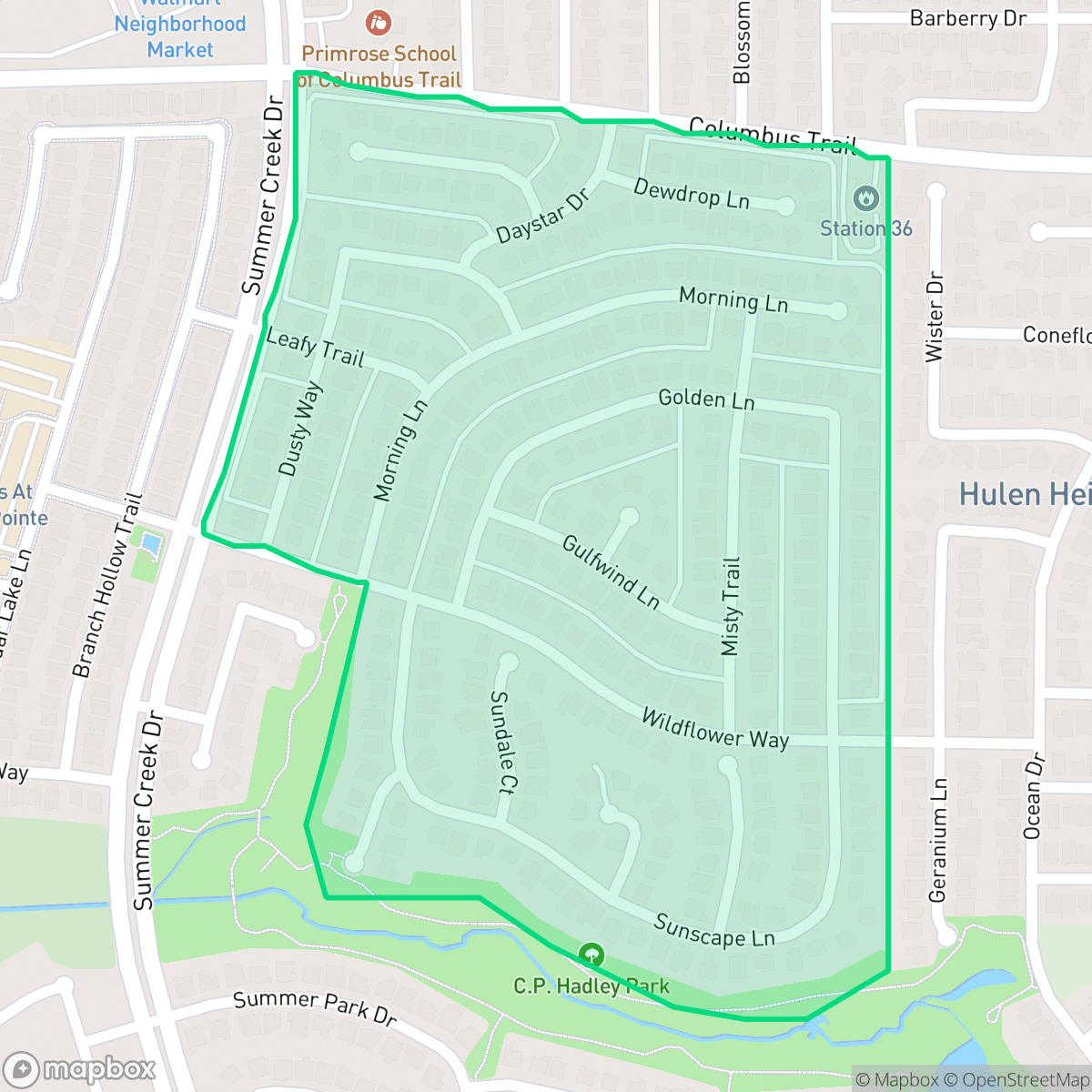
Summer Creek is a single-family residential community in southwest Fort Worth, Texas, with development beginning in 1987 by the Murray Development Company. Following Murray's bankruptcy during Phase I, Perry Homes assumed control of the operations and completed the neighborhood's three phases by the mid-1990s, resulting in a community of 320 brick-construction homes. The neighborhood is closely tied to its local green spaces, notably C.P. Hadley Park (originally named Summercreek Park), which was dedicated in 2006. The park features a 2010 bronze sculpture, *Prairie Wind*, by local artist Michael Pavlovsky, which celebrates the native North Texas prairie landscape that historically characterized the region.
The neighborhood features a uniform collection of brick-construction homes characterized by large footprints, complex rooflines, and private amenities such as three-car garages and backyard pools. According to iHuus data, the community excels in walkability, offering continuous sidewalks on both sides of residential streets and a dedicated off-street trail network that connects the area. The atmosphere is notably quiet, with a measured noise level of 54 decibels, primarily attributed to local road traffic rather than industrial or aviation sources. While the area lacks a dense commercial core, it maintains a strong visual appeal and a consistent suburban character that prioritizes residential privacy and outdoor access.
Families considering the area should note that school options are split between the Crowley Independent School District and the Fort Worth Independent School District, both of which face varying levels of academic and operational challenges. While the neighborhood provides an affluent and well-maintained environment, residents must balance the benefits of a quiet, pedestrian-friendly layout against the limited variety of immediate social and leisure commercial options. The community is best suited for those seeking a stable, single-family residential environment with reliable access to walking paths and greenbelts, provided they are comfortable with the surrounding school district performance and the necessity of commuting for major retail or employment hubs.
Neighborhood Scores Across 15 Qualities
Residential spacing varies from apartment zones with shared walls to standard suburban lots with moderate buffers between neighbors. This level of privacy is roughly in line with the Fort Worth average according to iHuus data.
Extensive sidewalk networks and dedicated off-street trails make navigating the area on foot very easy. This level of pedestrian connectivity is significantly higher than the average for Fort Worth.
Larger homes and premium amenities contribute to a landscape that is more visually polished than the Fort Worth average. According to iHuus data, the area features diverse architecture, spacious driveways, and frequent private backyard pools.
Extensive greenbelts and a central park corridor with connected walking paths make this area more dog friendly than the Fort Worth average. Large undeveloped fields and consistent sidewalk verges provide safe, traffic-free routes for pets.
Residential layouts consist of dense suburban housing tracts and commercial strips, though the area maintains a slightly less developed character than the Fort Worth average. According to iHuus data, the landscape features a mix of uniform single-family homes and pockets of open land.
Local social hubs and dining options provide more activity than the typical Fort Worth area. While some pockets remain quiet and suburban, other blocks feature a noticeable concentration of coffee shops and eateries.
Steady traffic noise from nearby busy streets is common here. This level of acoustic activity is slightly higher than the average for Fort Worth, according to iHuus data.
Air quality levels fluctuate between acceptable and unhealthy, presenting occasional concerns for sensitive groups. This pattern is slightly higher than the Fort Worth average, according to iHuus data.
Industrial activity and warehouses are entirely absent from this area, providing a quiet environment that is significantly cleaner of industrial proximity than the Fort Worth average. According to iHuus data, the neighborhood consists strictly of residential zones and light retail, with no detected hazardous sites.
Health insurance accessibility is significantly higher than the Fort Worth average, according to iHuus data. This indicates a high rate of coverage among the local population.
Political leanings in this area are more liberal than the average found throughout Fort Worth, according to iHuus data.
Residents live alongside a balanced mix of young adults, families, and older individuals. According to iHuus data, this age distribution is slightly more varied than the average found across Fort Worth.
Flood risk in this area is higher than the Fort Worth average, though a lack of detailed FEMA studies means the precise level of risk remains undetermined. Residents should remain aware of potential drainage concerns during heavy rain events.
Address-Level Insights for Summer Creek


iHuus Neighborhood Intelligence Insights
Get address-level neighborhood insights for Summer Creek
- Street-level scores — see how individual blocks compare, not just neighborhood averages
- Micro-zone boundaries — identify quiet pockets, flood boundaries, and walkable clusters before you visit
- 15 dimensions in full — walkability, noise, air quality, school quality, insurance coverage, population age profile, urban/rural index, and more
- Boundary risk alerts — know if your address sits near a block boundary where scores drop, the kind of detail no listing will ever mention
- School insights — individual school ratings and insights, not just district-level data
- Compare before you commit — side-by-side data across neighborhoods, down to block precision
No credit card required
Compare with Any Neighborhood
| Dimension | Summer Creek | Alamo Heights |
|---|---|---|
| 🚶 Walkabilityavg 7.5 | ||
| 🔊 Acoustic Comfortavg 4.12 | ||
| 🤫 Privacy Indexavg 5.64 | ||
| 🎨 Visual Appealavg 6.38 | ||
| 🐕 Dog Friendlinessavg 6.57 | ||
| 🗺️ Urban-Rural Indexavg 6.92 | ||
| ✨ Neighborhood Vibeavg 4.56 | ||
| 🏥 Health Insurance Coverageavg 5.8 | ||
| 🌿 Air Qualityavg 3.68 | ||
| 🏭 Industrial Proximityavg 8.13 | ||
| 🌊 Flood Safetyavg 3.61 | ||
| 🗳️ Ideological Leanavg 5.62 | ||
| 👥 Population Age Profileavg 4.51 | ||
| 🔥 Fire Safety | ||
| 🏫 School Quality |
Summer Creek Rankings
School Districts Serving Summer Creek
School Insights for Summer Creek
Below average outcomes; significant attendance and academic challenges.
School Insights
See what's really behind every school rating near Summer Creek
- Individual school ratings — each school's own score with outcome context, not just a district average
- Enrollment & class size data — student-to-teacher ratio and how it compares to the state average
- Full demographics breakdown — ethnicity and gender composition for every school in the enrollment zone
- Every school in the district — all schools within the enrollment boundary ranked by rating, not just the closest one
- Grade levels & benchmarks — elementary through high school, with below/above state-average flags
No credit card required