Stop Six, Fort Worth
Updated · 5,124 residents
Stop Six is a historic Fort Worth community defined by its mid-century residential grid and enduring local identity. The neighborhood offers a quiet, suburban atmosphere with modest green spaces, though residents typically rely on personal vehicles for daily errands and local travel.
Key Highlights
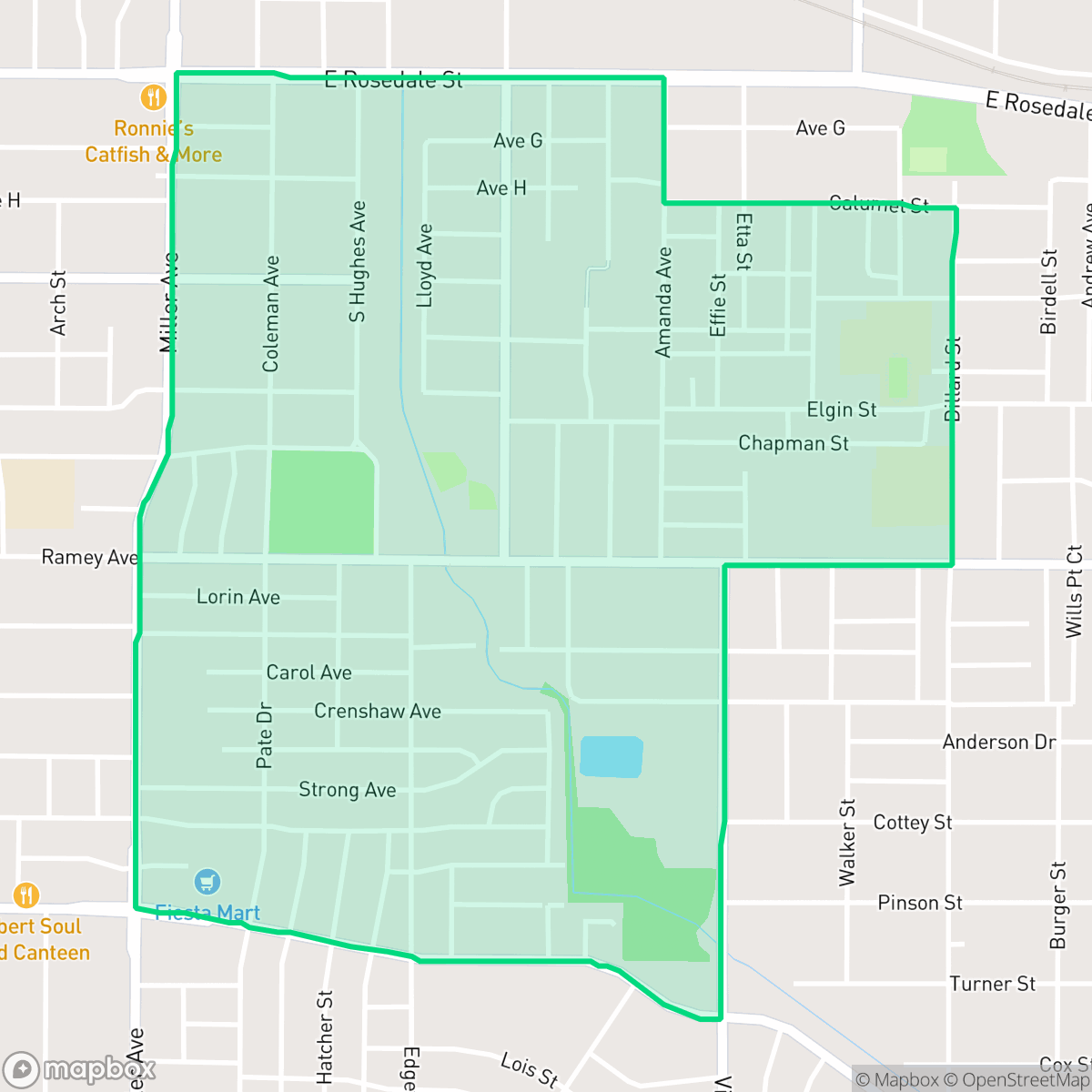
About Stop Six
Founded in 1896 when African American pioneer Amanda Davis purchased its first plot of land, the southeast Fort Worth neighborhood of Stop Six was originally a rural settlement known as Cowanville. It earned its lasting moniker as the sixth stop on the Northern Texas Traction Company's interurban streetcar line, which connected Fort Worth and Dallas from 1902 to 1934. Over the 20th century, it evolved into a thriving, self-sustaining Black community characterized by mid-century single-story wood and brick homes, designated as the Stop Six Sunrise Edition historic district in 2007. Local landmarks include the historic J.A. Cavile Apartments and Paul Laurence Dunbar High School on Ramey Avenue. Dunbar High School became a national focal point under legendary basketball coach Robert "Bob" Hughes, who cemented the neighborhood's proud athletic and cultural legacy.
This area functions as a classic suburban enclave characterized by a standard residential grid and uniform housing styles. While the neighborhood maintains a calm environment with equal parts streets and green space, it is primarily a car-dependent community where local amenities are dispersed. Residents frequent social hubs such as area churches and local dining spots, which serve as the primary anchors for community interaction. According to iHuus data, the area benefits from a stable suburban layout, though it lacks the high-density commercial walkability found in more central urban districts.
Living here involves navigating specific trade-offs regarding infrastructure and public services. While the neighborhood provides a consistent residential feel, it faces challenges related to flood safety and limited health insurance coverage among the local population. Families should also consider the broader context of the Fort Worth Independent School District, which currently experiences significant operational and financial pressures, despite the presence of high-performing specialty schools like the Young Men's Leadership Academy. The area is best suited for those seeking a quiet, established residential setting who prioritize affordability and a strong sense of local history over immediate proximity to high-density retail or transit hubs.
Neighborhood Scores Across 15 Qualities
Homes are spaced with consistent buffers and private fenced backyards, providing slightly more separation between neighbors than the Fort Worth average. According to iHuus data, the residential density allows for a balanced degree of privacy.
Low traffic on interior streets provides a calm environment for walking, though the lack of continuous sidewalks makes the area less walkable than the Fort Worth average.
Uniform tract housing and small yards characterize this area. The visual landscape is less varied than the Fort Worth average, featuring mostly consistent roof geometries and limited private greenery.
Access to dog-friendly spaces is below the Fort Worth average, though some residents can utilize public park trails and grassy verges located in the southern portion of the area.
Residential areas consist of a classic suburban layout with single-family homes and small commercial clusters. This environment is slightly less open than the typical Fort Worth landscape, according to iHuus data.
Local dining and social hubs provide more activity than the city average, though the layout remains largely car-dependent. Residents will find a variety of scattered restaurants and community spaces, but most errands require a vehicle due to the suburban street design.
Local traffic from nearby busy streets creates a consistent background hum. According to iHuus data, this level of activity is slightly higher than the average found throughout Fort Worth.
Air quality in this area fluctuates between acceptable and unhealthy levels, though conditions are slightly better than the Fort Worth average. Sensitive individuals should monitor local reports for occasional periods of concern.
Residential streets and light commercial services dominate the area, providing a landscape that is notably cleaner of heavy industry than the Fort Worth average. According to iHuus data, most residents will experience only minor, intermittent activity from local services like printing shops.
Health insurance coverage is significantly lower than the Fort Worth average. Residents may face greater challenges accessing employer-sponsored or private medical coverage according to iHuus data.
Voting patterns and census indicators show a predominantly liberal leaning, which is notably higher than the Fort Worth average according to iHuus data.
A balanced mix of young adults, families, and older residents characterizes the area. This demographic spread is largely consistent with the overall Fort Worth average, according to iHuus data.
Significant flood vulnerability exists in this area, which is considerably higher than the Fort Worth average. Residents should prepare for much higher insurance premiums and potential water-related hazards.
Address-Level Insights for Stop Six


iHuus Neighborhood Intelligence Insights
Get address-level neighborhood insights for Stop Six
- Street-level scores — see how individual blocks compare, not just neighborhood averages
- Micro-zone boundaries — identify quiet pockets, flood boundaries, and walkable clusters before you visit
- 15 dimensions in full — walkability, noise, air quality, school quality, insurance coverage, population age profile, urban/rural index, and more
- Boundary risk alerts — know if your address sits near a block boundary where scores drop, the kind of detail no listing will ever mention
- School insights — individual school ratings and insights, not just district-level data
- Compare before you commit — side-by-side data across neighborhoods, down to block precision
No credit card required
Compare with Any Neighborhood
| Dimension | Stop Six | Alamo Heights |
|---|---|---|
| 🚶 Walkabilityavg 7.5 | ||
| 🔊 Acoustic Comfortavg 4.12 | ||
| 🤫 Privacy Indexavg 5.64 | ||
| 🎨 Visual Appealavg 6.38 | ||
| 🐕 Dog Friendlinessavg 6.57 | ||
| 🗺️ Urban-Rural Indexavg 6.92 | ||
| ✨ Neighborhood Vibeavg 4.56 | ||
| 🏥 Health Insurance Coverageavg 5.8 | ||
| 🌿 Air Qualityavg 3.68 | ||
| 🏭 Industrial Proximityavg 8.13 | ||
| 🌊 Flood Safetyavg 3.61 | ||
| 🗳️ Ideological Leanavg 5.62 | ||
| 👥 Population Age Profileavg 4.51 | ||
| 🔥 Fire Safety | ||
| 🏫 School Quality |
Stop Six Rankings
School Districts Serving Stop Six
School Insights for Stop Six
Below average outcomes; significant attendance and academic challenges.
School Insights
See what's really behind every school rating near Stop Six
- Individual school ratings — each school's own score with outcome context, not just a district average
- Enrollment & class size data — student-to-teacher ratio and how it compares to the state average
- Full demographics breakdown — ethnicity and gender composition for every school in the enrollment zone
- Every school in the district — all schools within the enrollment boundary ranked by rating, not just the closest one
- Grade levels & benchmarks — elementary through high school, with below/above state-average flags
No credit card required