Stop Six Sunrise Edition, Fort Worth
Updated · 1,641 residents
Stop Six Sunrise Edition is a quiet, residential enclave in southeast Fort Worth defined by its open landscape and historic vernacular architecture. The area offers a peaceful, suburban environment that is notably dog-friendly, though residents face challenges regarding flood safety and access to local services.
Key Highlights
About Stop Six Sunrise Edition
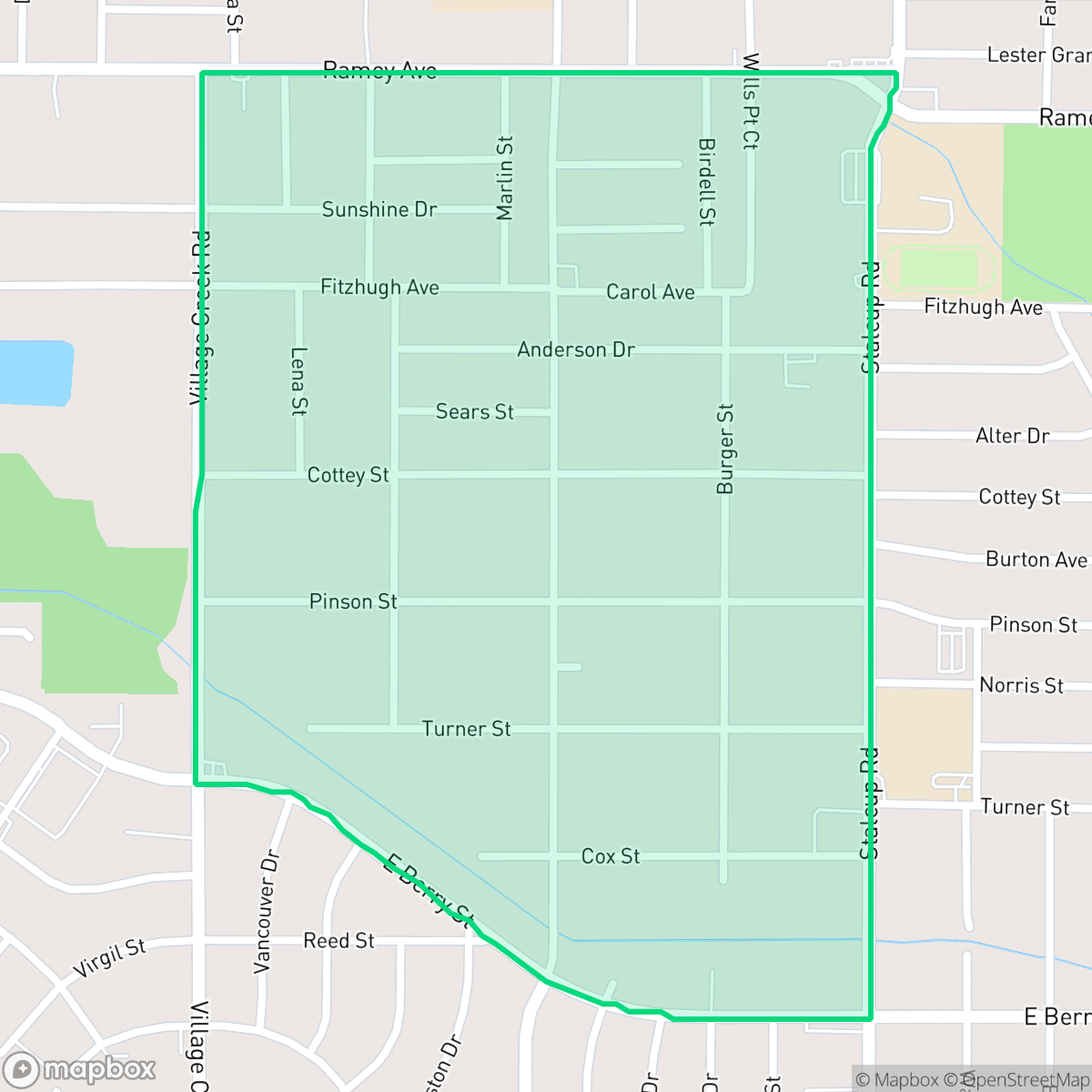
Located in southeast Fort Worth, the Stop Six Sunrise Edition is a historically significant neighborhood rooted in the early development of the city's streetcar system. Originally part of a pastoral, African American-settled community known as Cowanville, the area was nicknamed "Stop Six" as the sixth stop on the Northern Texas Traction Company’s interurban line, which operated from 1902 to 1934. Spanning approximately 392 acres, the Sunrise Edition was officially designated as a local historic district in 2007. Bounded by Ramey Avenue, Stalcup Road, Berry Street, and Langston Street, the neighborhood is characterized by its rural, open landscape and early-to-mid-20th-century vernacular architecture, including single-story wood-sided homes that reflect its transition from small agricultural homesteads to a suburban community.
Stop Six Sunrise Edition functions as a primarily residential community, offering a quiet, low-density environment that stands out for its lack of industrial encroachment. The area maintains a distinct suburban character, blending open green spaces with early-to-mid-20th-century homes. Residents benefit from a peaceful atmosphere that is well-suited for pet owners, as the neighborhood scores above the city average for dog friendliness. According to iHuus data, the area provides a consistent, if subdued, living experience, distinct from the more bustling urban corridors of Fort Worth.
Prospective residents should carefully weigh several livability trade-offs. The neighborhood faces significant challenges regarding infrastructure and public services, notably a very low score for flood safety and limited access to health insurance coverage. Educational opportunities are currently constrained by the broader instability of the Fort Worth Independent School District, which is navigating budget deficits and school closures. While the area offers a tranquil setting, those prioritizing high walkability or proximity to diverse retail and commercial services may find the neighborhood layout restrictive for daily errands.
Neighborhood Scores Across 15 Qualities
Housing layouts offer a moderate amount of spacing with some buffers between neighbors. According to iHuus data, this level of privacy is slightly higher than the Fort Worth average.
Low traffic volume makes for a quiet walking environment, though a lack of sidewalks makes the area less walkable than much of Fort Worth. According to iHuus data, residents should expect to rely more on vehicles for most errands.
Modest yard spaces and uniform housing designs characterize the area, which offers less visual variety than the Fort Worth average according to iHuus data.
Access to public parks and wide green verges is below the Fort Worth average. Residents may find fewer opportunities for walking pets compared to other parts of the city.
Open land and scattered homes are common throughout the area, though the landscape is slightly less developed than the Fort Worth average. Some sections feature a denser suburban layout with standard housing and nearby industrial zones, according to iHuus data.
Limited local business density and proximity to major highway corridors and industrial zones create a quiet but primarily car-oriented environment. According to iHuus data, the level of activity and social vibrancy is lower than the Fort Worth average.
Frequent noise from nearby railroad tracks and busy freeways characterizes this area. According to iHuus data, acoustic levels are slightly more disruptive than the Fort Worth average.
Air quality levels fluctuate between acceptable and unhealthy, with occasional concerns for sensitive groups. This neighborhood experience is slightly more impacted by pollutants than the Fort Worth average, according to iHuus data.
Primarily residential streets and open green spaces define this area, with noticeably less industrial activity than the Fort Worth average. Residents can expect mostly quiet surroundings with only occasional light commercial activity nearby.
Health insurance coverage is notably lower than the Fort Worth average, which may present challenges for accessing regular medical care. According to iHuus data, a small portion of the resident population is currently covered by health plans.
Voting patterns and census indicators show a significantly more liberal leaning than the Fort Worth average, according to iHuus data.
A balanced demographic spread of young adults, families, and older residents characterizes this area, aligning with the typical age distribution found across Fort Worth.
Significant flood vulnerability exists in this area, which is substantially higher than the Fort Worth average. Residents should anticipate elevated or prohibitive flood insurance costs based on iHuus data.
Address-Level Insights for Stop Six Sunrise Edition


iHuus Neighborhood Intelligence Insights
Get address-level neighborhood insights for Stop Six Sunrise Edition
- Street-level scores — see how individual blocks compare, not just neighborhood averages
- Micro-zone boundaries — identify quiet pockets, flood boundaries, and walkable clusters before you visit
- 15 dimensions in full — walkability, noise, air quality, school quality, insurance coverage, population age profile, urban/rural index, and more
- Boundary risk alerts — know if your address sits near a block boundary where scores drop, the kind of detail no listing will ever mention
- School insights — individual school ratings and insights, not just district-level data
- Compare before you commit — side-by-side data across neighborhoods, down to block precision
No credit card required
Compare with Any Neighborhood
| Dimension | Stop Six Sunrise Edition | Alamo Heights |
|---|---|---|
| 🚶 Walkabilityavg 7.5 | ||
| 🔊 Acoustic Comfortavg 4.12 | ||
| 🤫 Privacy Indexavg 5.64 | ||
| 🎨 Visual Appealavg 6.38 | ||
| 🐕 Dog Friendlinessavg 6.57 | ||
| 🗺️ Urban-Rural Indexavg 6.92 | ||
| ✨ Neighborhood Vibeavg 4.56 | ||
| 🏥 Health Insurance Coverageavg 5.8 | ||
| 🌿 Air Qualityavg 3.68 | ||
| 🏭 Industrial Proximityavg 8.13 | ||
| 🌊 Flood Safetyavg 3.61 | ||
| 🗳️ Ideological Leanavg 5.62 | ||
| 👥 Population Age Profileavg 4.51 | ||
| 🔥 Fire Safety | ||
| 🏫 School Quality |
Stop Six Sunrise Edition Rankings
School Districts Serving Stop Six Sunrise Edition
School Insights for Stop Six Sunrise Edition
Below average outcomes; significant attendance and academic challenges.
School Insights
See what's really behind every school rating near Stop Six Sunrise Edition
- Individual school ratings — each school's own score with outcome context, not just a district average
- Enrollment & class size data — student-to-teacher ratio and how it compares to the state average
- Full demographics breakdown — ethnicity and gender composition for every school in the enrollment zone
- Every school in the district — all schools within the enrollment boundary ranked by rating, not just the closest one
- Grade levels & benchmarks — elementary through high school, with below/above state-average flags
No credit card required