South Lake Worth, Fort Worth
Updated · 1,436 residents
South Lake Worth is a rural, low-density community in Fort Worth defined by its expansive open spaces and quiet, remote atmosphere. While it offers a secluded environment away from urban congestion, residents must navigate higher noise levels from road traffic and proximity to industrial zones.
Key Highlights
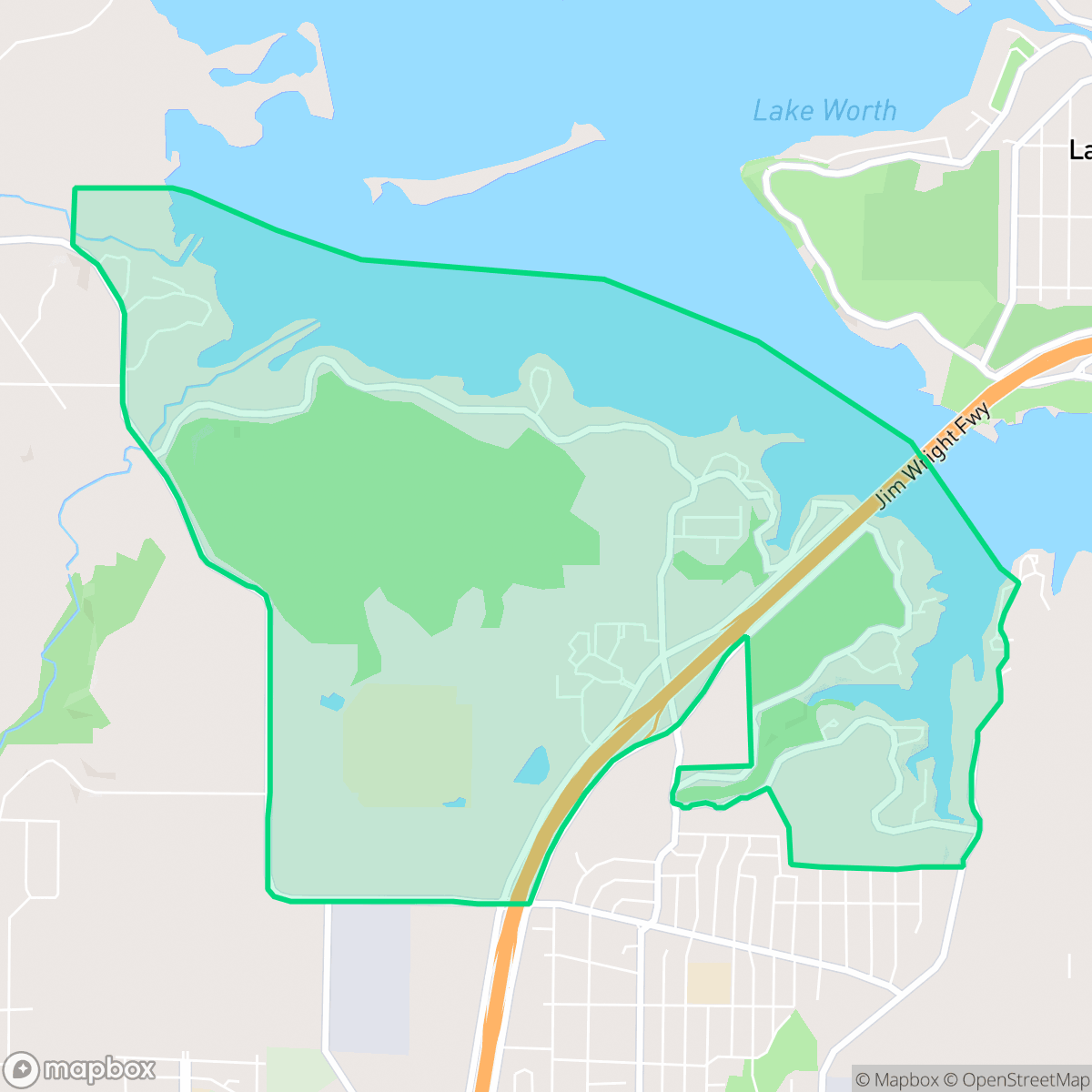
About South Lake Worth
South Lake Worth is defined by its rural landscape, characterized by vast open areas and a lack of dense commercial development. The area provides a secluded living environment, featuring a mix of residential blocks and light industrial units. Local landmarks such as The Point On Lake Worth and The Brickey's Bar And Grill serve as primary social hubs for the community, which maintains a distinctively quiet, small-town feel despite its proximity to the broader Fort Worth metroplex.
Prospective residents should weigh the benefits of this rural setting against specific livability trade-offs. The area experiences significant road traffic noise and carries risks associated with nearby industrial activity, including potential groundwater and soil concerns linked to a local EPA Superfund site. Additionally, the neighborhood faces challenges with flood safety, making it a location best suited for those prioritizing privacy and a rural lifestyle over high walkability or immediate access to urban amenities. Families may find the White Settlement Independent School District a stable educational option compared to other regional alternatives.
Neighborhood Scores Across 15 Qualities
Large lots with significant separation between properties offer more seclusion than the typical Fort Worth residential area, according to iHuus data.
Quiet streets allow for casual strolls, but a lack of sidewalks makes the area less walkable than much of Fort Worth. According to iHuus data, pedestrian infrastructure is notably below the city average.
Housing consists mainly of traditional tract homes with modest yards and simple rooflines. This visual landscape is slightly below the Fort Worth average for aesthetic variety.
Access to public parks and green verges for walking pets is slightly below the Fort Worth average. Residents may find fewer immediate options for off-leash activity compared to other parts of the city.
Large stretches of undeveloped woodland and open fields dominate the landscape, providing a much more rural character than the Fort Worth average. This area is defined by significant natural acreage and sparse building density, punctuated only by specific large-scale industrial complexes.
Low density and vast open spaces create a serene environment, though the area lacks the commercial activity and social density found in most of Fort Worth. Residents will find a peaceful landscape with very few local businesses or destinations nearby.
Frequent noise from nearby rail lines and major freeways characterizes the area. According to iHuus data, acoustic comfort in this neighborhood is significantly lower than the Fort Worth average.
Air quality in this area fluctuates between acceptable and unhealthy levels, though it remains slightly better than the Fort Worth average. Sensitive groups may experience occasional concern during periods of poor air quality according to iHuus data.
Heavy industrial activity, including quarrying operations and freight corridors, is notably more prevalent here than in the rest of Fort Worth. Residents should be aware of an adjacent EPA Superfund site with potential environmental impacts on soil and groundwater, according to iHuus data.
Health insurance accessibility is lower than the Fort Worth average, with fewer residents holding coverage compared to the rest of the city. According to iHuus data, a minority of the population in this area has access to employer or private health plans.
Conservative voters represent a significant majority in this area, establishing a political lean that is notably more conservative than the Fort Worth average according to iHuus data.
Residents live alongside a balanced mix of young adults, families, and older individuals. This demographic spread is slightly more varied than the average found throughout Fort Worth.
Frequent flooding is a concern in this area because parts of the neighborhood sit within a 100-year floodplain. This risk level is higher than the average for Fort Worth, and residents should prepare for potential flood insurance requirements.
Address-Level Insights for South Lake Worth


iHuus Neighborhood Intelligence Insights
Get address-level neighborhood insights for South Lake Worth
- Street-level scores — see how individual blocks compare, not just neighborhood averages
- Micro-zone boundaries — identify quiet pockets, flood boundaries, and walkable clusters before you visit
- 15 dimensions in full — walkability, noise, air quality, school quality, insurance coverage, population age profile, urban/rural index, and more
- Boundary risk alerts — know if your address sits near a block boundary where scores drop, the kind of detail no listing will ever mention
- School insights — individual school ratings and insights, not just district-level data
- Compare before you commit — side-by-side data across neighborhoods, down to block precision
No credit card required
Compare with Any Neighborhood
| Dimension | South Lake Worth | Alamo Heights |
|---|---|---|
| 🚶 Walkabilityavg 7.5 | ||
| 🔊 Acoustic Comfortavg 4.12 | ||
| 🤫 Privacy Indexavg 5.64 | ||
| 🎨 Visual Appealavg 6.38 | ||
| 🐕 Dog Friendlinessavg 6.57 | ||
| 🗺️ Urban-Rural Indexavg 6.92 | ||
| ✨ Neighborhood Vibeavg 4.56 | ||
| 🏥 Health Insurance Coverageavg 5.8 | ||
| 🌿 Air Qualityavg 3.68 | ||
| 🏭 Industrial Proximityavg 8.13 | ||
| 🌊 Flood Safetyavg 3.61 | ||
| 🗳️ Ideological Leanavg 5.62 | ||
| 👥 Population Age Profileavg 4.51 | ||
| 🔥 Fire Safety | ||
| 🏫 School Quality |
South Lake Worth Rankings
School Districts Serving South Lake Worth
School Insights for South Lake Worth
Below average outcomes; significant attendance and academic challenges.
School Insights
See what's really behind every school rating near South Lake Worth
- Individual school ratings — each school's own score with outcome context, not just a district average
- Enrollment & class size data — student-to-teacher ratio and how it compares to the state average
- Full demographics breakdown — ethnicity and gender composition for every school in the enrollment zone
- Every school in the district — all schools within the enrollment boundary ranked by rating, not just the closest one
- Grade levels & benchmarks — elementary through high school, with below/above state-average flags
No credit card required