Shaw Clarke, Fort Worth
Updated · 1,705 residents
Shaw Clarke is a compact, historic neighborhood in Fort Worth defined by its dense residential grid and proximity to active rail lines. While it offers a central location with access to local dining, the area experiences significant road noise and limited privacy due to closely spaced homes.
Key Highlights
About Shaw Clarke
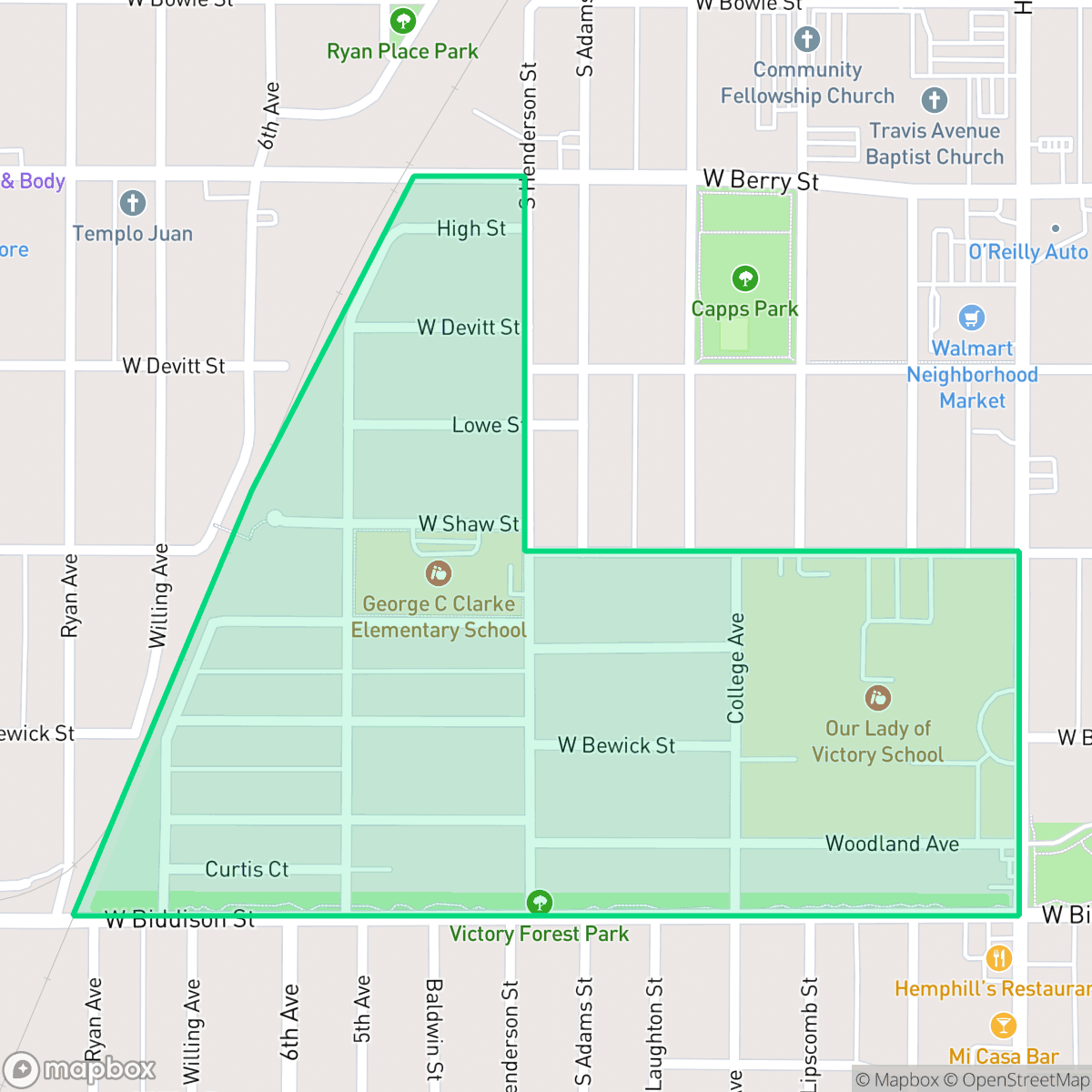
Platted in 1906, the Shaw Clarke neighborhood in Fort Worth was carved out of the vast acreage of the Shaw Brothers Dairy, a prominent local enterprise in an area once known as "Little Wisconsin". To develop the land, the Shaw brothers partnered with George Carson Clarke, a major South Side developer and future city parks superintendent. The neighborhood was annexed into Fort Worth in 1907, rapidly transforming from dairy pasture into a bustling streetcar suburb along Hemphill Street. Key historic landmarks soon followed, including the landmark Our Lady of Victory Academy, built on 15 acres acquired in 1908, and the Tudor Revival-style George C. Clarke Elementary School, erected in 1914. Today, the neighborhood's early 20th-century origins remain preserved in its historic street grid and residential architecture.
The neighborhood functions as a dense, low-rise urban environment characterized by a traditional grid layout. Residents benefit from local social spots such as Mama's Pizza and proximity to established transit corridors, which contribute to a steady level of neighborhood activity. The built environment consists primarily of modest, uniform housing on small lots, reflecting its origins as a working-class streetcar suburb.
Prospective residents should note that the area faces specific livability trade-offs, including elevated noise levels from road traffic and nearby industrial activity. The neighborhood has limited public green space for pets, and the local school district currently faces significant operational challenges that may influence family housing decisions. Given the density and lack of private outdoor amenities, the area is best suited for those prioritizing a central location and historic character over expansive living space or quiet seclusion.
Neighborhood Scores Across 15 Qualities
Residential spacing is somewhat tighter than the Fort Worth average, with some properties featuring narrow side yards and closely packed houses. Most lots offer a moderate buffer between neighbors, though some areas show higher density with limited separation between structures.
Sidewalks are often narrow or interrupted by utility poles and trees. While the grid layout and low traffic on residential streets allow for some pedestrian movement, walking accessibility is below the Fort Worth average according to iHuus data.
Residential streetscapes consist of uniform, small-lot homes with simple architecture and minimal yard space. This landscape is notably less varied than the Fort Worth average according to iHuus data.
Public green space and park access are restricted in this area. According to iHuus data, sidewalk verges are narrow and most greenery is confined to private, fenced backyards, making it less dog friendly than the Fort Worth average.
Residential areas feature a dense suburban layout with significant building cover and limited open space. This environment is slightly more urbanized than the typical Fort Worth landscape according to iHuus data.
A mix of suburban streets and social hubs provides more activity than the typical Fort Worth neighborhood. Residents can find various dining options and green spaces near the railway, according to iHuus data.
Frequent noise from nearby railroad tracks and heavy freeway traffic characterizes the area. According to iHuus data, acoustic comfort is lower than the Fort Worth average.
Air quality levels in Shaw Clarke fluctuate between acceptable and unhealthy periods. According to iHuus data, conditions are slightly better than the average found across Fort Worth.
Residential life is largely uninterrupted by heavy industry, though an active freight rail line and some warehouse structures introduce occasional noise and commercial traffic. According to iHuus data, the level of industrial adjacency remains comparable to the Fort Worth average.
Health insurance coverage is significantly lower in this area than the Fort Worth average. Residents may face greater challenges accessing employer-sponsored or private health plans according to iHuus data.
Voting patterns and census indicators in Shaw Clarke reflect a notably more liberal leaning than the Fort Worth average, according to iHuus data.
Residents live alongside a balanced mix of young adults, families, and seniors. According to iHuus data, the age distribution in Shaw Clarke is very similar to the broader Fort Worth area.
Significant flood vulnerability exists in this area, with risks notably higher than the Fort Worth average. Residents should expect elevated or potentially prohibitive flood insurance costs based on iHuus data.
Address-Level Insights for Shaw Clarke


iHuus Neighborhood Intelligence Insights
Get address-level neighborhood insights for Shaw Clarke
- Street-level scores — see how individual blocks compare, not just neighborhood averages
- Micro-zone boundaries — identify quiet pockets, flood boundaries, and walkable clusters before you visit
- 15 dimensions in full — walkability, noise, air quality, school quality, insurance coverage, population age profile, urban/rural index, and more
- Boundary risk alerts — know if your address sits near a block boundary where scores drop, the kind of detail no listing will ever mention
- School insights — individual school ratings and insights, not just district-level data
- Compare before you commit — side-by-side data across neighborhoods, down to block precision
No credit card required
Compare with Any Neighborhood
| Dimension | Shaw Clarke | Alamo Heights |
|---|---|---|
| 🚶 Walkabilityavg 7.5 | ||
| 🔊 Acoustic Comfortavg 4.12 | ||
| 🤫 Privacy Indexavg 5.64 | ||
| 🎨 Visual Appealavg 6.38 | ||
| 🐕 Dog Friendlinessavg 6.57 | ||
| 🗺️ Urban-Rural Indexavg 6.92 | ||
| ✨ Neighborhood Vibeavg 4.56 | ||
| 🏥 Health Insurance Coverageavg 5.8 | ||
| 🌿 Air Qualityavg 3.68 | ||
| 🏭 Industrial Proximityavg 8.13 | ||
| 🌊 Flood Safetyavg 3.61 | ||
| 🗳️ Ideological Leanavg 5.62 | ||
| 👥 Population Age Profileavg 4.51 | ||
| 🔥 Fire Safety | ||
| 🏫 School Quality |
Shaw Clarke Rankings
School Districts Serving Shaw Clarke
School Insights for Shaw Clarke
Below average outcomes; significant attendance and academic challenges.
School Insights
See what's really behind every school rating near Shaw Clarke
- Individual school ratings — each school's own score with outcome context, not just a district average
- Enrollment & class size data — student-to-teacher ratio and how it compares to the state average
- Full demographics breakdown — ethnicity and gender composition for every school in the enrollment zone
- Every school in the district — all schools within the enrollment boundary ranked by rating, not just the closest one
- Grade levels & benchmarks — elementary through high school, with below/above state-average flags
No credit card required