Scenic Bluff, Fort Worth
Updated · 4,282 residents
Scenic Bluff is a historic Fort Worth neighborhood known for its exceptional walkability and highly dog-friendly environment along the West Fork of the Trinity River. While it features a vibrant commercial corridor on Race Street, prospective residents should be aware of the area's low flood safety rating and the challenges facing the local school district.
Key Highlights
About Scenic Bluff
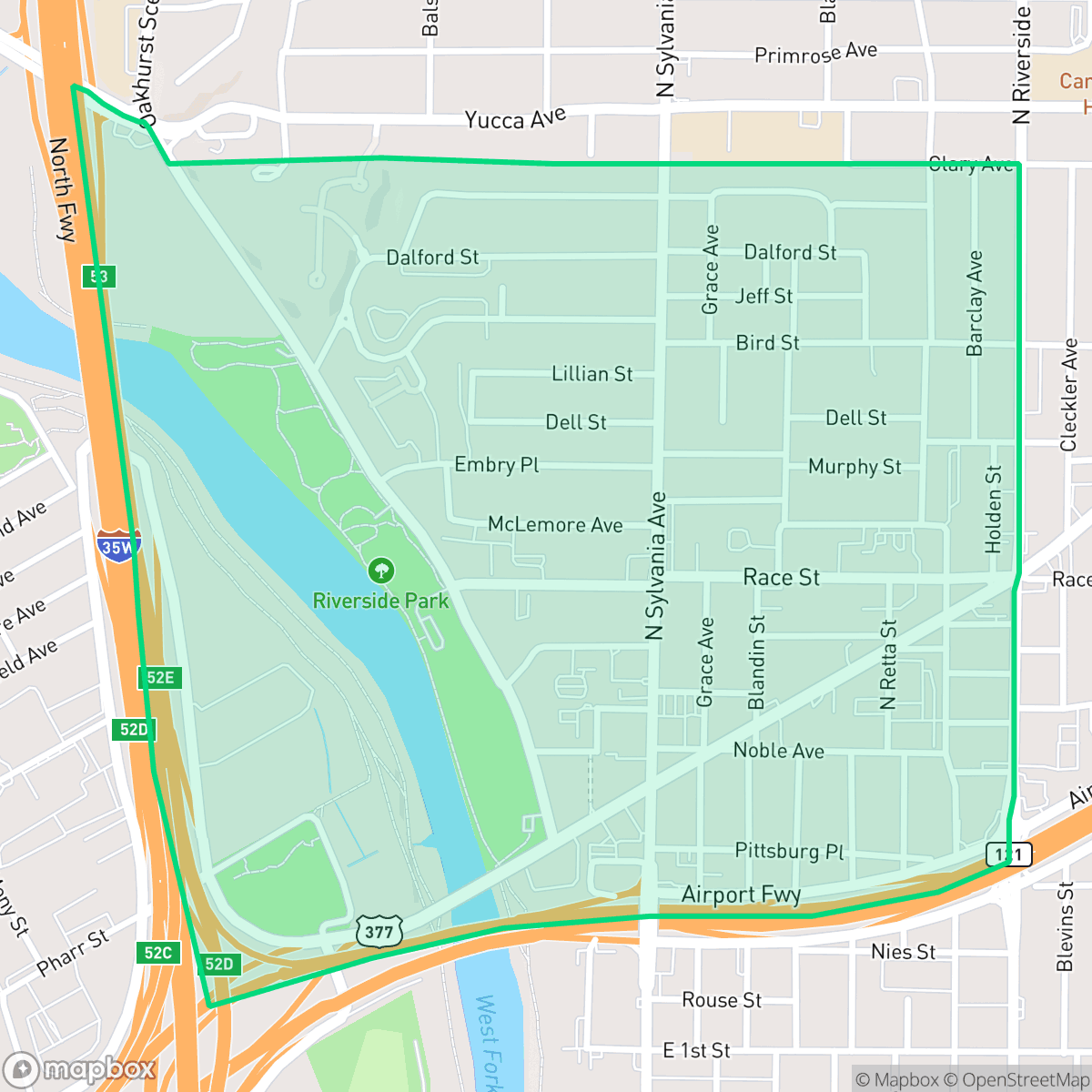
Located northeast of downtown Fort Worth overlooking the West Fork of the Trinity River, Scenic Bluff is one of the city's older neighborhoods, with residential roots dating back to the 1920s. The area's historic housing stock features a mix of traditional bungalows and ranch-style homes. Race Street serves as the neighborhood’s commercial epicenter; once primarily residential, it became home to the Sylvania Post Office around 1946 before gradually transitioning into a commercial corridor. Today, often referred to as part of the River East district, Scenic Bluff has experienced significant revitalization. The neighborhood is defined by local businesses like Tributary Cafe, Race Street Coffee, and the live music venue The Post at River East, alongside Riverside Park, which connects residents to the expansive Trinity Trails.
Situated northeast of downtown, the area balances its historic residential roots with an evolving commercial landscape centered on the River East district. According to iHuus data, the neighborhood stands out for its high level of walkability and welcoming atmosphere for pet owners, providing convenient access to the expansive Trinity Trails. The blend of traditional architectural styles and proximity to the riverfront creates a distinct sense of place that continues to attract those seeking an established community feel near the city center. Prospective residents should weigh these lifestyle benefits against several practical considerations. The neighborhood experiences moderate noise levels from local road traffic and has lower than average air quality. Furthermore, the area faces significant challenges regarding flood safety and limited access to health insurance coverage. Families with children should also consider the current instability within the Fort Worth Independent School District, which may impact educational planning for those moving to the area.
Neighborhood Scores Across 15 Qualities
Residential spacing offers a balance of openness and separation, providing slightly more buffer between neighbors than the Fort Worth average. Houses are typically detached with standard suburban distances between structures according to iHuus data.
Low traffic residential streets and a structured grid layout provide reliable pedestrian access. According to iHuus data, the walkability in this area is roughly comparable to the Fort Worth average.
Residential streetscapes feature modest single-family homes with uniform rooflines and small yards. According to iHuus data, the visual variety in this area is slightly below the Fort Worth average.
Wide green verges between sidewalks and roads provide consistent areas for walking pets safely. According to iHuus data, the availability of these connected green spaces is roughly in line with the Fort Worth average.
Open land and scattered homes amidst woodlands provide a more spacious feel than the Fort Worth average. According to iHuus data, the area features a mix of heavy industrial infrastructure alongside residential pockets and river corridors.
Local amenities and dining options provide a more active atmosphere than much of Fort Worth, though the car-dependent layout means most social hubs are not easily reached on foot. According to iHuus data, the area blends quiet industrial-suburban pockets with notable local eateries and coffee shops.
Local traffic from a nearby busy street creates a consistent background noise. This level of acoustic activity is typical for the Fort Worth area, according to iHuus data.
Frequent unhealthy air quality levels pose a significant risk to sensitive groups. According to iHuus data, the air quality in Scenic Bluff is lower than the Fort Worth average.
Industrial presence is minimal throughout most of the area, though some segments near major rail lines and logistics hubs experience higher levels of heavy truck traffic than the Fort Worth average. According to iHuus data, many streets remain quiet and residential, while other pockets feature active commercial services and light utility odors.
Health insurance accessibility is significantly below the Fort Worth average according to iHuus data. Residents may face higher challenges in accessing employer-sponsored or private medical coverage within the area.
Political leanings in this area trend more liberal than the Fort Worth average. According to iHuus data, the neighborhood contains a liberal majority with a modest opposing presence.
A balanced distribution of young adults, families, and older residents characterizes this area. This demographic variety is consistent with the broader Fort Worth population according to iHuus data.
Significant flood vulnerability exists here, with much higher risk levels compared to the Fort Worth average. Residents should prepare for elevated or potentially prohibitive flood insurance costs according to iHuus data.
Address-Level Insights for Scenic Bluff


iHuus Neighborhood Intelligence Insights
Get address-level neighborhood insights for Scenic Bluff
- Street-level scores — see how individual blocks compare, not just neighborhood averages
- Micro-zone boundaries — identify quiet pockets, flood boundaries, and walkable clusters before you visit
- 15 dimensions in full — walkability, noise, air quality, school quality, insurance coverage, population age profile, urban/rural index, and more
- Boundary risk alerts — know if your address sits near a block boundary where scores drop, the kind of detail no listing will ever mention
- School insights — individual school ratings and insights, not just district-level data
- Compare before you commit — side-by-side data across neighborhoods, down to block precision
No credit card required
Compare with Any Neighborhood
| Dimension | Scenic Bluff | Alamo Heights |
|---|---|---|
| 🚶 Walkabilityavg 7.5 | ||
| 🔊 Acoustic Comfortavg 4.12 | ||
| 🤫 Privacy Indexavg 5.64 | ||
| 🎨 Visual Appealavg 6.38 | ||
| 🐕 Dog Friendlinessavg 6.57 | ||
| 🗺️ Urban-Rural Indexavg 6.92 | ||
| ✨ Neighborhood Vibeavg 4.56 | ||
| 🏥 Health Insurance Coverageavg 5.8 | ||
| 🌿 Air Qualityavg 3.68 | ||
| 🏭 Industrial Proximityavg 8.13 | ||
| 🌊 Flood Safetyavg 3.61 | ||
| 🗳️ Ideological Leanavg 5.62 | ||
| 👥 Population Age Profileavg 4.51 | ||
| 🔥 Fire Safety | ||
| 🏫 School Quality |
Scenic Bluff Rankings
School Districts Serving Scenic Bluff
School Insights for Scenic Bluff
Below average outcomes; significant attendance and academic challenges.
School Insights
See what's really behind every school rating near Scenic Bluff
- Individual school ratings — each school's own score with outcome context, not just a district average
- Enrollment & class size data — student-to-teacher ratio and how it compares to the state average
- Full demographics breakdown — ethnicity and gender composition for every school in the enrollment zone
- Every school in the district — all schools within the enrollment boundary ranked by rating, not just the closest one
- Grade levels & benchmarks — elementary through high school, with below/above state-average flags
No credit card required