Ryan Place, Fort Worth
Updated · 3,139 residents
Ryan Place is a historic enclave in Fort Worth defined by its diverse architectural styles and quiet, tree-lined streets. While the area offers a calm atmosphere, residents experience notable noise from nearby road traffic and active freight rail lines.
Key Highlights
About Ryan Place
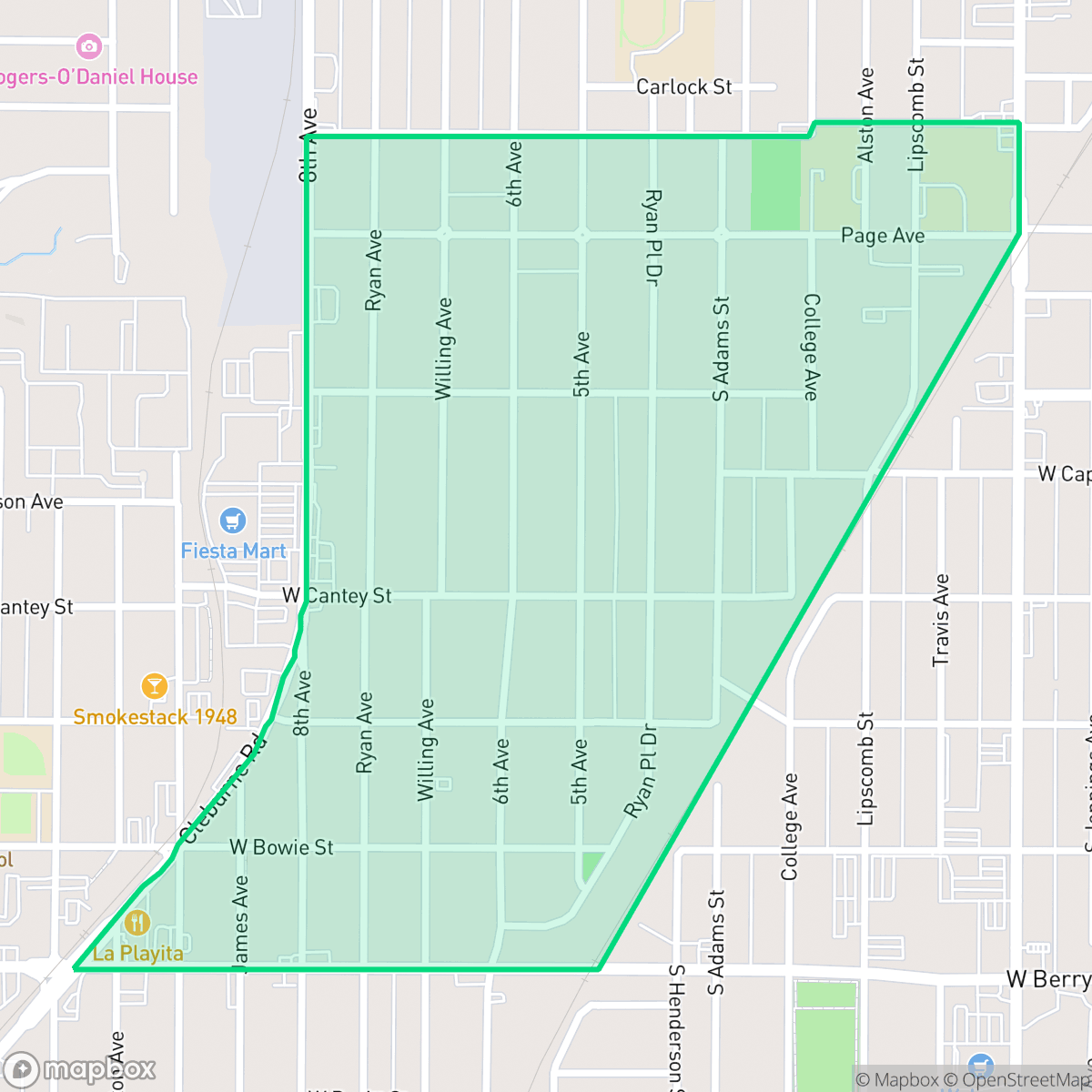
Established in 1911 by developer John C. Ryan as an exclusive enclave for Fort Worth’s elite, Ryan Place is a historic neighborhood south of downtown Fort Worth. Its showcase street, Elizabeth Boulevard (named for Ryan’s wife), was listed on the National Register of Historic Places in 1979, marking the city's first residential historic district. The neighborhood features a rich array of architectural styles, including Mediterranean, Georgian, Tudor, and Craftsman. Its grand entrance is marked by iconic Carthage stone and marble gates at Eighth Avenue, which were demolished by the city in 1955 but reconstructed in the 1980s using funds raised by the annual Candlelight Christmas in Ryan Place home tour. In 1969, residents formed the Ryan Place Improvement Association to successfully block a city plan to widen local avenues, preserving the neighborhood’s tree-lined, pedestrian-friendly character.
The neighborhood maintains a distinct identity through its mix of residential architecture and community-led preservation efforts. It functions as a dense suburban grid, providing a stable environment with proximity to local dining options such as La Tortilandia. The area benefits from a grid-based street layout that supports moderate walkability, though the presence of narrow sidewalks and limited public park access presents challenges for pet owners.
Prospective residents should consider the acoustic environment, as the area records elevated noise levels primarily due to road traffic and regional rail activity. While the neighborhood offers access to high-performing schools like Daggett Montessori, the broader school district faces significant operational and financial challenges. Given the lack of flood protection and proximity to industrial zones, the area is best suited for those prioritizing historical character and a central location over modern suburban amenities or absolute quiet.
Neighborhood Scores Across 15 Qualities
Residential spacing varies between closely packed homes and typical suburban lots with some buffer. According to iHuus data, this level of separation is slightly lower than the Fort Worth average.
Pedestrian access is supported by a grid layout with visible sidewalks and safe crossings, though some paths are narrow or interrupted. According to iHuus data, walking ease in this area is slightly below the Fort Worth average.
Uniform tract housing and small yards define the local landscape. This area features simpler architectural geometries and lacks the luxury amenities or large estates found more frequently elsewhere in Fort Worth.
Access to public greenery and walking trails is below the Fort Worth average, as much of the neighborhood greenery is contained within private yards. While a large park with trails exists in the northwest, many residential streets feature narrow sidewalks and limited public green space.
Residential grids and apartment complexes define much of the area, though the landscape remains slightly less developed than the Fort Worth average. According to iHuus data, the neighborhood features a mix of low-density housing and scattered open spaces.
A mix of quiet suburban streets and active social hubs provides a more vibrant atmosphere than the Fort Worth average. Residents have access to a diverse selection of local dining and community landmarks alongside peaceful green spaces and light industrial areas.
Frequent auditory disturbances from nearby railroad tracks and heavy freeway traffic characterize this area. According to iHuus data, acoustic comfort is notably lower than the Fort Worth average.
Air quality levels fluctuate between acceptable and unhealthy, presenting occasional concerns for sensitive groups. According to iHuus data, conditions in Ryan Place are slightly better than the Fort Worth average.
Occasional warehouses and an active freight rail line on the eastern edge introduce some industrial adjacency to the area. This level of industrial proximity is slightly higher than the Fort Worth average, according to iHuus data.
Health insurance accessibility is roughly in line with the Fort Worth average. According to iHuus data, a portion of the resident population lacks coverage.
Political leanings in this area skew liberal, representing a more progressive tilt than the typical Fort Worth neighborhood according to iHuus data.
Residents live alongside a balanced spread of young adults, families, and older individuals. This demographic distribution aligns closely with the Fort Worth average, according to iHuus data.
Flood risk in this area is considered moderate, as FEMA has not yet completed a detailed study for this specific location. According to iHuus data, the level of uncertainty here is slightly higher than the Fort Worth average.
Address-Level Insights for Ryan Place


iHuus Neighborhood Intelligence Insights
Get address-level neighborhood insights for Ryan Place
- Street-level scores — see how individual blocks compare, not just neighborhood averages
- Micro-zone boundaries — identify quiet pockets, flood boundaries, and walkable clusters before you visit
- 15 dimensions in full — walkability, noise, air quality, school quality, insurance coverage, population age profile, urban/rural index, and more
- Boundary risk alerts — know if your address sits near a block boundary where scores drop, the kind of detail no listing will ever mention
- School insights — individual school ratings and insights, not just district-level data
- Compare before you commit — side-by-side data across neighborhoods, down to block precision
No credit card required
Compare with Any Neighborhood
| Dimension | Ryan Place | Alamo Heights |
|---|---|---|
| 🚶 Walkabilityavg 7.5 | ||
| 🔊 Acoustic Comfortavg 4.12 | ||
| 🤫 Privacy Indexavg 5.64 | ||
| 🎨 Visual Appealavg 6.38 | ||
| 🐕 Dog Friendlinessavg 6.57 | ||
| 🗺️ Urban-Rural Indexavg 6.92 | ||
| ✨ Neighborhood Vibeavg 4.56 | ||
| 🏥 Health Insurance Coverageavg 5.8 | ||
| 🌿 Air Qualityavg 3.68 | ||
| 🏭 Industrial Proximityavg 8.13 | ||
| 🌊 Flood Safetyavg 3.61 | ||
| 🗳️ Ideological Leanavg 5.62 | ||
| 👥 Population Age Profileavg 4.51 | ||
| 🔥 Fire Safety | ||
| 🏫 School Quality |
Ryan Place Rankings
School Districts Serving Ryan Place
School Insights for Ryan Place
Below average outcomes; significant attendance and academic challenges.
School Insights
See what's really behind every school rating near Ryan Place
- Individual school ratings — each school's own score with outcome context, not just a district average
- Enrollment & class size data — student-to-teacher ratio and how it compares to the state average
- Full demographics breakdown — ethnicity and gender composition for every school in the enrollment zone
- Every school in the district — all schools within the enrollment boundary ranked by rating, not just the closest one
- Grade levels & benchmarks — elementary through high school, with below/above state-average flags
No credit card required