Rosemont, Fort Worth
Updated · 11,638 residents
Rosemont is a culturally vibrant, predominantly Hispanic community in south Fort Worth, characterized by a dense grid of modest tract housing and a central public park. While the area offers a quiet suburban atmosphere with local dining options, residents navigate tight living quarters and limited privacy within an established urban layout.
Key Highlights
About Rosemont
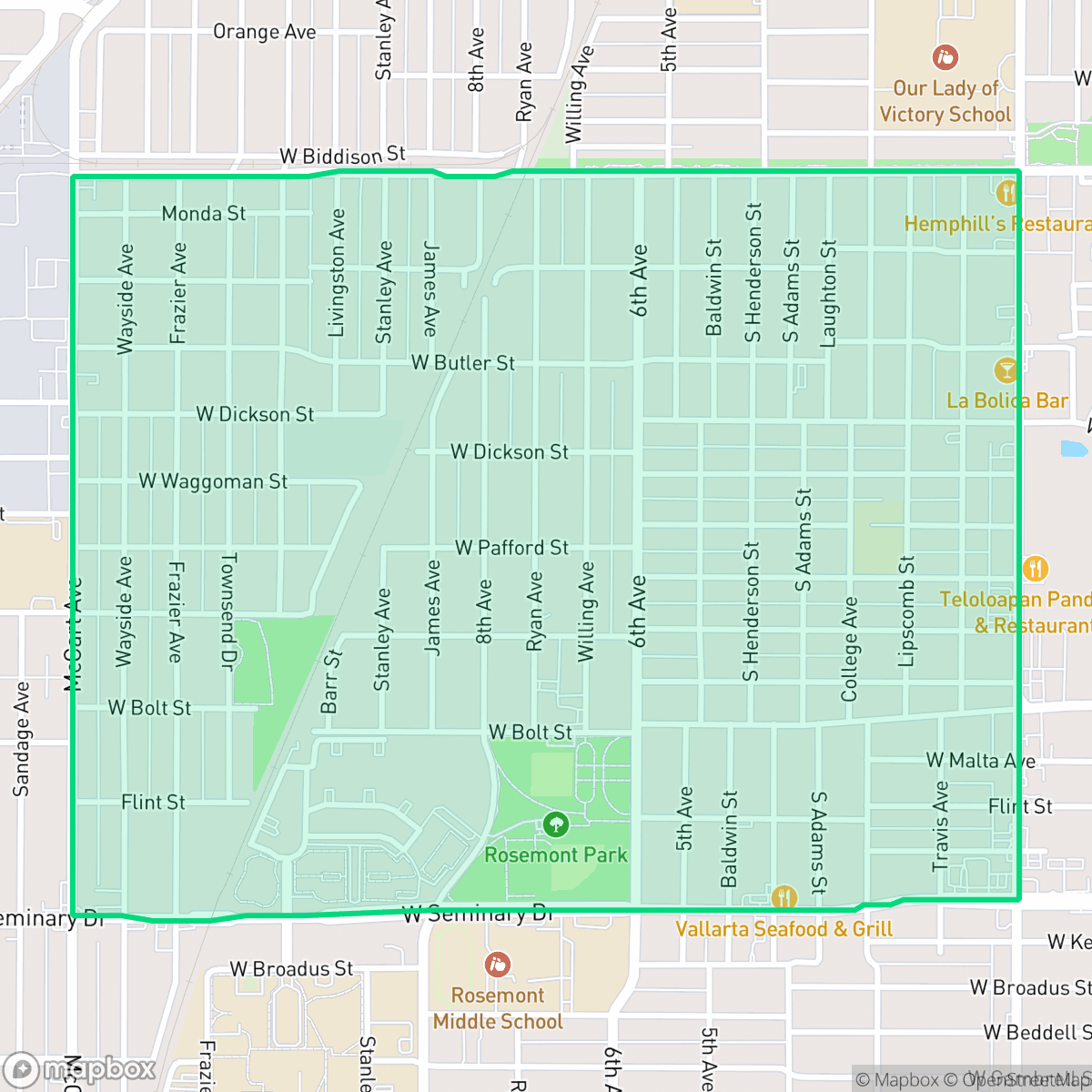
Located in south Fort Worth, Texas, the Rosemont neighborhood is anchored by Rosemont Community Park, established in 1927 on land purchased from C. L. Mobley and named after its long-time owner, Rosa Steele. During the Great Depression, the park received WPA-funded infrastructure. In World War II, it hosted federal barracks-style housing for defense workers, a portion of which was later sold to the adjacent Southwestern Baptist Theological Seminary in 1954. Architecturally, the neighborhood features Rosemont Middle School, designed in an eclectic Period Revival style by Elmer G. Withers. Today, the neighborhood is a culturally vibrant, predominantly Hispanic community. In 2020, Rosemont was selected for Fort Worth's Neighborhood Improvement Program to revitalize local infrastructure and community safety.
The neighborhood maintains a distinct suburban character defined by its dense residential grid and proximity to light industrial zones near the local railway. Residents enjoy access to community-focused spaces like the historic park, which serves as a central hub for outdoor activity and recreation. The local culinary scene features diverse, independent eateries that reflect the area's cultural identity, though the overall layout remains primarily car-dependent with limited pedestrian infrastructure for daily errands.
Prospective residents should consider the trade-offs regarding density and infrastructure. While the area features a highly-rated local elementary school, the broader school district faces significant operational and financial challenges. Housing is typically arranged on tight lots with minimal privacy buffers between neighbors. Additionally, the area faces specific environmental challenges, including low flood safety ratings and limited access to health insurance coverage, making it important for families to research local resources thoroughly before relocating.
Neighborhood Scores Across 15 Qualities
Residential spacing is relatively tight with some houses positioned closely together; this level of density is slightly higher than the Fort Worth average according to iHuus data.
Pedestrian infrastructure varies across the neighborhood, with some streets featuring narrow sidewalks and others lacking dedicated paths. While major intersections offer safe crossings, the overall connectivity is lower than the Fort Worth average.
Standard tract housing and older multi-family units characterize this area, which offers less visual variety than the Fort Worth average. Residential lots are typically small and lack private luxury amenities or expansive yards.
Public park access and wide grassy walking verges are below the Fort Worth average. While a central park provides some recreation, most greenery in the area is contained within private residential yards.
A transition between dense residential grids and industrial zones defines the area, offering slightly more open space than the Fort Worth average. According to iHuus data, the landscape features a blend of single-family homes, apartment complexes, and scattered woodland.
A mix of quiet residential blocks and active dining corridors provides a level of liveliness that is higher than the Fort Worth average. While the area features a diverse selection of local eateries, most locations require a vehicle to access.
Steady sound from nearby busy streets characterizes the area, though acoustic levels are slightly more peaceful than the Fort Worth average according to iHuus data.
Frequent unhealthy air quality levels pose a significant risk to sensitive groups. This area performs slightly below the Fort Worth average according to iHuus data.
Most of the area is residential, though an active rail line and some warehouses on the western edge introduce occasional heavy vehicle activity. According to iHuus data, the neighborhood features less industrial density than the Fort Worth average.
Health insurance accessibility is significantly lower in Rosemont than in the rest of Fort Worth. According to iHuus data, a small portion of the local population maintains active coverage.
Political leanings in this area are notably more liberal than the Fort Worth average. This creates a community landscape with a distinct progressive majority.
Residents live alongside a varied demographic of young adults, families, and seniors. This age distribution is slightly lower than the Fort Worth average according to iHuus data.
Significant flood risk is present in this area, which is notably higher than the Fort Worth average. According to iHuus data, residents should anticipate much higher flood insurance costs and potential environmental hazards.
Address-Level Insights for Rosemont


iHuus Neighborhood Intelligence Insights
Get address-level neighborhood insights for Rosemont
- Street-level scores — see how individual blocks compare, not just neighborhood averages
- Micro-zone boundaries — identify quiet pockets, flood boundaries, and walkable clusters before you visit
- 15 dimensions in full — walkability, noise, air quality, school quality, insurance coverage, population age profile, urban/rural index, and more
- Boundary risk alerts — know if your address sits near a block boundary where scores drop, the kind of detail no listing will ever mention
- School insights — individual school ratings and insights, not just district-level data
- Compare before you commit — side-by-side data across neighborhoods, down to block precision
No credit card required
Compare with Any Neighborhood
| Dimension | Rosemont | Alamo Heights |
|---|---|---|
| 🚶 Walkabilityavg 7.5 | ||
| 🔊 Acoustic Comfortavg 4.12 | ||
| 🤫 Privacy Indexavg 5.64 | ||
| 🎨 Visual Appealavg 6.38 | ||
| 🐕 Dog Friendlinessavg 6.57 | ||
| 🗺️ Urban-Rural Indexavg 6.92 | ||
| ✨ Neighborhood Vibeavg 4.56 | ||
| 🏥 Health Insurance Coverageavg 5.8 | ||
| 🌿 Air Qualityavg 3.68 | ||
| 🏭 Industrial Proximityavg 8.13 | ||
| 🌊 Flood Safetyavg 3.61 | ||
| 🗳️ Ideological Leanavg 5.62 | ||
| 👥 Population Age Profileavg 4.51 | ||
| 🔥 Fire Safety | ||
| 🏫 School Quality |
Rosemont Rankings
School Districts Serving Rosemont
School Insights for Rosemont
Below average outcomes; significant attendance and academic challenges.
School Insights
See what's really behind every school rating near Rosemont
- Individual school ratings — each school's own score with outcome context, not just a district average
- Enrollment & class size data — student-to-teacher ratio and how it compares to the state average
- Full demographics breakdown — ethnicity and gender composition for every school in the enrollment zone
- Every school in the district — all schools within the enrollment boundary ranked by rating, not just the closest one
- Grade levels & benchmarks — elementary through high school, with below/above state-average flags
No credit card required