Rock Island - Samuels, Fort Worth
Updated · 613 residents
Rock Island - Samuels is a historic Fort Worth enclave defined by its proximity to active rail corridors and industrial logistics hubs. While the area offers a unique mix of residential blocks and local cultural spots like Artspace111, residents should expect notable noise levels from freight traffic. It is a highly dog-friendly community that balances its industrial roots with accessible green spaces near the Trinity River.
Key Highlights
About Rock Island - Samuels
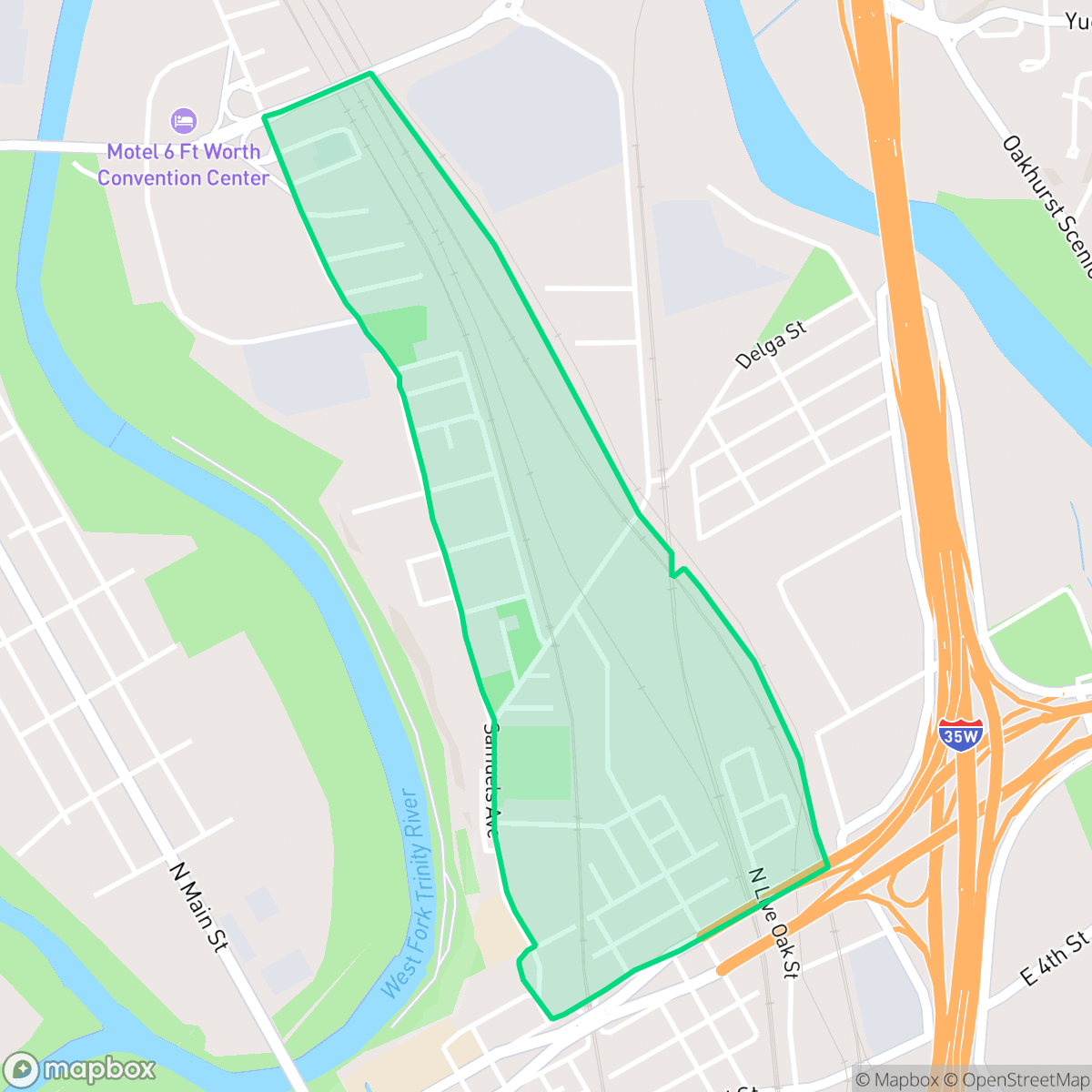
Rock Island - Samuels, situated northeast of downtown Fort Worth along a bend of the Trinity River, is one of the city's oldest residential areas. Originally part of a plantation, the area was named after Baldwin Samuels, who acquired the land in 1870. The neighborhood historically developed as an egalitarian enclave where wealthy barons built grand Victorian mansions alongside working-class residents living in simpler shotgun homes. It also featured early local attractions like the 1885 Rosedale Pavilion, Fort Worth's first trolley park. To the south, the Rock Island area emerged as a historically African American neighborhood. Today, the neighborhood is defined by its rich railroad history and surviving architectural landmarks, such as the 1889 Reilly-LeHane House and the Italianate-style David Chapman Bennett House.
The neighborhood functions as a dense urban mix where single-family homes and apartment complexes sit alongside active rail yards and logistics warehouses. Its geography is shaped by its location along the Trinity River, which provides residents with local green spaces and dining options such as Tia's On The Bluff. The area maintains an authentic, industrial character that reflects its history as a transit and manufacturing hub for the city.
Prospective residents should account for specific livability factors, including a higher than average noise level primarily driven by railroad activity. The neighborhood presents a complex profile with significant industrial proximity and flood safety considerations. While it offers a distinct atmosphere for those who appreciate historic architecture and central access, families should carefully evaluate the current state of the Fort Worth Independent School District, which faces ongoing operational challenges.
Neighborhood Scores Across 15 Qualities
Residential spacing provides a moderate amount of buffer between neighbors, though density is slightly higher than the Fort Worth average according to iHuus data.
Sidewalks are available on one side of the street along with safe crossings, though overall walkability is slightly below the Fort Worth average according to iHuus data.
Standard tract housing with simple rooflines and small yards defines the area. This level of visual variety is lower than the Fort Worth average.
Connected green spaces and wide, traffic-safe paths make this an excellent area for pet owners. According to iHuus data, this neighborhood offers significantly better access to walking areas for dogs than the Fort Worth average.
A mix of industrial warehouses and residential blocks creates a suburban character that is less dense than the Fort Worth average. According to iHuus data, the landscape features a notable presence of open river-adjacent land and light industrial corridors.
A tranquil rhythm prevails due to a prevalence of warehouses, freight corridors, and suburban-style streets. This area offers a lower level of activity compared to the Fort Worth average, characterized by a mix of industrial zones and pockets of green space.
Frequent sounds from nearby railroad tracks and heavy freeway traffic characterize this area. This level of acoustic disturbance is notably higher than the Fort Worth average, according to iHuus data.
Air quality in this area fluctuates between acceptable and unhealthy levels, presenting occasional concerns for sensitive groups. Conditions are slightly lower than the Fort Worth average, according to iHuus data.
Active rail yards, logistics warehouses, and heavy truck traffic are notable features of this area. According to iHuus data, the level of industrial proximity is considerably higher than the Fort Worth average.
Health insurance accessibility is lower here than the Fort Worth average, according to iHuus data. Residents may find fewer options for employer-sponsored or community-based coverage compared to other parts of the city.
Political leanings in this area skew more liberal than the Fort Worth average. Residents may find a modest presence of opposing viewpoints alongside a liberal majority, according to iHuus data.
A diverse mix of young adults, families, and older residents characterizes the area, aligning closely with the Fort Worth average. According to iHuus data, this demographic spread creates a stable residential environment without a heavy concentration of any single age group.
Significant flood hazards exist in this area, making it much more prone to flooding than the Fort Worth average. According to iHuus data, residents should anticipate much higher insurance premiums and potential property risks.
Address-Level Insights for Rock Island - Samuels


iHuus Neighborhood Intelligence Insights
Get address-level neighborhood insights for Rock Island - Samuels
- Street-level scores — see how individual blocks compare, not just neighborhood averages
- Micro-zone boundaries — identify quiet pockets, flood boundaries, and walkable clusters before you visit
- 15 dimensions in full — walkability, noise, air quality, school quality, insurance coverage, population age profile, urban/rural index, and more
- Boundary risk alerts — know if your address sits near a block boundary where scores drop, the kind of detail no listing will ever mention
- School insights — individual school ratings and insights, not just district-level data
- Compare before you commit — side-by-side data across neighborhoods, down to block precision
No credit card required
Compare with Any Neighborhood
| Dimension | Rock Island - Samuels | Alamo Heights |
|---|---|---|
| 🚶 Walkabilityavg 7.5 | ||
| 🔊 Acoustic Comfortavg 4.12 | ||
| 🤫 Privacy Indexavg 5.64 | ||
| 🎨 Visual Appealavg 6.38 | ||
| 🐕 Dog Friendlinessavg 6.57 | ||
| 🗺️ Urban-Rural Indexavg 6.92 | ||
| ✨ Neighborhood Vibeavg 4.56 | ||
| 🏥 Health Insurance Coverageavg 5.8 | ||
| 🌿 Air Qualityavg 3.68 | ||
| 🏭 Industrial Proximityavg 8.13 | ||
| 🌊 Flood Safetyavg 3.61 | ||
| 🗳️ Ideological Leanavg 5.62 | ||
| 👥 Population Age Profileavg 4.51 | ||
| 🔥 Fire Safety | ||
| 🏫 School Quality |
Rock Island - Samuels Rankings
School Districts Serving Rock Island - Samuels
School Insights for Rock Island - Samuels
Below average outcomes; significant attendance and academic challenges.
School Insights
See what's really behind every school rating near Rock Island - Samuels
- Individual school ratings — each school's own score with outcome context, not just a district average
- Enrollment & class size data — student-to-teacher ratio and how it compares to the state average
- Full demographics breakdown — ethnicity and gender composition for every school in the enrollment zone
- Every school in the district — all schools within the enrollment boundary ranked by rating, not just the closest one
- Grade levels & benchmarks — elementary through high school, with below/above state-average flags
No credit card required